 Bellingham Roofing
 Birchwood's Siding Has a Harder Job Than Most People Realize
Birchwood sits inside one of the wetter, greener pockets of Bellingham, and that's exactly why siding here wears differently than siding forty minutes inland. Homes in this part of Whatcom County deal with a steady combination of moisture off the Salish Sea, long stretches of overcast damp weather, and shaded, tree-lined lots that never fully dry out between storms. None of that is dramatic on its own. It's the accumulation — season after season — that eventually shows up as soft trim boards, streaked and stained wall surfaces, or siding that's holding water instead of shedding it.
Salt-tinged marine air is corrosive to fasteners and finishes over time. Driving rain, especially when it comes sideways off a windstorm, tests every seam, lap, and piece of flashing on a wall. And a long moss season means organic growth gets a foothold on any siding material that stays damp for extended periods, which accelerates wear on products that aren't built to handle it. A siding replacement in Birchwood isn't just a cosmetic upgrade — it's an opportunity to correct whatever let moisture in in the first place and put a wall system in place that's actually engineered for this climate.
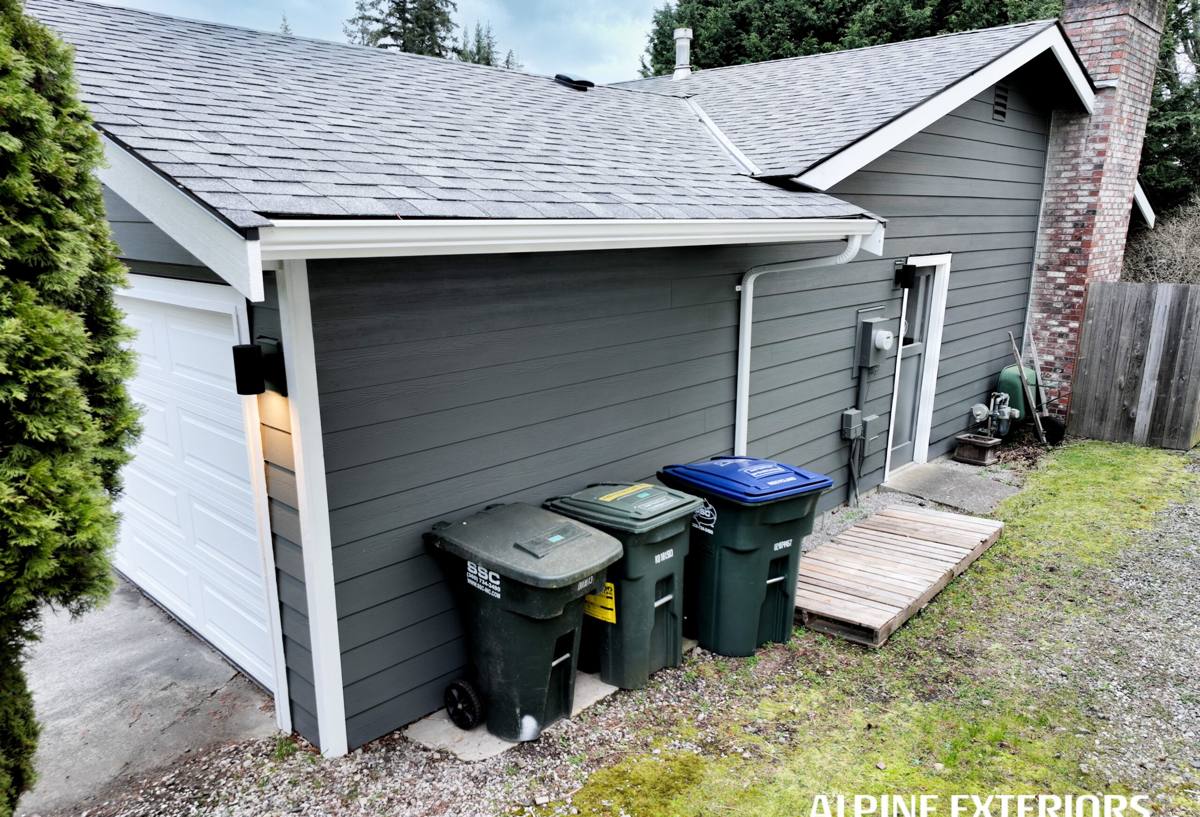
Signs a Birchwood Home Is Due for Siding Replacement
Most siding failure in this area doesn't happen suddenly. It builds slowly behind the surface while the outside still looks "fine enough" from the street. Here's what we look for during an assessment:
- Soft or spongy spots when pressing on siding or trim, especially near the bottom courses and around windows
- Persistent moss, algae, or dark streaking that comes back within weeks of cleaning
- Paint that's bubbling, peeling, or failing faster than a normal repaint cycle would suggest
- Visible warping, cupping, or separation at panel seams and butt joints
- Gaps or cracks around window and door trim where caulking has failed
- A musty smell or visible staining on interior walls that back up to exterior siding
- Siding that was installed with little or no gap at the bottom, trapping moisture against the foundation
Any one of these on its own might just need a repair. Several at once, or damage that keeps recurring in the same spots, usually means the underlying wall assembly has been compromised and a full replacement is the more honest recommendation.
What a Correct Siding Replacement Actually Involves
Siding replacement done right is mostly about what happens before the new material ever goes up. In a climate like this one, the water-resistive barrier, flashing details, and drainage plane matter more than the siding itself — because even the best siding product will fail early if it's fastened over a wall that can't manage moisture.
Tear-Off and Wall Inspection
We remove the existing siding down to the sheathing so we can actually see what's underneath — not guess at it. This is where hidden rot, damaged sheathing, or years-old moisture intrusion around windows and penetrations gets found and dealt with, rather than sealed back up under new material.
Water-Resistive Barrier and Flashing
A new weather-resistive barrier goes on with properly lapped seams, and flashing is installed at every window, door, and penetration so water is directed out and down instead of behind the wall. In a market with as much driving rain as Bellingham gets, this step is the difference between siding that lasts decades and siding that fails in five years.
Drainage Gap and Furring
Where the wall assembly calls for it, we build in a rainscreen gap so any moisture that does get past the outer layer can drain and dry instead of sitting against the back of the siding. This detail matters most in shaded, damp lots — which describes a lot of Birchwood.
Installation to Manufacturer Spec
Fastener type, placement, and spacing; proper clearance at the ground, roofline, and deck ledgers; correctly caulked and painted cut edges — these aren't optional extras, they're what keeps a warranty valid and what actually keeps water out. This is the step where most siding jobs, from any material, quietly go wrong.
Why We Only Install James Hardie Fiber Cement Siding
We get asked fairly often why we don't offer vinyl, LP SmartSide, or cedar as options. The honest answer is that each of those products asks a homeowner to accept a trade-off we're not willing to install and then walk away from.
Vinyl is inexpensive and low-maintenance, but it's a petroleum-based product that can warp or distort in direct sun and heat, and it isn't fire-rated the way fiber cement is. LP SmartSide is a wood-strand engineered product — it has real strengths, but it's still wood-based, which means edge sealing and paint maintenance have to be kept up religiously in a wet climate or moisture will eventually find a way in. Cedar and primed spruce are beautiful, but they demand ongoing refinishing, are more vulnerable to moisture and insect damage, and in a climate with this much sustained dampness, that maintenance burden only grows over time.
James Hardie fiber cement is non-combustible, dimensionally stable in wet and dry cycles, and holds a factory-applied ColorPlus finish that's formulated to resist fading and cracking far longer than field-applied paint. It's also engineered in climate-specific product lines, including an HZ5 formulation built for regions with harsher moisture and freeze-thaw exposure. For a neighborhood dealing with salt air, driving rain, and moss season every single year, it's the product we're willing to stand behind.
How the Common Siding Options Compare
| Material | Moisture Resistance | Maintenance | Fire Rating | Typical Lifespan |
|---|---|---|---|---|
| Vinyl | Sheds water but can trap moisture behind panels | Low, but can warp/fade in sun and heat | Not fire-rated | 15–25 years |
| LP SmartSide (engineered wood) | Good if sealed edges and paint are maintained | Moderate — paint and caulking upkeep needed | Combustible | 20–30 years with upkeep |
| Cedar / primed spruce | Vulnerable without diligent refinishing | High — regular refinishing required | Combustible | Varies widely with maintenance |
| James Hardie fiber cement | Dimensionally stable, engineered for wet climates | Low — factory finish holds up for years | Non-combustible | 30+ years when installed to spec |
Our Process for a Birchwood Siding Replacement
We keep the process straightforward because homeowners deserve to know what's happening to their house and when.
- On-site assessment — We walk the exterior, check trouble spots like window trim, deck ledgers, and low-clearance areas, and give a straight read on whether it's a repair or a full replacement situation.
- Product and color selection — We go over James Hardie's plank, shingle, and panel options and ColorPlus color palette so the final look fits the home and the neighborhood.
- Tear-off and wall prep — Old siding comes off, sheathing is inspected and repaired as needed, and the water-resistive barrier and flashing go in correctly the first time.
- Installation — Siding goes up to manufacturer spec, with proper fastening, clearances, and sealed cut edges.
- Final walkthrough — We inspect the finished work with the homeowner and make sure every detail — trim, caulking, touch-up paint — is done right before we call it complete.
What Drives the Cost of a Siding Replacement
Every home is different, but the same handful of factors tend to move the price up or down. Broad ranges — nothing exact until we've actually seen the house.
| Cost Factor | Why It Matters |
|---|---|
| Home size and wall complexity | More corners, gables, and dormers mean more cutting, flashing, and labor |
| Condition of the existing wall | Rotted sheathing or trim found during tear-off adds repair scope |
| Siding profile chosen | Lap, shingle, and panel styles vary in material and install time |
| Trim and accent work | Window and door trim, fascia, and accent bands add detail labor |
| Access and site conditions | Tight lots, slopes, and mature landscaping can affect setup and staging |
The only way to get a real number is a walk-through, but understanding these factors ahead of time helps homeowners ask better questions and compare quotes on an apples-to-apples basis.
Why It Matters That We Already Work in Birchwood
A crew that already works this neighborhood isn't guessing at what Birchwood homes are up against — we've seen the recurring moisture patterns, the shaded lots that stay damp longer, and the trim details that fail first in this specific stretch of Whatcom County. That familiarity shows up in small but real ways: knowing which wall orientations tend to take the worst of the driving rain, recognizing early moss growth before it's a structural issue, and understanding what Bellingham's building department expects for permitting and inspection on a residential siding job.
It also means straightforward logistics — a local crew is easy to reach for a warranty question five years down the line, not a company that was in town for one job and gone.
A short checklist worth using when vetting any siding contractor in this area:
- Do they explain the water-resistive barrier and flashing plan, not just the siding brand?
- Are they licensed and insured to work in Washington State?
- Can they speak specifically to local conditions — moss, salt air, driving rain — rather than generic sales talk?
- Do they offer a manufacturer-backed warranty in writing, not just a verbal promise?
- Will they show you the wall condition during tear-off, not just cover it back up?
Living With Hardie Siding in Bellingham's Climate
One of the practical advantages of fiber cement in a climate like this is how little ongoing attention it needs. A periodic rinse to keep moss and algae from getting a foothold, an eye on caulking at trim joints every year or two, and prompt attention to any landscaping that's crowding the wall and keeping it shaded and damp — that's most of what's required. Because the ColorPlus finish is baked on at the factory rather than field-applied, homeowners aren't stuck on a repainting cycle the way they would be with wood or fiber-primed products, which matters in a place where a dry, paintable stretch of weather isn't guaranteed every summer.
If your Birchwood home's siding is showing its age, or you just want a straight assessment of what shape it's really in, we're happy to take a look. The estimate is free, there's no pressure, and you'll walk away with a clear picture of what your home actually needs — use the form below to get started.