 Bellingham Roofing
 Building Decks for a Bay-Front Climate
Birch Bay sits right on the water, and that changes what a deck needs to survive out here. You're not just dealing with Pacific Northwest rain — you're dealing with salt-laden air blowing straight off the bay, wind exposure that inland Whatcom County lots don't see, and a moss and algae season that runs most of the year on anything that stays shaded and damp. A deck built the same way you'd build one in a sheltered Bellingham neighborhood won't hold up the same way a few miles up the coast in Birch Bay. Fasteners corrode faster near saltwater. Wood surfaces stay wet longer under the tree cover common on these lots. And wind-driven rain finds gaps in flashing and ledger connections that would never leak on a calmer site.
We're a Bellingham-based crew, and Birch Bay is part of our regular service area — not a place we drive out to occasionally. That matters when it comes to deck work, because the right approach here isn't generic. It's shaped by what we've seen fail on bay-front and near-bay properties and what actually holds up.
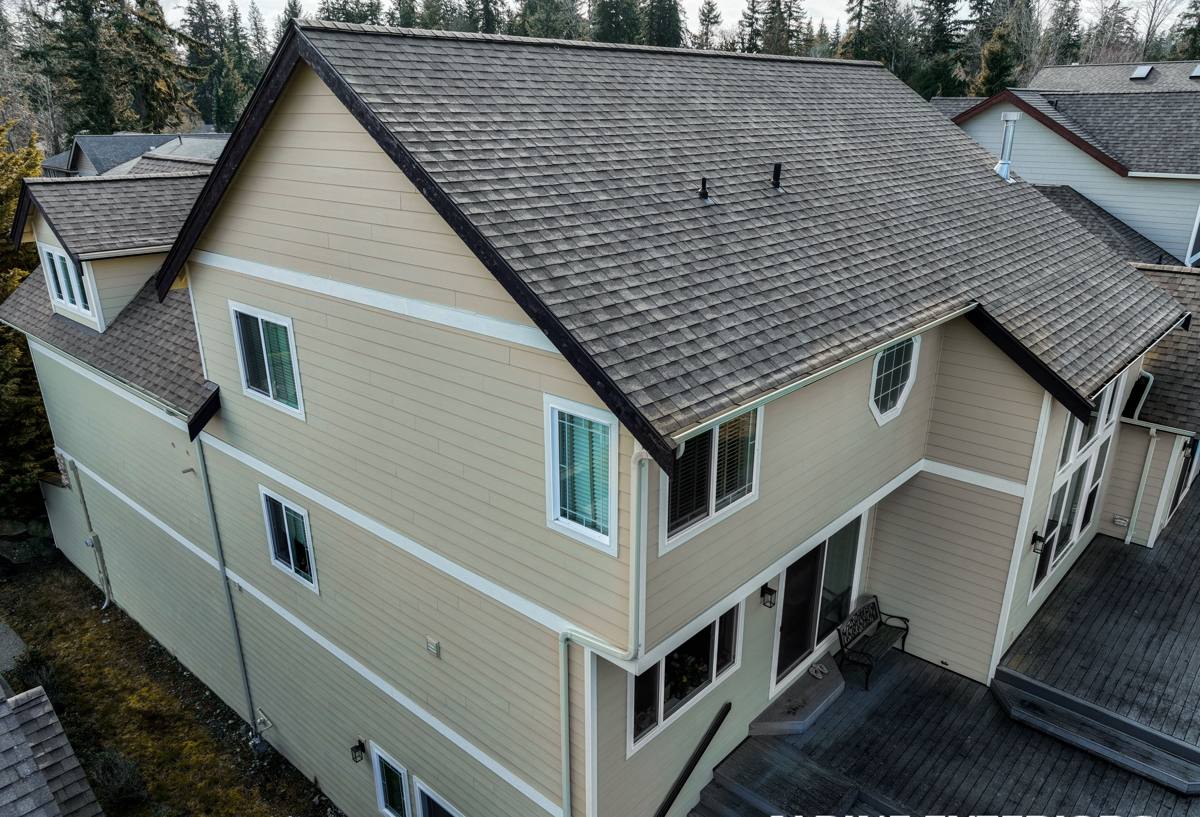
What Salt Air and Coastal Wind Do to a Deck
Homeowners moving to Birch Bay from inland areas are often surprised at how much faster hardware corrodes near the water. Standard galvanized fasteners can start showing rust streaks in a fraction of the time they'd last a few miles inland. That's not a defect in the deck — it's the environment. It just means the deck has to be built with that environment in mind from the start, not patched later.
Where the Damage Shows Up First
- Fastener heads and joist hangers — the first hardware to show corrosion, especially where galvanizing is thin or scratched during installation
- Ledger board connections — the single most common source of moisture intrusion and structural risk if flashing is skipped or done poorly
- Railing post bases — end grain and metal brackets at the post base sit in standing water longer than any other part of the structure
- Shaded, north-facing sections — slower to dry, first to grow moss and algae, and first to become slick underfoot
- Stair stringers — repeated wetting and drying at ground level accelerates rot at the stringer ends
What a Correctly Built Deck Looks Like Here
Fasteners and Hardware
For any deck within reach of salt air, we spec stainless steel or heavy-duty coated fasteners and connectors rated for coastal or treated-lumber exposure, not the base-grade galvanized hardware that's fine in drier inland conditions. It costs more up front. It's also the single easiest way to keep a deck from developing rust stains, loose connections, and hardware failure years before the decking itself wears out.
Ledger Flashing
The ledger board — where the deck attaches to the house — is where most structural deck failures start, and it's almost always a moisture problem, not a framing one. We flash the ledger connection properly: house wrap integration, flashing that sheds water away from the band joist, and a gap or drainage plane behind the ledger so water doesn't get trapped against the house siding. On a driving-rain site like Birch Bay, skipping or shortcutting this step is asking for hidden rot behind the wall.
Footings and Framing
Whatcom County frost depth and soil conditions determine footing depth, and we pull permits and follow the adopted building code for post spacing, beam sizing, and footing size rather than eyeballing it. On sites with poor drainage or heavy tree cover, we also pay attention to grading under the deck so water has somewhere to go instead of sitting against posts and framing.
Decking Material
Material choice matters more here than in a drier climate. We'll walk through real trade-offs rather than push one product:
| Material | How It Handles Salt Air & Moisture | Maintenance | Typical Lifespan |
|---|---|---|---|
| Pressure-treated wood | Good rot resistance if properly sealed and maintained; fasteners must be rated for treated lumber contact | Annual cleaning, periodic re-staining/sealing | 15-20 years with upkeep |
| Cedar | Naturally rot- and insect-resistant, but surface graying and moss growth happen faster in shaded, damp spots | Regular cleaning, occasional oil or sealant | 15-25 years with upkeep |
| Composite decking | Doesn't rot or absorb moisture like wood; some boards can still stain or grow algae film if never cleaned | Periodic washing, no staining or sealing needed | 25-30+ years, manufacturer-dependent |
| PVC decking | Fully moisture-resistant, handles salt exposure well | Occasional washing | 25-30+ years, manufacturer-dependent |
None of these is automatically "the right one" — it depends on your budget, how much upkeep you want to do, and how exposed the deck is to sun and shade. We'll give you a straight answer on what fits your specific lot rather than defaulting to whatever's easiest for us to install.
Moss, Algae, and Slip Risk
Birch Bay's tree cover and marine humidity mean a moss season that can run most of the year on any deck surface that doesn't get much direct sun. Moss isn't just cosmetic — it holds moisture against the decking surface, accelerates wood breakdown, and gets genuinely slippery when wet. Design choices we make to reduce this include spacing boards for airflow, avoiding overly tight board gaps that trap debris, and where the layout allows it, orienting the deck to get more sun exposure on the sections that see the most foot traffic.
Reducing Moss Buildup Long-Term
- Proper board spacing so water drains through instead of pooling on the surface
- Keeping vegetation trimmed back from deck edges to improve airflow and sun exposure
- Annual or seasonal cleaning before moss gets a foothold, rather than scraping it off once it's established
- Choosing a decking material and finish that matches how much shade the deck actually gets
Under-Deck Drainage and Ventilation
A lot of moisture problems on bay-area decks aren't visible from the top — they're happening underneath, where joists and framing stay damp long after the surface has dried. We build in ventilation gaps and, where it makes sense for the site, drainage systems that route water off the framing instead of letting it pool against joists and posts. This is especially important on decks with any storage or living space underneath, where trapped moisture has nowhere to escape.
Railings, Stairs, and Code
Guardrail height, baluster spacing, and stair rise/run are governed by the building code adopted in Whatcom County, and we build to those specs as a baseline, not a suggestion. Beyond code minimums, coastal wind exposure is worth factoring into railing design and post attachment, since a bay-front deck sees more sustained wind load than a sheltered inland yard. We size and anchor railing posts accordingly rather than treating every deck the same regardless of exposure.
Our Process for a Birch Bay Deck
- On-site assessment — we look at sun/shade exposure, wind direction, existing drainage, and how close the site is to the water, since all of that shapes material and flashing decisions.
- Design and material selection — honest conversation about wood versus composite versus PVC based on your budget and how much maintenance you actually want to do.
- Permitting — we handle the permit process and build to the footing, framing, and railing requirements that apply to your project.
- Framing and flashing — ledger flashing, coastal-rated hardware, and proper footing depth done right the first time, since these are the parts you can't easily fix later.
- Decking and railing installation — spacing and layout that accounts for drainage and moss reduction, not just appearance.
- Final walkthrough — we go over maintenance expectations specific to your material choice and your lot's exposure, so you know what upkeep actually looks like year to year.
Why a Local Crew Matters for This
Deck problems on bay-front and near-bay properties tend to be predictable if you've seen enough of them: corroded hardware, rotted ledger connections, moss-slick surfaces, and framing that stayed wet too long. A crew that works Bellingham and Birch Bay regularly has already seen what fails here and builds around it from the first footing, instead of learning the hard way on your project. We're not driving in from out of the area to quote a job we'll never have to service again — Whatcom County is where we work, and Birch Bay is part of that.
What to Ask Before You Hire a Deck Builder Here
- Do they spec stainless or coastal-rated fasteners for bay-exposed sites, or standard galvanized hardware?
- Will the ledger connection be flashed, and can they explain how?
- Do they pull permits and build to the footing depth and framing requirements for this county?
- Can they speak to material trade-offs honestly instead of pushing one product?
- Do they factor wind exposure into railing post attachment, or use the same spec everywhere?
If you're planning a new deck or replacing one that's showing its age, we're happy to come take a look and give you a straightforward, no-pressure estimate — just fill out the form below and we'll get in touch.