 Bellingham Roofing
 Birch Bay Sits Right on the Line Between "Beautiful" and "Brutal on Siding"
Birch Bay's waterfront setting is a big part of why people love living there — and it's exactly why the siding on Birch Bay homes tends to wear faster than siding on a house ten miles inland. Shoreline exposure means salt-laden air settling on exterior walls day after day, wind-driven rain hitting siding at angles that gutters and overhangs weren't designed for, and a long stretch of the year where surfaces simply don't dry out between storms. Add in the shade and moisture that a lot of Birch Bay lots hold onto under mature evergreens, and you've got a near-perfect recipe for moss, mildew, and slow moisture intrusion behind the cladding.
None of that means Birch Bay is a bad place to own a home — it means the siding on that home has a harder job to do than siding almost anywhere else in Whatcom County. When we replace siding out there, we're not just swapping old material for new; we're addressing the specific combination of salt air, driving rain, and moss pressure that this stretch of coastline throws at a house year-round.
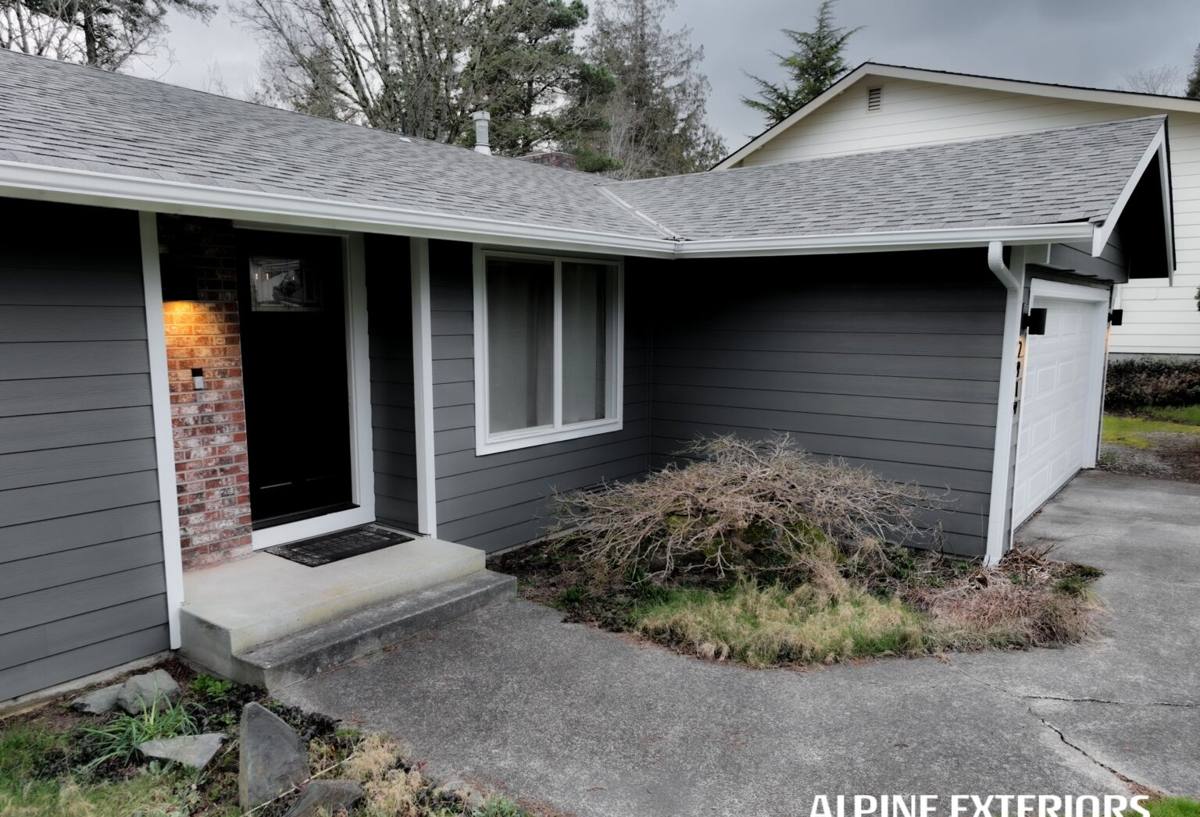
How to Tell Birch Bay Siding Has Reached the End of Its Useful Life
Coastal siding failure rarely announces itself with one obvious problem. It's usually a combination of smaller signs that, together, tell you the wall assembly underneath is no longer doing its job. Before recommending a full replacement, we look for a cluster of these issues rather than reacting to just one:
- Soft or spongy spots when you press on the siding, especially near the bottom courses and around window trim
- Persistent moss or dark streaking that comes back within weeks of being cleaned
- Paint that's bubbling, peeling, or won't hold a fresh coat for more than a season or two
- Visible gaps, warping, or buckling in lap siding, particularly on the sides of the house that face the water or prevailing wind
- A musty smell in an adjacent room, or moisture staining on interior walls near exterior corners
- Fascia, trim, or sheathing that feels punky or crumbles when probed
Any one of these can sometimes be a localized repair. Several at once, especially on an older wood or engineered-wood siding job, usually means the moisture has been getting behind the cladding for a while — and a repair patch won't fix a wall assembly that's already saturated.
Why We Only Install James Hardie Fiber Cement
Homeowners in Birch Bay get quoted a range of siding products, and it's worth knowing where we stand and why. We don't install vinyl, LP SmartSide, cedar, primed spruce, or other fiber cement brands — we install James Hardie exclusively. That's not a marketing preference; it's a standard we settled on after weighing how different materials actually hold up in a marine, high-moisture climate over decades, not just over the first few years.
Vinyl can warp and gap in temperature swings and doesn't hold paint if you ever want to change the color. Wood-based products, including engineered wood siding, are dimensionally more sensitive to moisture and require more diligent maintenance to keep water from finding the raw edges. Cedar is a beautiful, honest material, but it demands a maintenance commitment — refinishing, caulking, moisture monitoring — that most homeowners underestimate until the siding is already showing damage. James Hardie fiber cement is non-combustible, dimensionally stable across our wet winters and dry summers, and its ColorPlus factory finish is baked on under controlled conditions rather than field-applied, which matters enormously in an area where paint has to fight salt air and constant dampness. That's the honest tradeoff calculation behind why every siding job we do uses Hardie.
Hardie Product Lines Suited to a Coastal Lot
| Product | Best Use on a Birch Bay Home | What It Offers |
|---|---|---|
| HardiePlank lap siding | Primary wall cladding, most common choice | Traditional lap look, wide range of ColorPlus finishes, strong track record in wet coastal climates |
| HardieShingle | Accent gables, dormers, feature walls | Cedar-shingle appearance without the moisture upkeep of real wood shingles |
| HardiePanel | Modern or board-and-batten style elevations | Clean vertical lines, pairs well with trim accents on contemporary designs |
| HardieTrim | Window and door surrounds, corner boards, fascia | Matches the fiber cement performance of the field siding instead of mixing in wood trim that fails first |
For homes directly exposed to wind off the water, we typically spec Hardie's HZ5 product engineering, which is built for climate zones with higher moisture exposure — it's a meaningful upgrade over standard product for a lot that sits close to the shoreline.
What a Correct Siding Replacement Actually Involves
The siding itself is only part of the system that keeps water out of a wall. A replacement done right pays as much attention to what's underneath the siding as to the siding itself — that's especially true in Birch Bay, where the wall assembly needs to shed wind-driven rain, not just vertical rainfall.
Tear-Off and Inspection
We remove the existing siding down to the sheathing and inspect for rot, soft spots, and prior water damage. This step matters more on the water-facing sides of a house, where hidden moisture damage is most likely to have accumulated. Any compromised sheathing or framing gets addressed before anything new goes up — covering damaged material with new siding just hides the problem.
Weather-Resistive Barrier and Flashing
A correctly installed weather-resistive barrier (house wrap) goes on with proper overlaps and taped seams, shingle-style, so water is directed down and out rather than trapped behind the siding. Flashing at every window, door, and roof-to-wall intersection is critical — most siding failures we find in this area trace back to flashing details that were skipped or done incorrectly the first time, not to the siding material itself.
Rainscreen or Drainage Gap
On exposed coastal walls, a drainage gap between the house wrap and the siding gives any moisture that does get behind the cladding a path to drain and dry out, instead of sitting against the sheathing. This detail matters more in Birch Bay than in a lot of inland Whatcom County locations because of how much longer surfaces stay damp near the water.
Fastening and Joint Treatment
James Hardie siding has specific fastening patterns and clearance requirements — nailing too tight, too loose, or too close to panel edges are common installation mistakes that void warranty coverage and shorten the siding's service life. Butt joints and trim intersections get properly caulked and, where called for, flashed, so seams don't become entry points for driving rain.
Our Process, Start to Finish
- On-site assessment — we walk the exterior, check for existing moisture damage, and note which elevations take the most weather exposure
- Written estimate — a clear scope covering tear-off, sheathing repair allowances, house wrap, flashing, siding, trim, and cleanup
- Material selection — choosing the right Hardie product line, profile, and ColorPlus color for the home and its exposure
- Tear-off and sheathing repair — removing old siding and fixing any damaged framing or sheathing found underneath
- Water management installation — house wrap, flashing, and drainage gap where appropriate
- Siding installation — installed to James Hardie's fastening and clearance specifications
- Trim, caulking, and final detailing — corners, window and door surrounds, and joint sealing
- Walkthrough and cleanup — a final review with the homeowner and full site cleanup
What Drives the Cost of a Birch Bay Siding Job
Every home is different, but the same handful of factors move the price up or down on most Birch Bay siding replacements:
| Factor | Why It Matters |
|---|---|
| House size and elevation count | More square footage and more complex rooflines mean more material and more cutting and detail work |
| Condition of the sheathing underneath | Hidden rot found during tear-off adds repair scope that can't be priced until the old siding is off |
| Product line and profile chosen | HardieShingle accents and custom trim details cost more labor than straight HardiePlank runs |
| Water exposure of the lot | Waterfront and wind-exposed elevations often justify HZ5 product and extra flashing detail |
| Site access | Tight lots, fencing, or difficult staging areas affect labor time and equipment needs |
| Color and finish selection | Standard ColorPlus colors versus premium or custom finishes carry different material costs |
We give homeowners a real number after seeing the house in person — not a phone estimate — because the sheathing condition alone can change the scope significantly once tear-off begins.
Why It Matters That the Crew Already Works This Coastline
A contractor who mostly works inland jobs and occasionally takes a Birch Bay project isn't necessarily going to under-build the flashing or skip the drainage gap — but they're also less likely to have already seen, firsthand, where water finds its way into homes on this specific stretch of coast. Working Birch Bay and the surrounding Bellingham and Whatcom County waterfront regularly means we've already seen which elevations take the worst of the wind, which trim details tend to fail first in salt air, and which drainage details actually hold up after a few winters of driving rain — not just in a manufacturer's install guide, but on houses a few streets over from yours.
That local track record also matters for warranty support. If something needs attention down the road, you're dealing with a crew that's still working in the area, familiar with your home's specific exposure, rather than tracking down a contractor who's moved on to other regions.
Protecting Your Investment After Installation
James Hardie siding is built to need far less maintenance than wood or vinyl, but "low maintenance" isn't "no maintenance" — especially this close to the water. A short seasonal routine keeps a Birch Bay Hardie installation performing the way it's designed to:
- Rinse salt residue and grime off exterior walls once or twice a year, particularly on water-facing elevations
- Keep gutters clear so overflow doesn't run down the siding face and accelerate moss growth
- Trim back vegetation and tree limbs that keep siding shaded and damp longer than necessary
- Inspect caulking at trim joints and penetrations annually, and re-caulk if it's cracked or pulling away
- Watch for any soft spots or discoloration near the foundation line, where splashback and standing moisture are most common
Following this kind of routine is what lets a correctly installed Hardie exterior reach its full expected lifespan instead of showing premature wear from neglect.
Get a Straight Answer About Your Siding
If you're not sure whether your Birch Bay home needs a full siding replacement or just targeted repairs, we're happy to take a look and give you an honest read on it. Fill out the form below for a free, no-pressure estimate — we'll walk the exterior, tell you what we see, and give you real numbers before any work begins.