 Bellingham Roofing
 Birchwood sits close enough to the water and the tree line that its roofs take a beating most inland neighborhoods never see. Salt-laden air off Bellingham Bay, long stretches of driving rain, and a moss season that seems to start earlier every year all work against a roof at the same time. Metal roofing handles that combination better than almost anything else on the market, but only when it's specified and installed with this exact climate in mind. This page covers what a metal roof needs to do in Birchwood, what a correct installation actually involves, and how we approach the work when we're on your street.
Why Birchwood's Climate Is Harder on Roofs Than It Looks
Whatcom County weather doesn't hit roofs with dramatic storms as often as it hits them with relentless, low-grade exposure. That's actually the tougher test for a roofing system. Three factors matter most for Birchwood specifically:
- Salt air corrosion: Proximity to the bay means airborne salt settles on every exterior surface, including fasteners, flashing, and panel edges. Untreated or poorly coated metal will show surface corrosion years before a properly finished system would.
- Sustained wind-driven rain: Bellingham doesn't get flash flooding, but it gets long, saturating rain events pushed sideways by wind off the water. Every seam, lap, and penetration on a roof has to shed water under lateral pressure, not just straight-down rainfall.
- Extended moss and moisture season: Shade from mature trees, cool temperatures, and near-constant humidity give moss a long growing window. On the wrong roofing material, moss holds moisture against the surface for months at a time.
None of these factors are unique to Birchwood, but the combination — coastal salt exposure plus heavy tree cover plus consistent rain — is a specific local mix that shapes how we detail a metal roof here versus a drier or less shaded part of the county.
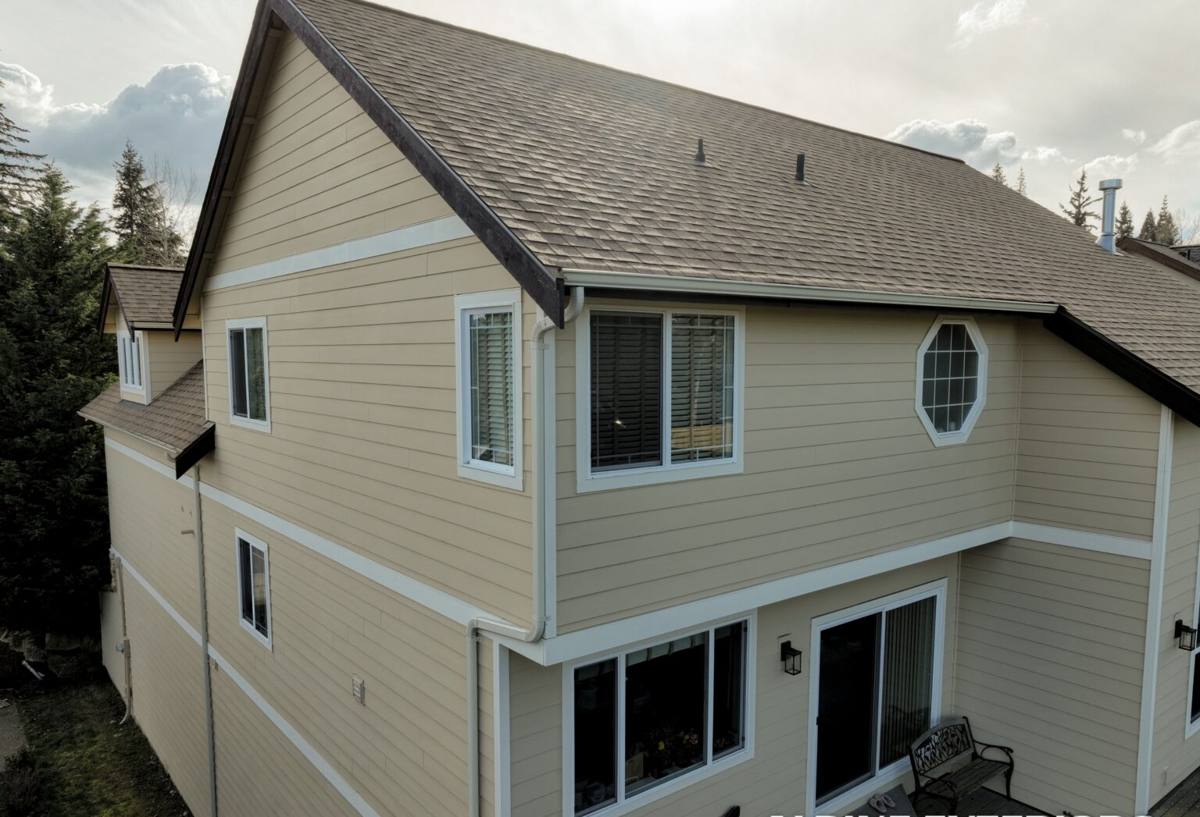
Why Metal Performs Well in This Environment
Metal roofing isn't the right fit for every home or every budget, but for Birchwood's conditions it solves several problems at once.
Moss resistance
Moss struggles to establish on a smooth, hard metal surface the way it does on the granular texture of asphalt shingles. It can still take hold in valleys, at abutments, or where debris accumulates, but on the open field of a metal roof it has far less to grip onto and far less organic material to feed on.
Water shedding
Standing-seam and properly lapped metal panel systems are built around continuous water paths with minimal horizontal joints. Under wind-driven rain, that matters more than raw slope — water gets pushed sideways, and a system with fewer horizontal seams gives it fewer places to work its way underneath.
Longevity against salt exposure
Not all metal roofing resists salt air equally, which is why material selection matters as much as the fact that it's "metal." Coating quality, fastener metallurgy, and panel alloy all determine how a roof ages within a few miles of the bay.
Metal Roofing Options and How They Hold Up Locally
Homeowners in Birchwood usually choose between a few common metal roofing formats. Each has real trade-offs worth understanding before you commit.
| System | Typical Fit | Salt Air / Coastal Notes |
|---|---|---|
| Standing seam (concealed fastener) | Most homes, especially where longevity and clean appearance matter | Best option near the bay — no exposed fasteners to corrode, continuous panel runs shed wind-driven rain well |
| Exposed-fastener panel | Budget-conscious projects, outbuildings, secondary structures | Lower upfront cost, but exposed screws and washers are the first thing to fail in salt air and need periodic inspection |
| Metal shingle / shake profile | Homes wanting a traditional look with metal's durability | Good moss resistance, but has more seams and laps than standing seam, so flashing detail work matters more |
For homes within easy reach of the water, we generally steer clients toward standing seam or a high-quality coated panel system with concealed fasteners. It's not that exposed-fastener systems are bad roofing — it's that the maintenance burden of periodically checking and replacing gaskets and fasteners is a real ongoing cost in this specific environment, and most homeowners would rather not take that on.
What a Correct Metal Roof Installation Actually Involves
The panels themselves get most of the attention, but in a climate like this the details around the panels are what actually determine whether the roof performs for its full service life.
Underlayment and moisture barrier
A high-temperature, self-adhering underlayment at eaves, valleys, and penetrations gives you a second line of defense if wind-driven rain ever gets past the panel laps. Given how much sustained rain Birchwood sees, we don't treat this as optional.
Fastener and flashing metallurgy
Mixing incompatible metals — say, steel fasteners against an aluminum panel — sets up galvanic corrosion that accelerates dramatically in salt air. Every fastener, flashing piece, and trim component needs to be metallurgically compatible with the panel system, not just close enough.
Valley and penetration detailing
Valleys are where wind-driven rain concentrates and where moss is most likely to gain a foothold if debris builds up. Pipe boots, skylights, and chimney flashing are the most common failure points on any roof, metal included, so these get built with extra lap and sealant redundancy rather than the minimum code allows.
Edge and eave protection
Drip edge and eave flashing have to be sized and lapped correctly to handle water being driven sideways by wind, not just falling straight down. This is a detail that's easy to under-build and hard to fix after the fact.
Ventilation
Metal roofs perform best over a properly ventilated attic or roof deck. In a humid, tree-shaded neighborhood like Birchwood, inadequate ventilation traps moisture underneath the roof deck even if the roof surface itself is shedding water perfectly.
Signs a Birchwood Roof Needs Attention
Whether you currently have metal, shingles, or another material, these are the signs we look for most often on homes in this part of Bellingham:
- Moss or dark streaking concentrated on north-facing or heavily shaded slopes
- Rust staining running down from fasteners, flashing, or panel edges on an existing metal roof
- Water staining on interior ceilings after wind-driven rain events specifically, rather than after every rain
- Granule loss or curling on asphalt shingles nearing the end of their service life
- Visible corrosion or pitting on any exposed metal trim, gutters, or flashing
- Sagging or soft spots near valleys, where moisture tends to concentrate over time
Our Process for Birchwood Metal Roofing Projects
We approach every metal roof in this neighborhood the same structured way:
- On-site assessment: We look at slope, shade exposure, existing ventilation, and how close the home sits to the water, since that affects coating and fastener recommendations.
- System selection: Based on that assessment, we recommend a panel type, gauge, and coating suited to the home's specific exposure — not a one-size-fits-all product.
- Written scope and estimate: You get a clear breakdown of materials, flashing details, underlayment, and ventilation work before anything is scheduled.
- Tear-off and deck inspection: Where applicable, we check the roof deck for hidden moisture damage before installing anything new over it.
- Installation with detailed flashing work: Panels go on with the fastener compatibility, lap, and valley detailing described above — not shortcuts.
- Final walkthrough: We review the completed roof with you, including how to spot early signs of moss or wear so small issues get caught before they become expensive ones.
Maintenance Realities for Metal Roofs in This Climate
Metal roofing is lower-maintenance than most alternatives, but "lower-maintenance" isn't "no-maintenance," especially this close to the bay and under tree cover. A sensible maintenance rhythm for Birchwood homes includes:
- Clearing debris from valleys and gutters at least once a year, more often on heavily treed lots
- A visual check of fasteners and flashing every year or two, especially on exposed-fastener systems
- Prompt attention to any moss establishing in shaded valleys before it spreads across the field of the roof
- Keeping gutters and downspouts flowing freely so water isn't backing up against eave flashing during heavy rain
Homeowners who stay on top of this short list generally get the full expected service life out of a metal roof, and often more, without any surprises.
Cost Factors for Birchwood Metal Roofing Projects
Metal roofing costs more upfront than asphalt shingles, and the exact number depends on several variables specific to the home and the job:
| Factor | Why It Matters |
|---|---|
| Panel system type | Standing seam with concealed fasteners generally costs more than exposed-fastener panel systems, reflecting the added labor and material for continuous seams |
| Roof complexity | More valleys, penetrations, and roof planes mean more flashing work, which adds labor time regardless of panel type |
| Coating and alloy grade | Coatings and alloys built for coastal salt exposure cost more than standard-grade options but reduce long-term corrosion risk |
| Tear-off and deck condition | Hidden moisture damage found during tear-off can add repair work before new roofing goes on |
| Ventilation upgrades | Older homes often need attic or roof ventilation improvements to get full performance from a new metal roof |
We don't publish flat pricing because these variables genuinely change the number from one home to the next — that's part of why we start with an on-site assessment rather than a phone quote.
Why Local Experience in Birchwood Matters
A crew that already works this neighborhood knows which slopes tend to hold moss longest, how close individual streets sit to salt air exposure, and what kind of wind-driven rain patterns are typical here versus other parts of Whatcom County. That familiarity shows up in small decisions — where to add extra underlayment, which valleys need reinforced flashing, how much ventilation a given attic actually needs — that a crew unfamiliar with the area might treat as optional rather than necessary.
If you're considering a metal roof for a Birchwood home, we're happy to take a look and walk you through what your specific roof needs, with no pressure to commit. Reach out for a free estimate using the form below.