 Bellingham Roofing
 Why Blaine's Setting Is Hard on Exterior Siding
Blaine sits right on the water in the far northwest corner of Whatcom County, and that waterfront location shapes everything about how siding ages here. Salt-laden air moves off the water and settles on exterior surfaces year-round, accelerating corrosion on fasteners, trim, and any exposed metal flashing. Add in Whatcom County's long, wet fall-through-spring stretch of driving rain, and siding on Blaine homes takes on moisture loads that inland properties simply don't see.
Then there's moss. The combination of shade, humidity, and mild temperatures gives moss and algae an extended growing season on north- and west-facing walls, roof-adjacent siding, and anywhere airflow is limited. Moss holds moisture against the surface long after a rain event has passed, which is exactly the condition that causes rot in wood-based products and finish breakdown in lower-grade fiber cement or engineered wood siding.
None of this means siding fails automatically — it means siding in Blaine needs to be inspected, maintained, and repaired with an understanding of these specific stressors. A repair that would hold up fine in a dry inland climate can fail again within a season here if it doesn't account for salt exposure and prolonged moisture contact.
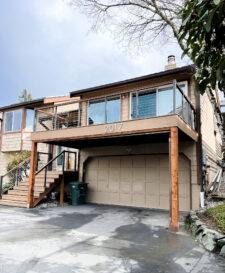
Signs a Blaine Home Needs Siding Repair
Most siding problems don't show up as a dramatic failure — they show up as small signals that get easy to ignore. Homeowners in Blaine should watch for:
- Soft or spongy spots when you press on siding, especially near the bottom courses and around window and door trim
- Visible moss or dark green-black staining that keeps returning after cleaning
- Cracked, bubbling, or peeling paint/finish, particularly on walls that face prevailing wind and rain
- Gaps or separation at seams, corners, and butt joints where caulking has shrunk or failed
- Rust streaking below nail heads or metal trim pieces
- Visible warping, buckling, or waviness in a section of siding
- Interior signs — musty smell, discoloration on interior walls, or soft drywall near exterior corners
Any one of these is worth a look. Several together usually mean water has been getting behind the siding for a while, not just sitting on top of it.
What a Correct Siding Repair Actually Involves
A quality repair is not just replacing the piece of siding that looks bad. Visible damage is often the last symptom of a problem that started somewhere else — a failed piece of flashing, a gap in the weather-resistive barrier, or a butt joint that was never properly sealed. A repair done right includes:
Diagnosis before demolition
Before removing anything, we look at the surrounding area: trim, flashing, window and door penetrations, and the general drainage path of water down that section of wall. Pulling one damaged board without understanding why it failed just means the replacement fails the same way.
Checking what's behind the siding
Once siding is removed, the water-resistive barrier (house wrap or building paper) and any sheathing underneath need to be inspected. If moisture has reached the sheathing, that has to be addressed — dried, repaired, or replaced — before new siding goes back on. Covering damaged sheathing with new siding just hides a problem that will resurface.
Correct flashing and sealing
Given how much wind-driven rain Blaine gets, flashing details around windows, doors, and horizontal trim matter as much as the siding material itself. Repairs need to restore (or improve) proper water-shedding paths, not just re-caulk over a gap and call it done.
Matching material and finish
A patch that doesn't match the surrounding siding in profile, exposure, or finish sticks out and can also perform differently than what's around it. Matching matters both for appearance and for how the wall handles water going forward.
Common Repair Scenarios We See in Blaine
| Issue | Typical Cause Locally | What Proper Repair Involves |
|---|---|---|
| Soft or rotted bottom courses | Splash-back, poor grading, or failed caulking trapping moisture | Remove affected boards, inspect sheathing, correct drainage/clearance, replace with matched material |
| Recurring moss/algae staining | Shaded walls, limited airflow, long damp season | Clean surface, address the moisture source (overhanging vegetation, poor sun exposure), reseal joints |
| Rust streaks at fasteners | Salt air corroding non-coated fasteners over time | Remove and replace with corrosion-resistant fasteners rated for coastal exposure |
| Cracked or open seams | Caulk failure from UV and moisture cycling | Remove old sealant, re-flash if needed, reseal with exterior-grade sealant rated for the exposure |
| Warped or buckled panels | Moisture absorption in wood-based or lower-grade products | Replace affected sections; evaluate whether surrounding panels are also compromised |
Repair vs. Replacement: How We Help You Decide
Not every problem calls for a full re-side, and we don't push replacement when a targeted repair will genuinely hold up. But we're also honest when repair is just delaying an inevitable, larger cost. A few factors guide that conversation:
| Factor | Leans Toward Repair | Leans Toward Replacement |
|---|---|---|
| Extent of damage | Isolated to one or two areas | Recurring across multiple walls or elevations |
| Underlying material condition | Sheathing and barrier are sound | Widespread moisture intrusion behind siding |
| Age of existing siding | Still well within expected service life | Original siding is aging out or was a lower-grade product to begin with |
| Match availability | Existing product/profile can be reasonably matched | Discontinued product or poor color/texture match available |
| Long-term cost | Repair cost is modest relative to remaining life | Repeated repairs are adding up to a meaningful fraction of replacement cost |
When a home's existing siding is a wood-based or lower-grade product that's showing this kind of wear in a coastal, moss-prone setting like Blaine, we'll say so plainly. Sometimes the honest answer is that a well-executed repair now buys a few more good years. Other times, the pattern of damage tells us the material itself is the problem, and continuing to patch it isn't a good use of money.
Why We Repair With James Hardie Fiber Cement
We install only James Hardie fiber cement siding, and that shapes how we approach repairs too. When a repair calls for new material — a replacement board, a corner piece, a section of trim — we use Hardie fiber cement products rather than mixing in a different material. Fiber cement doesn't absorb moisture the way wood-based or engineered wood siding can, which matters directly in a climate where siding stays damp for extended stretches during moss season. It also won't rot, and it holds up to the freeze-thaw and wet-dry cycling that's common along the Whatcom County coast.
Where a repair involves color-matching, Hardie's factory-applied ColorPlus finish gives us a consistent, durable finish to match against, rather than relying purely on field-applied paint that can weather differently than the original coating over time. And because Hardie's HZ5 product line is engineered for higher-moisture, harsher climates, replacement pieces perform to the same standard as new installations — not a lesser patch.
If a home's existing siding is a different material entirely — vinyl, LP SmartSide, cedar, or another fiber cement brand — we'll still repair what's there when that's the right call for the homeowner. But we'll always be straightforward that when the time comes for a fuller re-side, Hardie fiber cement is what we recommend and what we put on the wall, for the reasons above.
Our Repair Process
- Inspection and diagnosis — We look at the damaged area and the surrounding wall system, not just the obvious problem spot.
- Straightforward assessment — You get a clear explanation of what's causing the damage, what repair involves, and whether repair or replacement makes more sense for that section.
- Written scope and estimate — No vague verbal quotes; you know exactly what's being done before work starts.
- Removal and inspection behind the siding — Any compromised sheathing or barrier material gets addressed, not covered up.
- Correct flashing and sealing — Water management details get fixed or improved, not just patched over.
- Matched material installation — New Hardie fiber cement material installed to manufacturer spec, properly fastened with corrosion-resistant hardware.
- Final walk-through — We confirm the repair with you before considering the job finished.
Why Local Experience Matters for This Kind of Work
A crew that already works in Blaine and the surrounding Whatcom County coastline knows what to expect before they even pull the first board. They know which wall orientations tend to hold moss, how far salt exposure typically reaches from the waterfront, and which fastener and sealant choices actually hold up here versus in a drier inland area. That experience shows up in fewer callbacks and repairs that solve the actual problem the first time, rather than a generic patch that looks fine for a season and then fails again.
It also means a faster, more accurate diagnosis. Someone unfamiliar with coastal Pacific Northwest conditions might treat a moss stain as a cosmetic issue when it's actually pointing to a moisture problem building behind the siding. Local experience is what tells the difference.
Questions to Ask Before Hiring a Siding Repair Contractor
- Will you inspect what's behind the damaged siding, or just replace the visible piece?
- What fasteners and sealants do you use, and are they rated for coastal/salt-air exposure?
- Can you match the existing siding profile, texture, and finish — and if not, what's the alternative?
- Do you provide a written scope of work before starting, not just a verbal estimate?
- How do you handle a repair if you find moisture damage in the sheathing once siding is removed?
- What warranty applies to the repair work and the materials used?
If a contractor can't answer these clearly, that's worth noting before you hire them.
If you're seeing moss, soft spots, cracked seams, or rust stains on your Blaine home's siding, it's worth having someone look before the damage spreads further. We offer free, no-pressure estimates — use the form below to get a straightforward assessment of what's going on and what it would take to fix it right.