 Bellingham Roofing
 Building Decks for Edgemoor's Wooded, Water-Adjacent Lots
Edgemoor sits among the more distinctive building sites in Bellingham — sloped, tree-covered lots close to Chuckanut Bay and Bellingham Bay, many with the mature fir and cedar canopy that gives the neighborhood its character. That same setting that makes Edgemoor desirable also makes deck-building here different from a flat, open lot in town. Shade from tall conifers keeps wood surfaces damp long after a storm passes. Proximity to saltwater means airborne salt reaches fasteners and metal connectors year-round, not just on stormy days. And Whatcom County's wet season puts driving rain against ledger boards and ground-level framing for months at a stretch.
A deck built without those three factors in mind — shade, salt air, and sustained rain — will show problems faster here than almost anywhere else in Bellingham. This page covers what a correctly built Edgemoor deck actually requires, from material selection through the framing details most contractors skip.
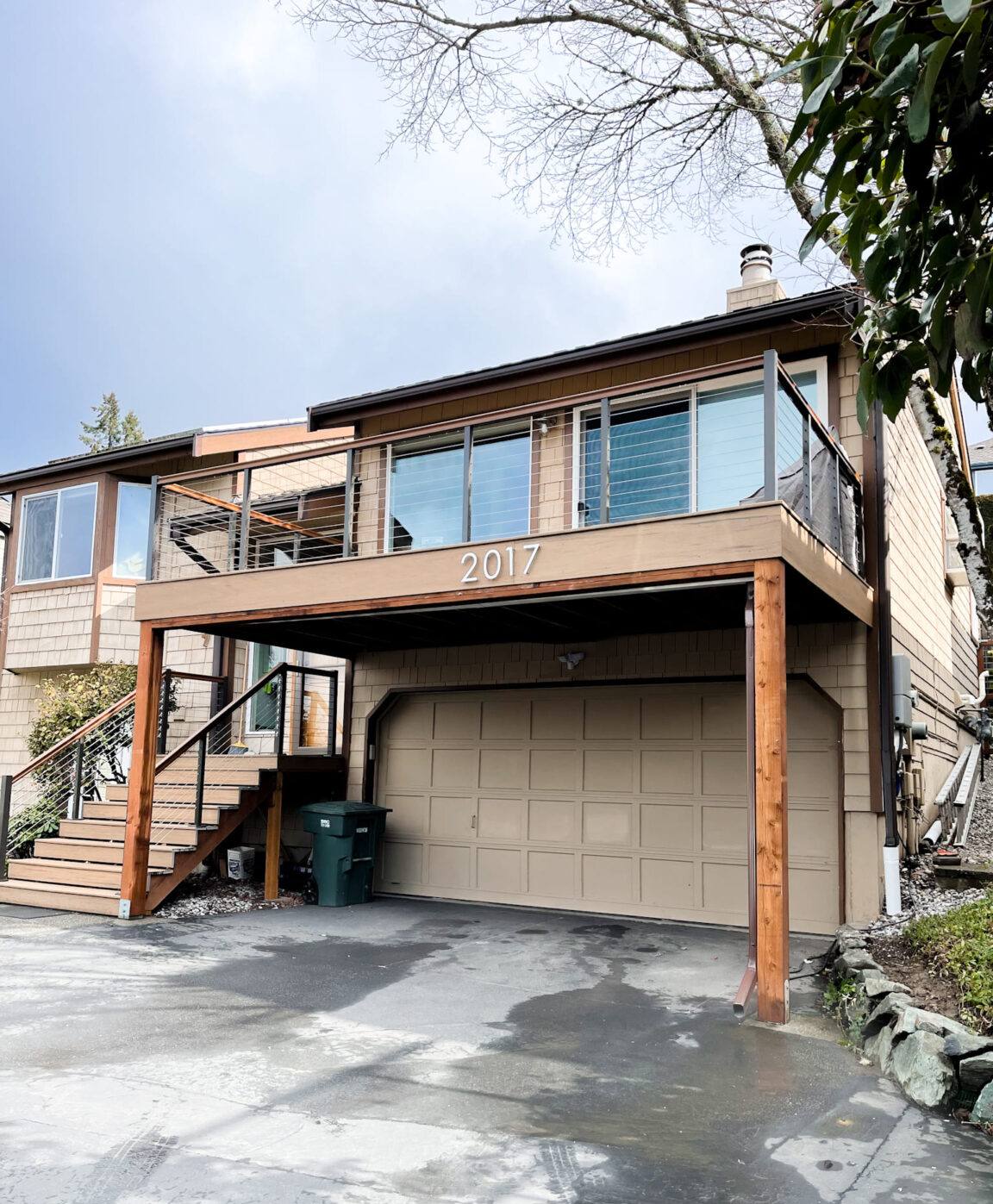
What Edgemoor's Climate Does to a Deck
Moss and Algae from Tree Cover
Wooded lots hold moisture. Decking under a fir or cedar canopy dries slower after rain than decking in open sun, and needle and leaf litter traps organic debris in board gaps and against framing. That combination is exactly what moss and algae need to take hold. Beyond the slip hazard, sustained moisture against wood surfaces accelerates rot at fastener points and board edges — the places where water sits longest.
Salt Air and Hardware Corrosion
Decks within a mile or two of Bellingham Bay or Chuckanut Bay take on salt-laden air, especially with onshore wind. Salt air corrodes standard fasteners, joist hangers, and post bases faster than inland locations. Once a fastener starts rusting, it weakens at exactly the connection points that carry structural load — ledger bolts, hanger nails, post-to-footing hardware.
Driving Rain and Ledger/Flashing Failure
Pacific storms off the Washington coast bring rain that hits horizontally, not just straight down. That matters most at the ledger board — where the deck attaches to the house — and at any point where decking meets a wall, door threshold, or stair landing. Improperly flashed ledger connections are one of the most common causes of hidden rot and, in worst cases, deck failure, because water gets behind the board and into the house framing where nobody sees it until damage is advanced.
What a Correctly Built Edgemoor Deck Requires
| Climate Factor | What It Does to a Deck | What We Build For |
|---|---|---|
| Tree canopy shade | Slower drying, moss/algae growth, organic debris buildup | Gapped board spacing, ventilated framing, moss-resistant surface options |
| Salt air proximity | Accelerated corrosion of fasteners and connectors | Stainless steel or marine-grade coated hardware throughout |
| Driving rain | Water intrusion at ledger, wall, and stair connections | Proper ledger flashing, house wrap integration, sealed penetrations |
| Sloped, wooded lots | Uneven grade, root systems, limited equipment access | Engineered footings sized to actual soil and slope conditions |
Decking Material Choices for a Shaded, Salt-Air Lot
Composite Decking
For lots with heavy tree cover, composite decking is often the more practical long-term choice. It doesn't absorb moisture the way wood does, which slows moss growth compared to untreated lumber, and it doesn't need the annual staining or sealing that wood decking under a canopy demands. The trade-off is upfront cost — composite runs higher per square foot than cedar — and it still needs to be kept clear of debris, since moss and algae can grow on any damp surface, composite included.
Cedar
Cedar has natural rot resistance and a look that fits Edgemoor's wooded setting well. It requires more upkeep than composite, though — regular cleaning to keep moss from establishing, and periodic sealing to maintain its resistance to moisture. Under heavy shade, that maintenance schedule tightens up compared to a cedar deck in full sun.
Why We're Selective About Tropical Hardwoods
Tropical hardwoods like ipe are extremely dense and rot-resistant, which sounds ideal for a wet climate. In practice, that density makes them difficult to work with correctly — they're prone to splitting if pre-drilling isn't precise, and their tight grain means they don't take stain evenly over time. We'll install them when a homeowner specifically wants that look and understands the maintenance commitment, but we don't default to them on shaded Edgemoor lots, where the added moisture load makes an already installation-sensitive material harder to get right.
Material Comparison
| Material | Upfront Cost | Maintenance | Best Fit |
|---|---|---|---|
| Composite | Higher | Low — occasional cleaning | Heavily shaded, low-maintenance priority |
| Cedar | Moderate | Moderate — annual cleaning/sealing | Partial shade, natural wood look |
| Tropical hardwood | Highest | Moderate to high — periodic oiling | Homeowners committed to upkeep, specific aesthetic |
The Details That Actually Determine Whether a Deck Lasts
Fasteners and Hardware
Every deck we build within salt-air range of the water uses stainless steel or marine-grade coated fasteners and connectors — not the standard galvanized hardware that's fine further inland. This applies to joist hangers, ledger bolts, post bases, and every screw. It costs more than standard hardware. It also means the connections holding the deck together aren't the first thing to fail.
Ledger Flashing
Where the deck ties into the house, we install proper flashing that integrates with the existing house wrap or siding — not just a bead of caulk over the ledger board. This is the single most important detail for keeping driving rain out of the wall framing behind the deck, and it's also the detail most likely to be shortcut on a fast, cheap job.
Footings for Sloped, Wooded Sites
Edgemoor's terrain means footings often can't follow a simple flat-lot template. We size and place footings based on actual slope, soil conditions, and root systems on the specific lot, and we pull permits through the appropriate Whatcom County or City of Bellingham process depending on where the property sits. Skipping engineering on a sloped lot is how you end up with a deck that settles unevenly within a few years.
Board Spacing and Airflow
Under tree cover, board gap width and under-deck ventilation matter more than they would in an open, sunny yard. Adequate spacing lets water drain and air circulate, which is one of the most effective ways to slow moss establishment without relying entirely on chemical treatments or constant cleaning.
Our Process, Start to Finish
- On-site assessment — we walk the actual lot, noting slope, tree cover, sun exposure, and proximity to the water, since these vary block to block in Edgemoor.
- Design and material selection — we recommend decking and hardware based on that specific site, not a generic package.
- Permitting — we handle the permit process with the correct jurisdiction before any work starts.
- Ledger and framing — flashing and structural connections go in first, and this is the stage where corners get cut on rushed jobs. It isn't rushed on ours.
- Decking and finish work — boards, railings, and stairs go in to the spacing and hardware standards described above.
- Walkthrough — we go over basic maintenance specific to your lot's shade and moisture conditions before we consider the job done.
A Homeowner's Maintenance Checklist for a Shaded Edgemoor Deck
- Sweep leaf and needle debris off the deck surface regularly, especially in fall — trapped organic matter holds moisture against boards
- Clear gutters and downspouts near the deck so runoff isn't draining directly onto or under it
- Check for early moss growth in shaded corners and low-traffic areas and clean it before it spreads
- Inspect visible hardware annually for rust or corrosion, particularly if the deck is within a mile or two of saltwater
- Reseal wood decking on the schedule appropriate to the species — don't stretch it because the deck "still looks fine"
- Keep an eye on the ledger board area where the deck meets the house — staining or soft wood there is worth a professional look right away
Why Local Experience Matters on This Job
A deck built to a generic national spec doesn't account for the fact that an Edgemoor lot under a fir canopy fifty yards from the bay behaves nothing like a deck built on an open, inland lot elsewhere in Whatcom County. Hardware that's adequate in Ferndale can under-perform here. Board spacing that works in full sun grows moss under tree cover. A crew that's built decks across Edgemoor's specific mix of slope, shade, and salt exposure knows to build for those conditions from the start, rather than learning it after the first callback.
If you're planning a new deck or replacing one that hasn't held up in Edgemoor's conditions, we're happy to come take a look at your specific lot. We'll walk the site, talk through material options honestly — including the trade-offs, not just the upsides — and put together a straightforward estimate with no pressure to sign on the spot. Use the form below to get started.