 Bellingham Roofing
 Building Decks for Sudden Valley's Terrain and Tree Cover
Sudden Valley sits in a different microclimate than a lot in downtown Bellingham. Lots here tend to be wooded, sloped, and close to Lake Whatcom, which means more shade, more standing humidity under the canopy, and a longer window each year when surfaces stay damp. That combination changes how a deck should be framed, what it should be built from, and how often it needs attention. A deck design that works fine on an open, flat lot in a drier part of Whatcom County can struggle here — algae and moss take hold faster in shaded, low-airflow spots, and sloped lots often call for taller framing and different footing work than a standard ground-level deck.
We've built and repaired decks throughout Sudden Valley long enough to know which details matter on this kind of lot and which are just extra cost. This page covers what a Sudden Valley deck actually needs, how we build it, and what to expect from the process.
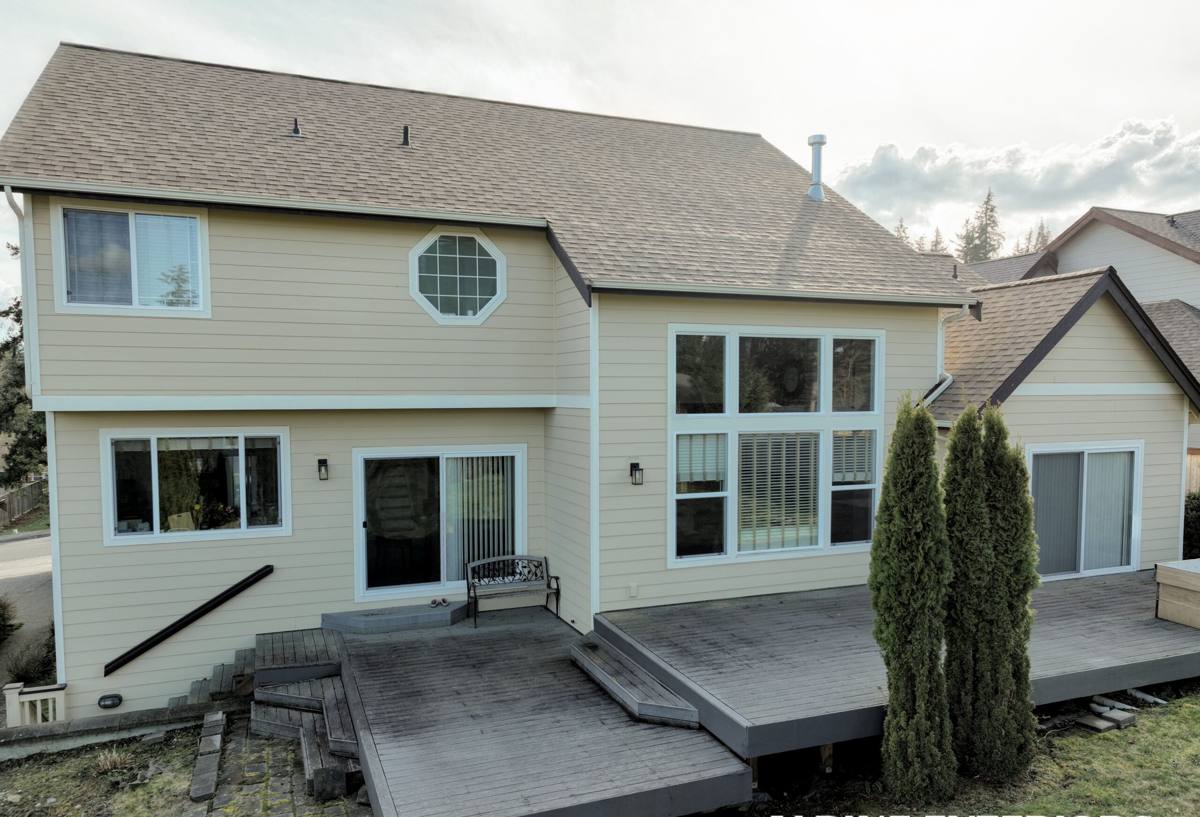
What the Bellingham Climate Does to a Deck
Whatcom County's climate is mild, but it's also wet for a large part of the year, and Sudden Valley's tree cover and lake proximity add to that. A few things play out consistently on decks in this area:
- Salt-tinged marine air moving in from the Puget Sound region accelerates corrosion on unprotected fasteners and hardware, even well inland.
- Driving rain during fall and winter storms pushes moisture into end grain, fastener holes, and any spot where flashing was skipped or done poorly.
- A long moss and algae season — shaded, tree-covered lots like many in Sudden Valley stay damp longer after each rain, which is exactly the condition moss needs to establish on decking, stairs, and railings.
- Needle and leaf litter from surrounding trees collects between deck boards and in corners, holding moisture against the wood or composite surface if it isn't cleared regularly.
None of this means a deck can't hold up well here — it means the build has to account for it from the start, rather than relying on the homeowner to fight moss and rot with a pressure washer every spring.
Where Problems Actually Start
Most deck failures we get called out to repair in this area didn't start with the decking boards themselves. They started underneath: framing lumber that wasn't rated for ground contact where it needed to be, ledger boards attached to the house without proper flashing, or joists that were never coated on the cut ends after installation. Moisture finds every one of those gaps eventually, and by the time it shows on the surface, the structure underneath has usually been compromised for a while.
Choosing the Right Decking Material for This Neighborhood
There's no single "best" decking material — it depends on your budget, how much upkeep you're willing to do, and how shaded your specific lot is. Here's how the common options actually compare for a Sudden Valley setting:
| Material | Upfront Cost | Moss/Moisture Resistance | Maintenance | Typical Lifespan |
|---|---|---|---|---|
| Pressure-treated wood | Lowest | Fair — needs sealing to perform well | Annual cleaning and re-sealing recommended | 15-20 years with upkeep |
| Cedar | Mid-range | Naturally decay-resistant, but surface still needs care | Periodic cleaning, staining or sealing every few years | 15-25 years with upkeep |
| Composite decking | Higher | Good — won't rot, but surface can still grow moss/algae in shade | Periodic washing, no sealing or staining | 25-30+ years, manufacturer-dependent |
| PVC/capped polymer | Highest | Very good — fully capped surface resists moisture absorption | Occasional washing | 25-30+ years, manufacturer-dependent |
On heavily shaded Sudden Valley lots, we generally steer homeowners away from bare, unsealed wood as a long-term-low-maintenance choice — it's not that the wood fails outright, it's that moss and mildew show up fast in shade and require more frequent cleaning than most people want to keep up with. Composite and capped polymer boards cost more up front but hold up better against surface staining without repeated sealing. That said, plenty of homeowners are happy with cedar or treated wood as long as they go in knowing the maintenance schedule and keep to it.
Structural Considerations: Framing, Footings, and Slope
A lot of Sudden Valley properties aren't flat. Sloped lots mean taller decks, which means more attention paid to a few structural details that a low, flat deck doesn't have to worry about as much:
Footings
On sloped ground, footing depth and placement matter more, since the deck may be carrying more height and lateral load. We size and place footings to the actual grade and soil conditions on your lot rather than using a one-size template.
Ledger Attachment
Where a deck attaches to the house, proper flashing behind the ledger board is one of the most important — and most commonly skipped — steps in deck building. Done wrong, this is where water gets behind siding and into the wall structure. Done right, it's one of the cheapest insurance policies on the whole project.
Joist Protection
Every cut end of framing lumber loses its factory treatment right at the cut. We coat cut ends and joist tops before decking goes down, which is a small step that meaningfully slows moisture intrusion into the framing over the life of the deck.
Ventilation
Taller, sloped-lot decks often have more airflow underneath than low decks do, which actually helps with drying — but stairs, skirting, and any enclosed under-deck storage need to be planned so they don't trap moisture against the framing.
Railings, Fasteners, and Hardware That Actually Last
Hardware is where a lot of decks quietly fail years before the decking itself wears out. In a marine-influenced climate like ours, we use fasteners and connectors rated for coastal exposure — not because every screw needs to be top-shelf, but because the ones holding your ledger, stair stringers, and railing posts are carrying real structural load and are expensive to replace once they're buried under finished decking.
For railings, code requirements in Washington set minimum heights and baluster spacing, and those requirements apply whether the deck is six inches off the ground or built up on a sloped Sudden Valley lot. We build railings to meet code as a baseline, then talk through material options — wood, metal, or composite — based on your maintenance preference and the look you want.
Our Deck Building Process
- On-site walkthrough: We look at your specific lot — slope, tree cover, sun exposure, drainage, and how the deck connects to the house — before recommending materials or a layout.
- Design and material selection: We go over the material comparison honestly, including maintenance expectations, so you're picking based on real trade-offs rather than a showroom sample.
- Permitting: Deck projects in Whatcom County typically require a permit depending on size and height; we handle that process as part of the job.
- Framing and structural work: Footings, ledger flashing, joists, and cut-end treatment — the parts that determine how long the deck lasts, even though they're invisible once the project is done.
- Decking, railings, and stairs: Installed to the fastening pattern and spacing the material manufacturer specifies, which affects both appearance and long-term performance.
- Final walkthrough: We go over care and maintenance specific to the material you chose, so you know what upkeep actually looks like before the first wet season hits.
Maintenance Realities: What to Actually Expect
Every deck in this area needs some seasonal attention — the question is how much. A quick checklist for what Sudden Valley homeowners should plan on, regardless of material:
- Clear leaves and needles from between boards and deck corners regularly, especially in fall
- Sweep or rinse off surface moss and algae buildup before it gets a foothold, particularly in shaded areas
- Check railing posts and stair connections annually for movement or loosening
- Keep gutters and downspouts near the deck clear so runoff isn't draining directly onto or under it
- Re-seal or re-stain wood decking on the schedule appropriate to the product — don't wait until it's visibly gray and worn
- Trim back overhanging branches where practical to improve airflow and sun exposure on shaded sections
Why Hire a Crew That Already Works in Sudden Valley
Building a deck that holds up in this neighborhood isn't a mystery, but it does take getting the framing, flashing, and material choices right for the specific conditions on a shaded, sloped, lake-adjacent lot — not just following a generic deck plan. A crew that's already worked on Sudden Valley properties has seen where moss actually takes hold, which slopes need extra footing attention, and which shortcuts show up as callbacks a few years down the road. That local experience translates into fewer surprises during the build and a deck that's set up to handle the specific climate it's sitting in, rather than a best guess at it.
We're a local roofing and exterior contractor based in Bellingham, and deck building is one of the services we handle for homeowners throughout Whatcom County, including Sudden Valley. If you're planning a new deck or replacing one that's showing its age, we're happy to walk your property, talk through material options honestly, and put together a straightforward estimate — no pressure, no hard sell. Reach out using the form below to get started.