 Bellingham Roofing
 Fairhaven's Roofs Work Harder Than Most
Fairhaven sits close enough to the water that its homes deal with a combination of stresses most inland Bellingham neighborhoods don't see in the same intensity: salt-laden air off Bellingham Bay, wind-driven rain that gets pushed sideways under poorly sealed edges, and deep tree cover that keeps roofs shaded and damp for months at a time. Any one of those factors is manageable on its own. Together, over a Whatcom County winter, they shorten the useful life of a shingle roof that wasn't installed with this specific exposure in mind.
None of this means asphalt shingles are the wrong choice for Fairhaven. They remain one of the most practical, cost-effective roofing materials available, and a properly installed asphalt shingle roof holds up well here for decades. The catch is the word "properly." A shingle roof built to a generic spec, without attention to the salt air, the rain volume, and the moss pressure specific to this part of Bellingham, will show its age faster — curling edges, granule loss, soft moss mats, and leaks at the details that get skipped when a crew is unfamiliar with the area.
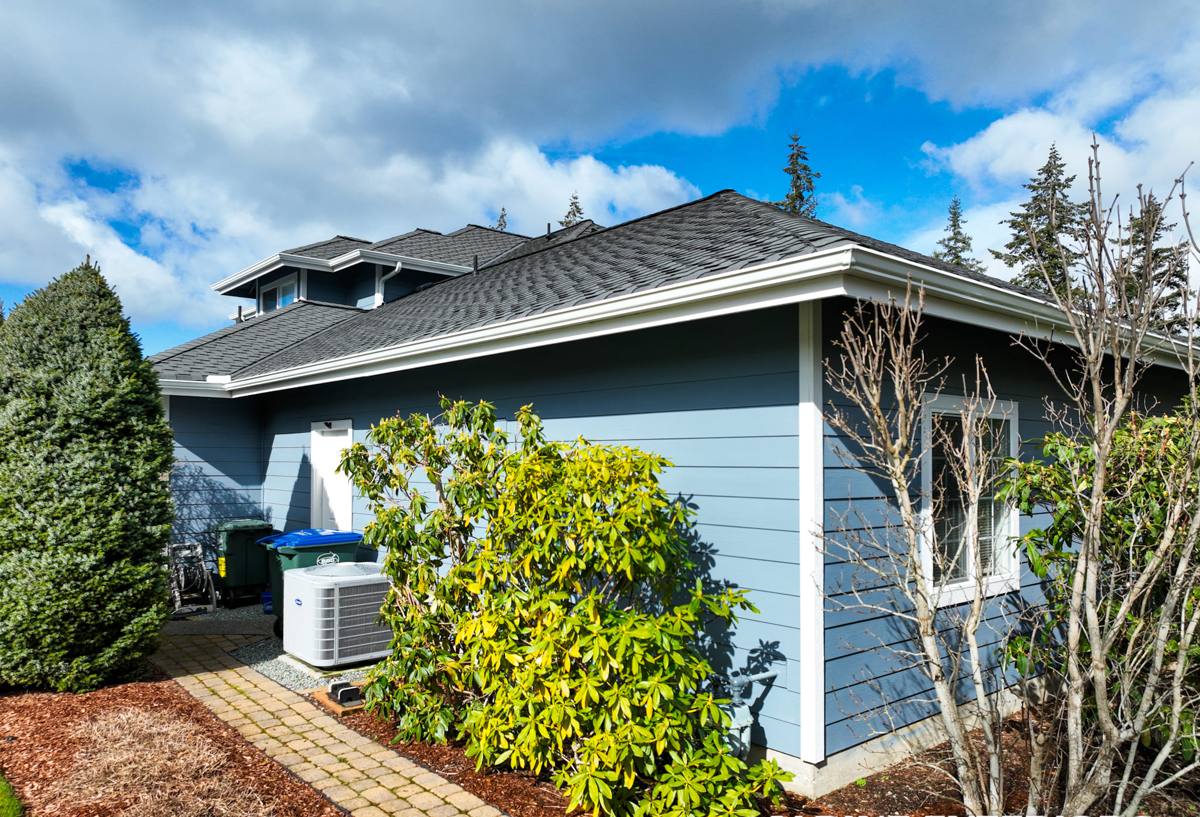
What a Correct Installation Involves Here
Asphalt shingle roofing is often talked about as if the shingle itself is the whole job. It isn't. The shingle is the visible top layer of a system, and in a wet coastal climate the layers underneath the shingles matter as much as the shingles themselves.
Underlayment
A synthetic or self-adhering underlayment rated for high-moisture climates goes down first, with extra attention paid to laps and fastening pattern. In driving rain, water can travel further up a roof deck than people expect, so underlayment coverage needs to account for wind-driven moisture, not just straight-down rainfall.
Ice and Water Barrier at Vulnerable Points
Eaves, valleys, and any low-slope transitions get a self-adhering membrane rather than relying on underlayment alone. These are the spots where standing water and debris collect, and where a roof is most likely to leak first if the detailing was rushed.
Flashing
Chimneys, skylights, sidewalls, and any roof-to-wall transition need new, correctly stepped and counter-flashed metal — not caulk smeared over old flashing to save time. Reused or under-built flashing is one of the most common causes of "mystery leaks" on otherwise sound roofs.
Ventilation
Balanced intake and exhaust ventilation keeps the underside of the roof deck dry and at a stable temperature. Poor ventilation traps moisture in the attic, which shortens shingle life from underneath and contributes to the kind of dampness that helps moss and algae take hold on the topside.
Nailing and Fastening
Correct nail placement, count, and depth affect wind resistance far more than the shingle brand does. A high-end shingle installed with a sloppy nailing pattern will underperform a mid-range shingle installed correctly.
Choosing a Shingle Built for Salt Air and Shade
Not every asphalt shingle is equally suited to a marine, tree-shaded environment like Fairhaven. The two factors worth paying attention to are wind rating and algae resistance, since those map directly onto the conditions the roof will actually face.
| Shingle Type | Typical Wind Rating | Algae/Moss Resistance | Best Fit For |
|---|---|---|---|
| Standard 3-tab | Lower end of the range | Standard granules, no built-in resistance | Budget-driven projects, less exposed roof planes |
| Architectural (dimensional) | Mid to high, depending on line | Often available with algae-resistant granules | Most Fairhaven homes; better durability-to-cost ratio |
| Impact-rated / high-wind architectural | Highest available | Algae-resistant granules standard on most lines | Exposed sites, waterfront-adjacent lots, homeowners wanting maximum longevity |
We steer most Fairhaven homeowners toward an architectural shingle with algae-resistant (copper- or zinc-infused) granules as the practical baseline. The upcharge over a basic 3-tab is modest, and the payoff — slower moss and algae colonization, a heavier shingle that handles wind better, and a longer warranty period — is well worth it in a climate that gives moss every advantage it needs.
Moss, Algae, and Salt: What's Actually Happening
Moss doesn't grow on a roof by accident. It needs shade, moisture, and organic debris to get started, and Fairhaven's tree canopy provides all three for long stretches of the year. Once moss establishes itself, it holds water against the shingle surface, works into the granule layer, and can lift shingle edges as it grows — which is how a moss problem turns into a leak problem if it's left alone. Salt air adds a separate issue: it accelerates the breakdown of exposed metal flashing, fasteners, and vent components faster than it affects the shingles themselves, so those details deserve regular attention even on a roof that still looks fine from the ground.
A few habits go a long way toward protecting the investment in a new roof:
- Keep overhanging branches trimmed back to reduce shade and debris buildup on the roof plane.
- Clear gutters and valleys of needles and leaves at least twice a year, more often under heavy tree cover.
- Have moss physically removed rather than just chemically treated once it's established — chemical treatments alone won't lift moss that's already gripping the shingle surface.
- Use zinc or copper strips near the ridge on shade-heavy roof planes to slow future moss regrowth.
- Schedule a walk-on inspection every couple of years to catch lifted shingles, cracked flashing sealant, or granule loss before it becomes a leak.
- Avoid pressure washing shingles — it strips protective granules and shortens the roof's life rather than extending it.
How Our Process Works
Every roof starts with an on-site look, not a phone estimate. We walk the roof plane by plane, check the attic for ventilation and moisture signs, and look at flashing details around chimneys, skylights, and sidewalls before writing anything down. That inspection tells us whether a repair is realistic or whether the roof has reached the point where replacement is the more honest recommendation.
From there, we put together a written estimate that spells out the shingle line, underlayment, flashing scope, and ventilation plan — not just a single lump-sum number. On replacement projects, we handle tear-off, deck inspection and repair where needed, new underlayment and ice-and-water barrier at the vulnerable points, new flashing, correct ventilation, and a full cleanup with magnetic nail sweeps of the property. On repair projects, we scope the work to the actual failure point rather than upselling a full replacement when it isn't needed.
Repair or Replace: How to Think About It
Homeowners in Fairhaven often ask whether a leak or a patch of moss means the whole roof needs to go. Usually it doesn't. The right call depends on the roof's age, how widespread the wear is, and what's happening underneath the shingles.
| Factor | Favors Repair | Favors Replacement |
|---|---|---|
| Roof age | Under 12-15 years | Approaching or past typical service life for the shingle grade |
| Extent of damage | Localized — one valley, one flashing point, a few shingles | Spread across multiple roof planes |
| Granule loss | Minor, isolated | Widespread bald spots or exposed mat |
| Decking condition | Solid, no soft spots | Soft, spongy, or visibly stained decking |
| Moss/algae extent | Light coverage, recently started | Thick mats that have lifted shingle edges |
| Underlying ventilation | Already adequate | Needs a full rebuild to correct anyway |
When the deck is sound and the damage is contained, a targeted repair is the right, cost-conscious answer. When a roof is old enough that a repair would just be a temporary patch on a system that's failing broadly, we'll say so directly rather than stringing along a series of repair calls.
Why a Crew That Already Works Fairhaven Matters
A roofing crew that regularly works this part of Bellingham has already seen how a given shingle line, underlayment, and ventilation setup actually performs under salt air and heavy tree shade — not just how it's rated on paper. That experience shows up in small decisions: which flashing details need extra attention on a shaded roof plane, where moss tends to establish first, how much ventilation a given attic actually needs given the shade and humidity around it. A crew unfamiliar with Whatcom County's coastal microclimates is more likely to build to a generic spec that underperforms here, even if the workmanship is otherwise fine.
There's also a practical service side to it. A local crew can respond faster to a storm-damage call, knows which permitting requirements apply in this jurisdiction, and has an ongoing reason to stand behind the work — we're not driving in from out of the area for a one-time job.
Permits, Timing, and Warranty Coverage
Most asphalt shingle replacements require a building permit, and we handle that as part of the project rather than leaving it to the homeowner. Typical installation timelines for a residential roof run a few days to about a week depending on size, roof complexity, and weather windows — and in this climate, we plan around rain forecasts rather than pushing through wet conditions that compromise the install. Materials typically carry a manufacturer's warranty on the shingles themselves, and we back our installation labor separately, so it's worth asking any contractor to spell out both pieces clearly rather than quoting "warranty included" without detail.
If you're weighing a repair, a full replacement, or just want a straight answer about what condition your roof is actually in, we're happy to take a look. Use the form below to request a free, no-pressure estimate for your Fairhaven home.