 Bellingham Roofing
 Decking Built for Fairhaven's Marine Climate
Fairhaven sits close enough to Bellingham Bay that salt-laden air is a daily fact of life, not an occasional nuisance. Add Whatcom County's long wet season, frequent drizzle that never quite turns into a proper downpour, and the shaded, moss-friendly conditions common on lots with mature evergreens, and you have one of the more demanding environments in the Pacific Northwest for an outdoor deck. Wood decking in this setting needs constant attention — sanding, staining, sealing, and re-sealing — just to keep moisture from working its way into the grain. Composite decking was developed specifically to resist that kind of punishment, and for Fairhaven homeowners it has become the practical choice for anyone who wants a deck that looks good in July and still looks good in February.
This page is about composite decking as it applies to this specific neighborhood: what the salt air and rain actually do to a deck over time, what a correctly built composite deck looks like from the framing up, and why a crew that already works in this part of Bellingham catches problems that an out-of-town installer might miss.
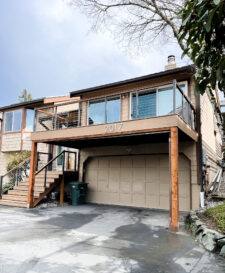
What Salt Air, Rain, and Moss Actually Do to a Deck
Salt Air
Airborne salt from the bay settles on every exterior surface, including decking. On wood, it accelerates the breakdown of surface fibers and speeds up graying and splintering even under a sealant. On metal fasteners and hardware, salt exposure is the bigger issue — it drives corrosion far faster than it would inland, which is why fastener selection matters more here than it does on a deck twenty miles east.
Driving Rain
Bellingham doesn't usually get violent storms, but it gets sustained, wind-driven rain that finds its way into every gap, seam, and end-cut that isn't properly sealed. Water that gets trapped between boards, under fascia, or around post bases doesn't dry quickly in our climate — the air stays damp for days at a time, which means a small leak path becomes a long-term rot problem instead of a quick dry-out.
Moss and Algae
Shaded, moisture-retentive spots — under tree canopy, on the north side of a house, or anywhere airflow is limited — grow moss and algae on almost any surface, decking included. On wood, moss holds moisture against the board and accelerates decay. On composite, moss is mostly a surface and traction issue rather than a structural one, but it still needs to be accounted for in board selection and deck layout.
Why Composite Makes Sense for This Neighborhood
Composite decking is made from a blend of wood fibers and recycled plastics, formed into boards that don't require staining, sealing, or annual refinishing. For a Fairhaven property dealing with salt air and near-constant dampness for much of the year, that translates into a few real advantages:
- No annual sanding, staining, or sealing cycle — the finish is baked into the board, not applied on top of it
- Capped composite boards resist moisture absorption far better than raw wood, which matters when the air itself stays damp for weeks
- Consistent color and grain pattern that doesn't gray or blotch the way cedar or fir can under salt exposure
- Better resistance to splintering, which matters for bare feet on a deck used through a long wet-to-dry seasonal swing
- Class B fire rating on most composite products, which some Whatcom County insurers factor into premiums
Composite isn't maintenance-free — we'll get into what upkeep actually looks like below — but it removes the single biggest failure point of a coastal wood deck: moisture getting into exposed grain year after year until the boards start to cup, split, or rot.
What a Correct Composite Deck Build Involves
The board itself is only part of the job. Most composite deck problems we get called out to fix in the Bellingham area trace back to the substructure or the details, not the decking material. A correctly built composite deck involves:
Framing and Substructure
Composite boards are heavier than wood and behave differently under load, so joist spacing has to match the manufacturer's specification for the board profile you're using — this is often tighter than standard wood-deck framing, especially at diagonal layouts or stair treads. In a marine climate, we also favor treated or coated framing lumber and stainless or coated fasteners throughout the substructure, since the framing is hidden but still exposed to the same salt-laden, damp air as everything else.
Ventilation Underneath
A deck built low to the ground, or over a patio, without adequate airflow underneath traps moisture against the joists and the underside of the decking. This is one of the more common issues we find on older Fairhaven decks — the top surface looks fine, but the framing underneath has been sitting in damp, stagnant air for years. Proper joist spacing off the ground, and ventilation gaps where the deck meets the house, keep that from happening.
Fastening and Hardware
Hidden fastener systems are standard on most composite decks now, and they matter more here than they would in a drier climate — every exposed screw head is a corrosion point in salt air. We use fasteners and structural hardware rated for coastal or marine exposure, not standard interior-grade hardware, on every composite deck we build in this area.
Flashing at the Ledger Board
Where a deck attaches to the house, proper ledger flashing is what keeps driving rain from working its way behind the siding and into the wall framing. This is arguably the single most important — and most commonly skipped — detail on a deck attached to a house in a wet climate, because a bad ledger connection doesn't show itself until the rot is already inside the wall.
Board Spacing and Drainage
Correct gapping between boards allows water to shed quickly instead of pooling, which matters directly for moss and algae control — standing water on a deck surface is exactly the environment moss needs to establish itself. Spacing that's too tight traps debris and moisture between boards; spacing that's too wide creates a tripping and drainage-catch issue of its own.
Comparing Decking Options for a Fairhaven Property
| Factor | Composite Decking | Pressure-Treated Wood | Cedar |
|---|---|---|---|
| Annual maintenance | Occasional cleaning only | Staining/sealing every 1-2 years | Staining/sealing every 1-2 years, more prone to graying |
| Moisture resistance | High (capped boards resist absorption) | Moderate, depends on sealant upkeep | Moderate, softer wood is more absorbent |
| Salt air performance | Strong — material doesn't corrode or wick salt | Fair — fasteners are the weak point | Fair — grain absorbs salt-laden moisture |
| Moss/algae resistance | Good with proper drainage and spacing | Weaker — moss holds moisture against grain | Weaker — same issue as PT wood |
| Upfront cost | Higher material cost | Lowest material cost | Mid-to-high material cost |
| Typical lifespan (PNW climate, maintained) | 25-30+ years | 15-20 years | 15-20 years |
None of these is universally "right" — a wood deck that's properly maintained can last a long time here too. The trade-off is honest: wood costs less up front and more in ongoing labor and materials over its life; composite costs more up front and largely removes that ongoing maintenance burden. For homeowners who've already been through a few Bellingham winters with a wood deck and are tired of the sanding-and-sealing cycle, composite is usually the better long-term fit.
Our Process for a Fairhaven Composite Deck
- On-site assessment — we look at sun exposure, tree canopy, drainage slope, proximity to the water, and the condition of any existing structure before recommending a product or layout.
- Design and board selection — we walk through board profiles, colors, and railing/fascia options suited to the home and to how much direct salt exposure the site actually gets.
- Permitting — most deck rebuilds and new builds in Bellingham require a permit; we handle that process rather than leaving it to the homeowner.
- Demo (if replacing an existing deck) — including an honest look at the ledger connection and framing once the old decking is off, since that's often where the real problems are hiding.
- Framing correction or rebuild — substructure brought up to spec for the composite board being installed, with coastal-rated fasteners and proper ledger flashing.
- Composite installation — hidden fastener systems, correct board spacing, and attention to drainage at every seam.
- Final walkthrough — we go over basic care with the homeowner before we consider the job done.
Composite Deck Care in a Salt-Air, High-Moss Climate
Composite decking is low-maintenance, not no-maintenance. A short seasonal routine goes a long way toward keeping a Fairhaven deck looking and draining the way it should:
- Rinse the surface periodically to clear salt residue and airborne grime before it builds up in the board texture
- Sweep debris out of board gaps so drainage channels stay clear, especially under tree canopy where needles and leaves collect
- Use a soft-bristle brush and a composite-safe cleaner on any moss or algae spots rather than a pressure washer on high setting, which can damage the board's cap layer
- Check and clear gutters and downspouts feeding onto or near the deck so runoff isn't concentrated on one section
- Inspect railing posts and ledger flashing once a year, since these are the points most likely to show an early moisture problem
Why Local Experience Matters on This Job
Composite decking is sold as a fairly uniform product nationally, but how it needs to be installed is not uniform at all — it depends heavily on the climate it's going into. A crew that mostly builds decks in a dry inland climate isn't thinking about ledger flashing, fastener corrosion, or under-deck ventilation the same way a crew working the Bellingham waterfront every week is. We see the failure points that show up specifically in this kind of environment — moss establishing in poorly drained gaps, hardware corroding faster than expected, framing that was never given room to breathe — because we're the ones called back out to fix decks that were built without those details in mind. Building it right the first time, with materials and fasteners suited to Whatcom County's marine climate, costs less over the life of the deck than correcting those problems later.
Get a Straightforward Estimate
If you're weighing a new composite deck or replacing an aging wood deck on a Fairhaven property, we're happy to take a look and give you a straightforward assessment — what your site needs, what it doesn't, and a real cost range before any work begins. Use the form below to request a free, no-pressure estimate.