 Bellingham Roofing
 Why Ferndale's Climate Is Hard on Siding
Ferndale sits close enough to Bellingham Bay and the Strait of Georgia that salt-laden air is a constant, low-grade factor in how exterior materials age here. Add Whatcom County's wet fall-through-spring weather pattern — long stretches of driving rain pushed sideways by wind off the water — and you have a climate that punishes any siding product with weak seams, absorbent edges, or a finish that can't shrug off moisture. Then there's moss. Shaded north and west walls, tree cover, and months of damp conditions mean algae and moss growth isn't an occasional nuisance here, it's a season that runs most of the year.
None of this is exotic — it's just persistent. Siding that's marginal in a drier climate gets exposed fast in Ferndale. Swelling at cut edges, paint failure, soft spots behind trim, and streaking from moss and mildew show up years earlier on homes here than they would twenty miles inland. That's the backdrop for every siding decision a Ferndale homeowner makes, and it's why we treat this as a local install, not a generic one.
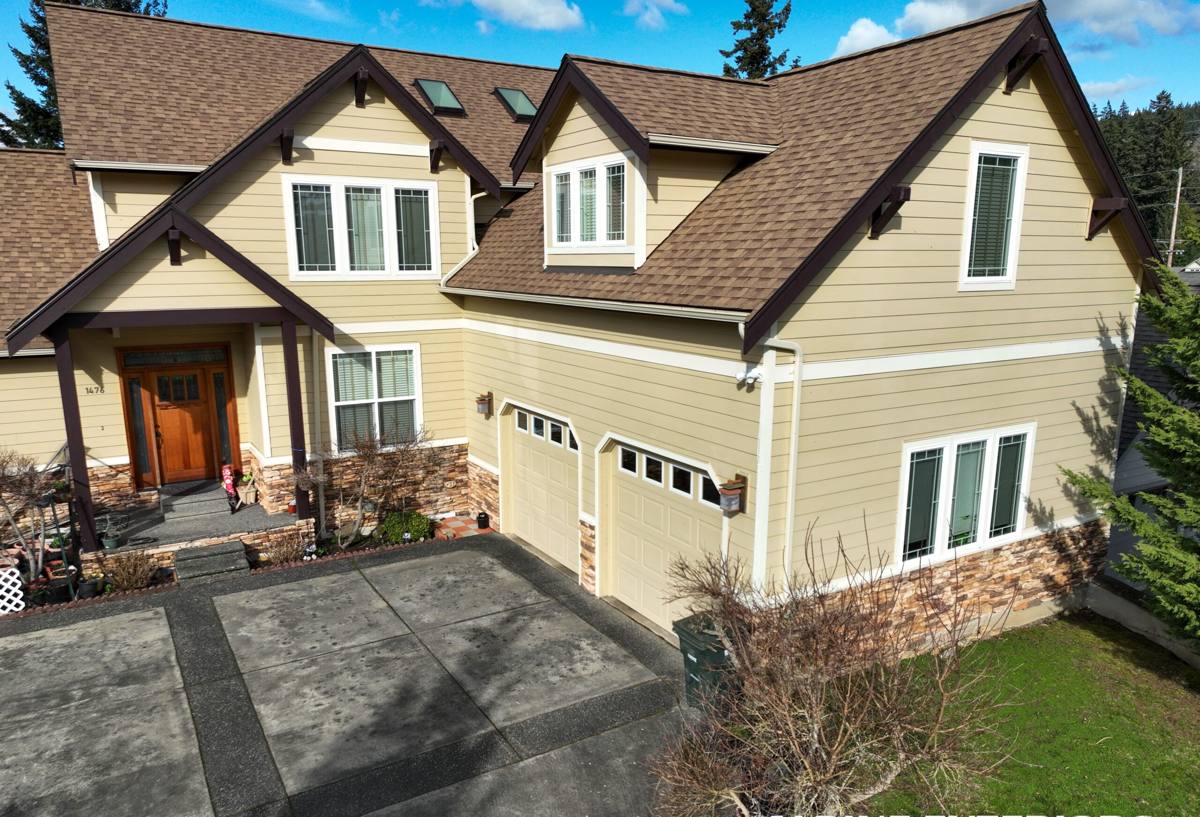
What Salt Air and Driving Rain Actually Do to a Wall
Salt air
Airborne salt is corrosive to exposed metal fasteners, flashing, and trim, and it accelerates the breakdown of finishes that aren't built to handle it. On siding materials that rely on field-applied paint, salt exposure shortens the repaint cycle. On siding with a weak core, salt-driven moisture cycling — wet, dry, wet again — speeds up swelling and delamination at any exposed edge.
Driving rain
Wind-driven rain doesn't just fall on a wall, it gets pushed into laps, seams, and penetrations. A siding system is only as good as its weakest joint. Poor overlap, missing flashing, or caulk used as a substitute for proper detailing will eventually let water behind the cladding — and once water is behind the siding, the sheathing and framing pay the price, not just the finish.
Moss and prolonged dampness
Moss and algae need moisture and shade to establish, and Ferndale's tree cover and marine-layer humidity provide both for a large part of the year. Beyond the cosmetic staining, sustained moss growth holds moisture against the wall surface longer than open air would, which matters most on materials that absorb water at all.
Why We Install James Hardie Fiber Cement — and Nothing Else
We standardized on James Hardie fiber cement siding for every home we side, including here in Ferndale, and we don't install vinyl, LP SmartSide, Cemplank, Allura, or bare cedar or primed spruce. That's not a marketing position — it's a decision based on what holds up under exactly the conditions described above.
Fiber cement is a cement, sand, and cellulose fiber composite. It doesn't have the wood fiber core that engineered wood products rely on, so it isn't vulnerable to the same edge-swelling and moisture-driven failure modes if it's cut, primed, and sealed correctly. It's also non-combustible, which matters given wildfire smoke seasons are becoming a normal part of Pacific Northwest summers, and it holds paint and factory finishes far longer than bare wood products because the substrate itself doesn't move much with moisture.
James Hardie's ColorPlus finish is baked on at the factory under controlled conditions, rather than field-applied on site in whatever weather happens to show up that week. That matters in a climate where a clean, fully-cured paint window can be hard to find between rain systems. Hardie also builds region-specific HZ product lines engineered for moisture exposure like ours, and backs the product with a transferable warranty that's meaningful because the material itself is durable enough to make good on it.
Why we don't install the alternatives
| Product | What it gets right | Why it's a tougher fit for Ferndale's climate |
|---|---|---|
| Vinyl siding | Low upfront cost, low maintenance in mild climates | Panels can warp or rattle loose in sustained wind-driven rain events; seams and J-channels are common water entry points; finish isn't repairable, only replaceable |
| LP SmartSide / engineered wood | Workable, lighter weight, decent value | Wood-strand core is moisture-sensitive at cut edges and seams; consistent performance depends heavily on perfect field sealing, which is hard to guarantee in a wet, salt-air climate |
| Cemplank / Allura fiber cement | Similar composition to Hardie, lower price point | We standardized on one product system, one factory finish process, and one warranty structure so every install and every callback is consistent — splitting between brands undercuts that |
| Bare or primed cedar/spruce | Classic look, renewable material | Requires an ongoing repaint and recaulk cycle that's demanding in a climate with a short dry season and heavy moss pressure |
What a Correct Fiber Cement Install Involves
The siding itself is only part of the system. Most siding failures we get called out to inspect — regardless of brand — trace back to installation shortcuts, not the product. For Ferndale, given the rain exposure, we treat the following as non-negotiable:
- A drainable water-resistive barrier behind the siding, lapped correctly top-to-bottom and sealed at every penetration
- Proper flashing at windows, doors, and any horizontal trim — not caulk used as a flashing substitute
- Correct fastener type and placement per Hardie's engineering specs, sized to resist wind and moisture cycling without splitting the board
- Minimum clearance from grade, decks, and roof lines so the bottom course of siding isn't sitting in a wet zone
- Factory-cut and factory-primed edges used wherever possible, with any field cuts sealed per manufacturer spec before installation
- Correct panel and lap spacing to allow the assembly to shed water rather than trap it
Skip any one of these and you can end up with a product that's rated for the climate but installed in a way that isn't. That's the gap we're closing by only running crews that install Hardie to spec, on every job, not just the ones where it's convenient.
How We Approach a Ferndale Job Specifically
We adjust the plan based on where the house sits and what it's exposed to, which is different house to house even within Ferndale.
Assessment
We look at wall orientation relative to prevailing wind and rain, existing moss or staining patterns, tree cover and shade, and any signs of past moisture intrusion — soft trim, stained sheathing, failed caulk joints — before we ever talk product selection.
Product and detailing selection
We select the Hardie plank profile, exposure, and color system that fits the home, and plan flashing and water-resistive barrier details around the specific exposure risks we found in the assessment — a shaded north wall with moss history gets treated differently than a south-facing wall that mostly deals with sun and wind.
Installation
Crew installs to Hardie's written specifications and local code, with attention to the fastening, flashing, and clearance details covered above. We don't treat those as optional line items to speed up a job.
Final walkthrough
We walk the finished job with the homeowner, confirm caulking and trim details are clean, and go over basic care expectations for the first year.
Living With Fiber Cement Siding Through Ferndale's Moss Season
Correctly installed fiber cement is low-maintenance, not zero-maintenance. In a climate with this much sustained dampness, a little seasonal attention goes a long way toward keeping the finish looking right for the long haul.
- Rinse siding down annually, more often on shaded north- and west-facing walls prone to moss and algae
- Keep gutters clear so overflow isn't running down the wall face during heavy rain events
- Trim back vegetation and tree limbs that keep a wall section shaded and damp longer than the rest of the house
- Inspect and recaulk trim joints periodically — caulk is a maintenance item even on a low-maintenance product
- Address any moss or algae growth early with a gentle wash rather than letting it establish and stain the finish
Why It Matters That We Already Work in Ferndale
A crew that already works Whatcom County homes knows what shows up here — where moss tends to establish first, which wall orientations take the worst of the wind-driven rain, and what past siding failures in this area typically look like when we're called out to assess them. That's not something you get from a general contractor bidding a siding job as a side offering. It shows up in the details: where we add extra flashing attention, how we sequence the water-resistive barrier around a shaded wall, and what we flag for the homeowner during the walkthrough.
Fiber cement siding done right can be one of the lowest-maintenance, longest-performing choices you make on a Ferndale home. Done wrong — wrong fasteners, skipped flashing, unsealed cuts — it can fail in the exact ways this climate is built to expose. The material and the installation both have to hold up their end.
If you're planning a siding project in Ferndale, we're glad to walk the house with you, look at what your specific walls are dealing with, and put together a straightforward, no-pressure estimate — just fill out the form below to get started.