 Bellingham Roofing
 Decks in Happy Valley Face a Different Set of Problems
Happy Valley sits on Bellingham's south side, close to Fairhaven and the WWU campus, and it's a neighborhood defined by hillside lots, mature tree canopy, and a mix of older homes with newer infill construction tucked in between. That combination — shade, slope, and age — changes what a deck needs to hold up here compared to a flat, sun-exposed lot somewhere inland. A deck built without that context in mind usually looks fine for a year or two, then starts showing problems that trace straight back to the design and material choices made on day one.
This page is about one job in one neighborhood: custom deck construction for Happy Valley homes, built around what Bellingham's climate and this specific terrain actually do to a structure over time.
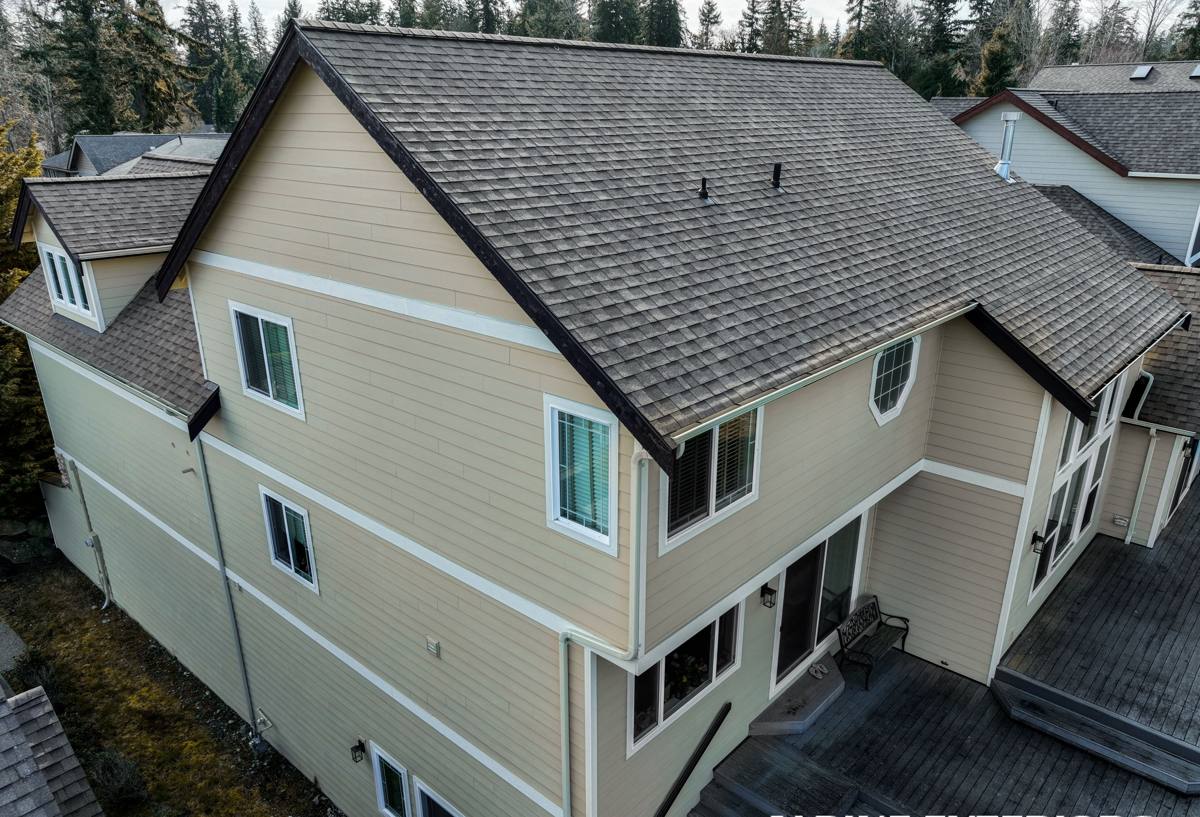
What Bellingham's Climate Does to a Deck
Whatcom County doesn't get the flooding rains of some regions, but it gets steady, driving rain for months at a stretch, plus proximity to Bellingham Bay that puts a fine layer of salt air on everything near the water and, to a lesser degree, across the rest of the city. Add in tree cover — common in Happy Valley — and you get shade that keeps surfaces damp long after the rain stops. That's the recipe for moss, algae, and slow wood rot.
- Moss and algae: shaded, damp decking grows a slick green film if it can't dry out between rain events — a slip hazard as much as a cosmetic one.
- Fastener corrosion: salt-laden air accelerates rust on anything less than a fully rated fastener, showing up first as staining around screw heads and nail pops.
- Hidden rot: the framing and ledger board you don't see are more exposed to failure than the decking boards you do see, because water finds its way behind and underneath long before it shows on the surface.
- Slow drying cycles: a long wet season means any design flaw that traps moisture has months to do damage before summer gives the structure a chance to dry out.
None of this means a deck can't hold up in this climate — it means it has to be designed for these conditions specifically, not built to a generic spec and hoped for the best.
Why Tree Cover Changes the Calculus
A deck under mature trees deals with more than shade. Falling needles, leaves, and organic debris settle into board gaps and railing joints, holding moisture against the wood or composite surface and feeding moss growth even in spots that get some sun. Board spacing, gap width, and how easy the deck is to sweep and rinse all matter more under tree canopy than they do on an open lot.
Choosing the Right Decking Material for This Neighborhood
There's no single "best" decking material — there's a best fit for a given lot, budget, and how much upkeep the owner actually wants to do. In a shaded, damp environment like much of Happy Valley, the honest trade-offs look like this:
| Material | Moisture & moss behavior | Maintenance | Typical lifespan | Relative cost |
|---|---|---|---|---|
| Pressure-treated wood | Absorbs water, prone to moss in shade without regular cleaning | Annual cleaning, periodic sealing | 10-15 years with upkeep | Lowest upfront |
| Cedar | Naturally rot-resistant but still needs airflow and drainage to stay ahead of moss | Cleaning, occasional oiling/staining | 15-20 years with upkeep | Mid-range |
| Composite decking | Doesn't absorb water like wood, but surface film (pollen, moss spores) still needs washing | Periodic rinsing, no sealing/staining | 25-30 years | Higher upfront |
| PVC/capped polymer | Fully sealed surface, most resistant to moisture-driven damage | Occasional cleaning | 25-30+ years | Highest upfront |
We'll walk through this table with actual product samples during your estimate rather than push one option — the right call depends on how much shade your specific lot gets, your budget, and whether you'd rather spend time maintaining a deck or spend more up front to maintain it less.
The Structural Details That Actually Matter
The decking boards get all the attention because they're what you see and walk on, but the framing underneath is what determines whether the deck is still safe in ten years. This is where corners get cut on decks that fail early, and it's the part homeowners can't easily inspect themselves once the boards are down.
Ledger Board Flashing
Where the deck attaches to the house is the single most common failure point on any deck in a wet climate. Without proper flashing — metal or membrane flashing installed to shed water away from the ledger board and the house's wall assembly behind it — water works its way in behind the siding and rots the rim joist and sheathing from the inside, often for years before it's visible from outside.
Footings and Frost Depth
Footings need to be sized and set to the depth required by local code, on undisturbed or properly compacted soil. On hillside lots, that also means accounting for slope and drainage so a footing isn't sitting somewhere water pools after every storm.
Joist Spacing and Species
Joist spacing has to match the decking material's span rating — composite and PVC boards often require tighter joist spacing than solid wood decking, and using a wood-spec layout under composite boards is a common source of bounce and premature sagging.
Fasteners and Hardware
In a coastal-influenced climate, hardware rated for the environment isn't optional. That means stainless steel or coated fasteners rated for ground contact and exterior exposure, hot-dip galvanized or stainless structural connectors, and hardware compatible with whatever decking material is installed — some composite manufacturers specify particular fastener types to avoid staining or reacting with the board's coating.
Drainage, Airflow, and Keeping Moss Off the Surface
A deck's ability to dry out between rain events matters as much as what it's built from. We look at three things on every project:
- Slope away from the house: the deck surface should shed water outward, not pool against the ledger board or house wall.
- Airflow underneath: enough clearance and, where the deck is low to the ground, venting so the framing can dry rather than sitting in trapped moisture.
- Board gapping: correct spacing between boards so water drains through rather than sitting on the surface, especially under tree cover where debris collects in the gaps.
Skipping any of these doesn't cause an obvious problem on day one — it shows up two or three wet seasons later as soft spots, persistent moss, or a musty smell coming from underneath the deck.
Railings and Hardware Built for the Conditions
Railings take a lot of the same punishment as the deck frame, plus they're handled constantly, so any corrosion or loosening shows up fast. We spec railing hardware and post connections to the same standard as the structural fasteners below the decking — rated for exterior, damp-climate exposure — and we make sure post-to-frame connections are through-bolted into properly blocked framing rather than just screwed into a rim joist that wasn't built to take the load.
Permits: Whatcom County and City of Bellingham Requirements
Most custom deck projects in Bellingham require a building permit, and requirements can vary depending on deck height, size, and whether it's attached to the house. We handle the permit application and inspection scheduling as part of the project rather than leaving it to the homeowner to sort out — it's part of what "custom deck construction" should mean, not an add-on. If your Happy Valley property has any slope, retaining wall, or setback considerations, that gets factored into the plan before we ever apply for the permit, not discovered partway through the build.
How We Approach a Happy Valley Deck Project
- On-site assessment: we look at sun/shade exposure, slope, existing structure (if replacing a deck), and how the house's siding and flashing meet the proposed ledger location.
- Material walkthrough: we go over wood, composite, and PVC options against your budget and how much maintenance you actually want to take on.
- Design and permit submission: framing plan, footing layout, and railing design get drawn up and submitted to the city or county as required.
- Construction: footings, framing, ledger flashing, decking, and railings — built in that order, with flashing and structural connections done to hold up specifically in this climate, not to a bare-minimum code pass.
- Final walkthrough: we go over drainage, gaps, and any maintenance the specific material you chose will need going forward.
Working this neighborhood regularly means we already know what a Happy Valley lot's slope, shade, and tree cover usually mean for a deck build — we're not learning the terrain on your project.
A Maintenance Checklist Worth Following
Whatever material you choose, a little seasonal attention goes a long way in this climate:
- Sweep leaves and needles out of board gaps before they compact and hold moisture
- Rinse the deck surface a few times a year, more often under heavy tree cover
- Check the ledger board area annually for staining, soft wood, or gaps in flashing
- Look underneath the deck once a year for standing water or poor airflow
- Re-seal or re-stain wood decking on the schedule the product calls for — don't wait for visible fading
- Tighten or replace any railing hardware showing early rust or looseness
If you're weighing a new custom deck or a replacement for one that's showing its age, we're glad to walk your property, talk through material options honestly, and give you a straightforward estimate — no pressure, no upsell script. The form below gets that conversation started.