 Bellingham Roofing
 Why Ferndale's Climate Is Hard on Siding
Ferndale sits close enough to Bellingham Bay and the Strait of Georgia that salt-laden air is a real factor in how exterior materials age here, not a theoretical one. Add Whatcom County's long wet season, driving rain off the water, and the shaded, damp conditions that keep moss and algae established on north- and west-facing walls for much of the year, and you have a climate that is genuinely tough on siding. Materials that perform fine in a drier climate often show their weaknesses fast in a place like this: swelling at seams, paint failure, soft spots at the bottom courses, and moss staining that never fully washes off.
This isn't a reason to panic about your siding — it's a reason to be deliberate about what goes on the house and how it's installed. Siding on a Ferndale home needs to shed wind-driven rain, resist moisture absorption at the most vulnerable points (butt joints, corners, and the bottom few inches near grade), and hold its finish without constant repainting. That's the standard we hold every Hardie installation to, and it's why we don't offer alternatives that don't hold up as well under these specific conditions.
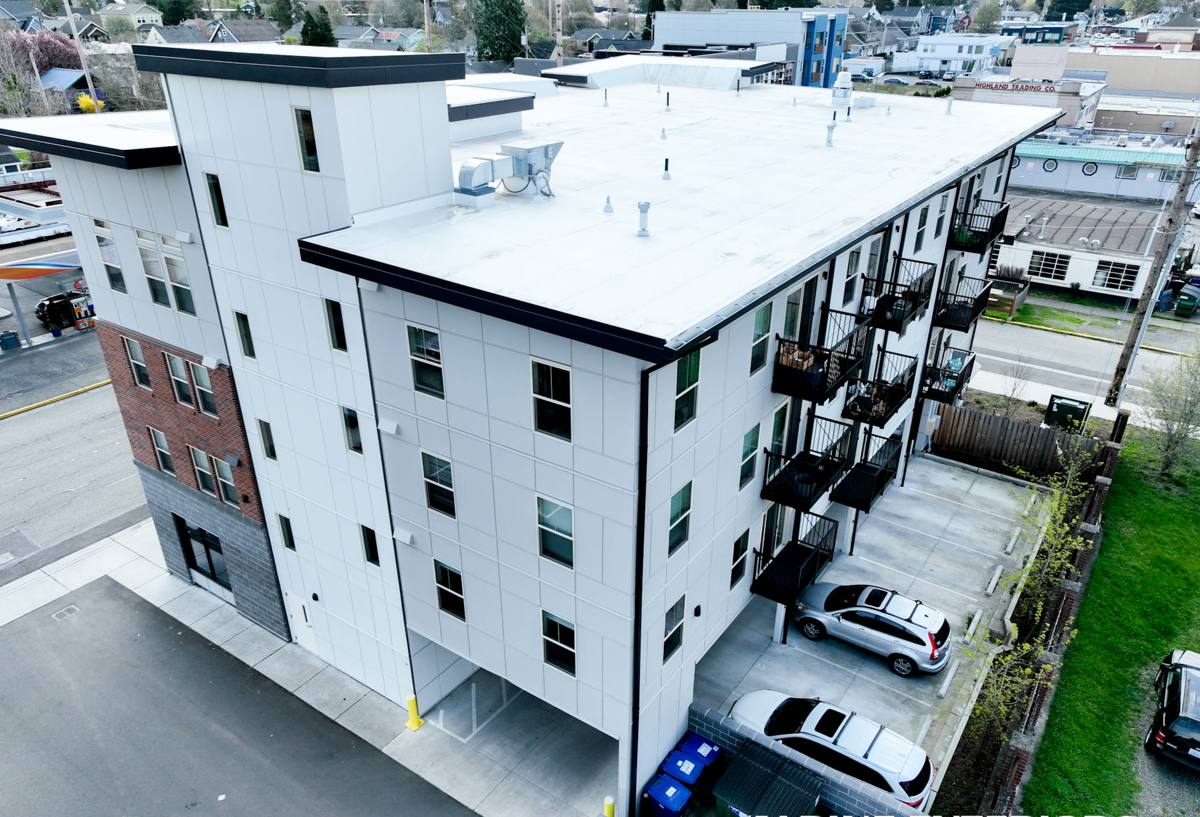
Why We Install James Hardie and Nothing Else
We only install James Hardie fiber cement siding. We don't offer vinyl, LP SmartSide, Cemplank, Allura, primed spruce, or cedar, and that's a deliberate choice, not a limitation of what we're capable of installing. Each of those products has legitimate strengths, but each also carries a trade-off — moisture sensitivity at cut edges, seam and expansion behavior, a maintenance schedule that's hard to keep up with in a wet coastal climate, or a finish that fades and chalks faster than homeowners expect. In a climate like Ferndale's, those trade-offs show up sooner and cost more to manage over the life of the siding.
James Hardie fiber cement doesn't have those same weak points. It's non-combustible, it doesn't swell or rot the way wood-based products can, and its factory-applied ColorPlus finish is engineered to hold color and resist the kind of fading and cracking that shows up on field-painted siding within a few years in a marine climate. That's the reason we standardized on one product line instead of offering a menu of options — we'd rather install one system correctly and stand behind it than install several and hope each one performs.
The HZ5 Product Line
James Hardie engineers its siding by climate zone, and the Pacific Northwest falls into the HZ5 category — the line built for regions with sustained moisture, freeze-thaw cycling, and coastal exposure. HZ5 panels and lap siding are formulated and tested for exactly the conditions Ferndale sees: extended wet seasons, wind-driven rain, and the humidity that keeps moss and mildew active on exterior walls for much of the year. This isn't a marketing distinction — it affects the product's moisture resistance and how it's rated to perform over time in this specific climate.
ColorPlus Factory Finish
Field-applied paint is one of the more common failure points on siding in this region, because it's applied on-site under whatever weather conditions happen to be available and it's only as good as the prep work and the coat thickness. ColorPlus finish is baked on at the factory under controlled conditions, with a multi-coat process that's more consistent than what's achievable in the field. The result is a finish that holds its color and resists cracking and chipping longer, which matters in a climate that gives painted surfaces a hard time.
What a Correct Installation Involves
Fiber cement siding is only as good as the installation underneath it. The material itself resists moisture well, but a siding system fails at its weak points — the seams, corners, and penetrations — if those details aren't handled correctly. This is where a lot of installations go wrong, and it's where the difference between a correct job and a fast one shows up years later.
Moisture Management Details
- A drainable water-resistive barrier behind the siding, not just wrapped and stapled flat, so any moisture that gets behind the cladding has somewhere to go
- Proper flashing at every window, door, and roof-to-wall transition, installed to shed water outward and downward, not just caulked over
- Correct clearance between the bottom of the siding and grade, decks, patios, and roof lines, so the lowest courses aren't sitting in standing moisture
- Factory-cut edges primed and sealed at every field cut, since an unsealed cut edge is the most common point of moisture intake on fiber cement
- Fastener placement and spacing to manufacturer spec, so panels aren't over- or under-driven in a way that cracks the material or leaves gaps
Common Installation Mistakes We See
The most frequent problems we run into on homes that had fiber cement installed by a crew unfamiliar with the product are unsealed cut edges, siding installed tight to grade or a deck surface with no drainage gap, and caulk used in place of proper flashing at penetrations. None of these are visible from the curb the day the job finishes. They show up two, five, or ten years later as staining, soft spots, or paint failure at specific points on the house — almost always the same points, because they're the same mistakes repeated house to house.
Comparing Siding Options for a Ferndale Home
Homeowners often ask us to explain, in plain terms, why fiber cement costs more upfront than vinyl or engineered wood. The table below reflects the real trade-offs we see in this climate specifically — not a general national comparison.
| Factor | James Hardie Fiber Cement | Vinyl | Engineered Wood / Cedar |
|---|---|---|---|
| Moisture resistance in wet coastal climate | High — engineered for this climate zone | Good, but seams and panel expansion can trap moisture | Moderate — vulnerable at cut edges and untreated surfaces |
| Finish durability | Factory-baked finish, long color retention | Color molded in but can fade and chalk | Field-applied paint or stain, shorter repaint cycle |
| Fire resistance | Non-combustible | Combustible | Combustible |
| Moss and algae resistance | Resists staining better; finish sheds growth more easily | Can stain in shaded, damp areas | Prone to moss and mildew without regular treatment |
| Typical maintenance | Occasional wash, repaint on a much longer cycle | Low, but damage (cracks, warping) isn't repairable, only replaceable | Regular repainting/staining and edge sealing |
| Upfront cost | Higher | Lower | Moderate |
Our Process for Ferndale Projects
Every siding project we take on in the Ferndale area follows the same sequence, because skipping steps is where problems start.
- On-site assessment: we inspect the existing siding, sheathing, and any signs of past moisture intrusion before quoting anything, since what's underneath the current siding affects the scope of the job.
- Tear-off and sheathing check: old siding comes off and we inspect the sheathing for rot or damage, repairing or replacing anything compromised before new material goes on.
- Water-resistive barrier and flashing: a drainable barrier goes on first, followed by flashing at every window, door, and transition point.
- Hardie installation: panels and trim installed to manufacturer spec, with every cut edge primed and sealed on site.
- Final inspection and walkthrough: we walk the finished job with the homeowner and go over what was done and what to expect going forward.
Why a Crew That Already Works Ferndale Matters
Siding installation isn't one-size-fits-all across Whatcom County. A crew that regularly works homes near Bellingham Bay and the Ferndale area already knows to plan around the wetter stretches of the year, knows which details on a house need extra attention because of consistent wind-driven rain, and isn't learning the region's quirks on your project. That familiarity shows up in scheduling around weather windows, in how flashing details are handled on homes exposed to salt air, and in catching moss and moisture issues on the existing structure before they get sealed behind new siding.
It also matters for accountability. A local crew is still around the following winter, and the one after that, if something needs a look. That's a meaningful difference from a crew that's in and out of the area for a single job.
Keeping James Hardie Siding Looking Right in This Climate
Fiber cement is low-maintenance compared to painted wood, but "low-maintenance" doesn't mean "no maintenance" in a climate like this one. A short annual routine keeps a correctly installed Hardie exterior performing the way it's designed to.
- Rinse the siding once or twice a year, focusing on shaded, north-facing walls where moss and algae tend to establish first
- Check caulking around windows, doors, and trim annually and re-caulk any joints that have cracked or pulled away
- Trim back vegetation and tree limbs that keep sections of the wall shaded and damp longer than the rest of the house
- Keep gutters clear so overflow isn't running directly down the siding face during heavy rain
- Watch the bottom courses near grade, decks, and patios for staining, which usually signals a drainage or clearance issue worth addressing early
What Affects the Cost of a Ferndale Siding Project
Every house is different, so we don't quote broad numbers without seeing the property, but a few factors consistently drive cost on jobs in this area: the condition of the sheathing underneath the existing siding, the complexity of the roofline and number of window and door openings that need flashing, the height and accessibility of the walls, and whether the ColorPlus factory finish or a field-applied finish is chosen for trim details. Homes with existing moisture damage from a prior siding failure typically cost more, since that repair work happens before any new siding goes on — which is exactly why the assessment step in our process matters.
If you're planning ahead for a siding project on a Ferndale home, we're glad to walk through the specifics with you. We offer a free, no-pressure estimate — take a look at the form below to get started.