 Bellingham Roofing
 South Hill's Siding Problem Isn't Like Everywhere Else
South Hill sits close enough to Bellingham Bay that homes here take a steady dose of salt-laden air on top of everything else Whatcom County weather throws at a house. That combination — salt air, wind-driven rain off the water, and a moss season that can run most of the year in the shade of mature trees — is harder on exterior siding than a straightforward rain climate alone. Salt air accelerates corrosion on exposed fasteners and trim metal. Driving rain doesn't just fall on a wall, it gets pushed sideways into laps, seams, and butt joints. And moss doesn't just look bad; it holds moisture against a wall surface for weeks at a time, which is exactly the condition that rots wood-based siding and delaminates cheaper composite products.
None of that is a reason to avoid siding your home well. It's a reason to be specific about what product goes up and how it's installed. This page is about one job: James Hardie fiber cement siding, installed correctly, on South Hill homes.
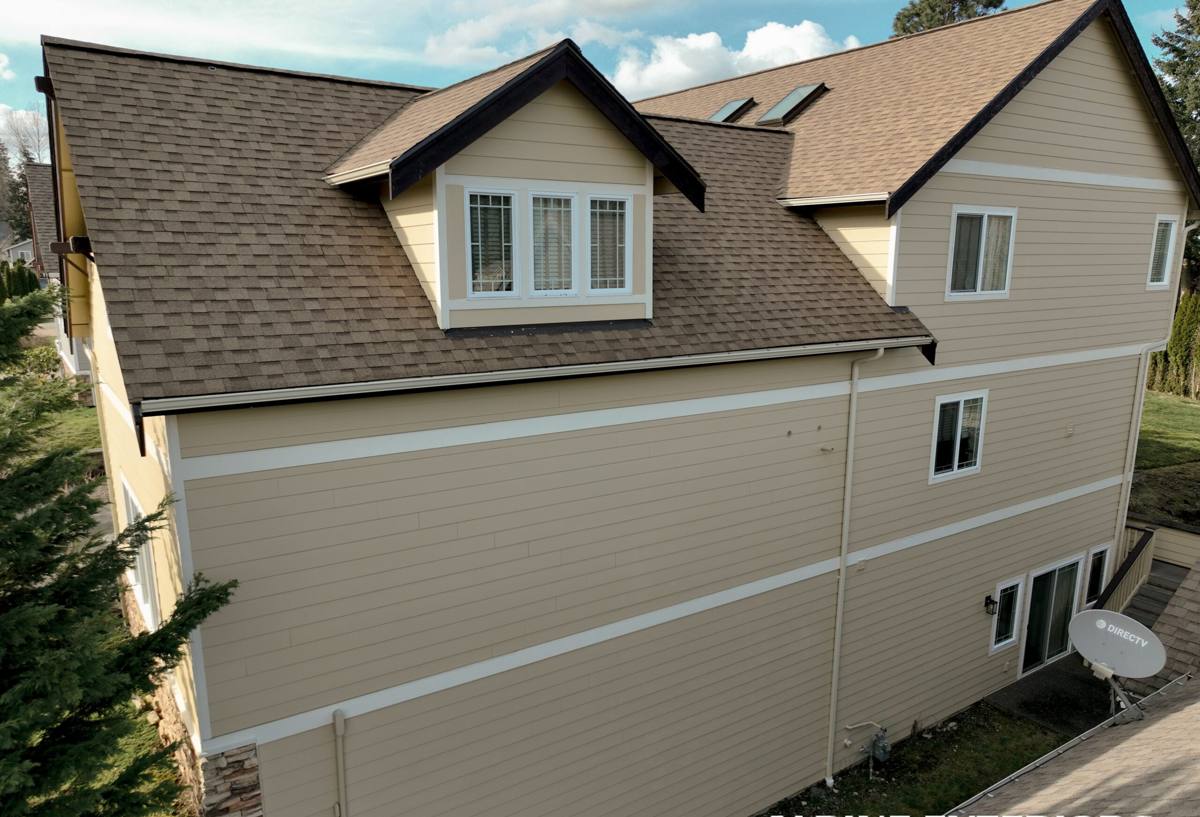
Why We Install Only James Hardie Here
We don't install LP SmartSide, vinyl, Cemplank, Allura, primed spruce, or cedar. That's not a marketing position — it's a decision we made after weighing how each of those products actually performs over 20-30 years in a wet, salt-influenced Pacific Northwest climate versus how James Hardie performs. Wood-based products like primed spruce and engineered wood siding depend entirely on paint film and caulk staying intact to keep moisture out; once that seal fails at a cut edge or fastener hole, the substrate itself is organic material that can absorb water and break down. Cedar is a beautiful natural material but it's also organic, requires ongoing refinishing, and is a known fuel source in wildfire-adjacent conditions. Vinyl is low-maintenance in the sense that it doesn't rot, but it's a thin plastic product that can warp, fade, and crack, and it doesn't hold paint if a homeowner ever wants to change the color.
James Hardie fiber cement is cement, sand, and cellulose fiber — it's non-combustible, it doesn't absorb water the way wood does, and it holds its factory-baked ColorPlus finish far longer than field-applied paint on other substrates. Hardie also engineers specific product formulations for different climate zones, and the HZ5 line used throughout Western Washington is built around exactly the moisture exposure South Hill homes deal with. That's the whole reason we standardized on one manufacturer instead of offering a menu of siding options.
What Hardie Gets Right for This Kind of Exposure
- Fiber cement doesn't rot, and it isn't a food source for moss or mildew the way wood-based siding can be
- The ColorPlus factory finish is baked on under controlled conditions, so it resists the fading and chalking that field-applied paint shows first on salt-exposed elevations
- HZ5 formulation is engineered for wetter, harsher climates rather than a one-size-fits-all national product
- Fiber cement holds a straight, tight reveal over time instead of warping the way vinyl or lower-grade composites can in temperature swings
What "Correct" Installation Actually Means
James Hardie siding is only as good as the installation behind it. The product itself is durable, but the water-management details — flashing, gapping, fastener placement, and the weather-resistive barrier underneath — are what actually keep a South Hill home dry through decades of driving rain. This is where a lot of siding jobs go wrong, and it's rarely visible until years later when moisture has already gotten behind the cladding.
The details that matter most in this climate
- Weather-resistive barrier and flashing come first. Every window, door, and penetration needs proper head flashing and a correctly lapped barrier underneath the siding — the siding is the second line of defense, not the only one.
- Manufacturer-specified gaps at butt joints and trim. Hardie's installation guidelines call for small gaps at panel ends and trim to allow for expansion and to let any incidental moisture drain rather than wick.
- Correct fastener type, spacing, and placement. In a salt-air environment, fastener corrosion resistance matters more than it does further inland — the wrong fastener can bleed rust streaks and lose holding power years before the siding itself would fail.
- Proper clearance at grade and roof lines. Siding installed too close to the ground, a deck, or a roof surface stays wet longer and is more likely to wick moisture, especially where moss and organic debris tend to collect.
- Caulking only where Hardie's specs call for it — not as a substitute for correct flashing. Caulk is a maintenance item that eventually fails; flashing done right doesn't depend on it.
Any crew can nail up Hardie boards. Doing the water management correctly underneath them is the part that determines whether a homeowner is dealing with a trim rot problem in twelve years or not.
Product Lines and What Fits a South Hill Home
James Hardie makes several profiles, and the right one depends on the home's architecture and how it's currently detailed. We walk through this with every homeowner rather than defaulting to one product.
| Product | Look | Where It Fits Best |
|---|---|---|
| HardiePlank lap siding | Traditional horizontal lap, smooth or cedar-textured | Most common choice; fits traditional and craftsman-style homes throughout the neighborhood |
| HardiePanel vertical siding | Clean vertical panels, often with battens | Board-and-batten look, accent gables, modern or farmhouse-influenced homes |
| HardieShingle siding | Staggered or straight-edge shingle profile | Character homes wanting a shingle look without cedar's maintenance burden |
| HardieTrim boards | Smooth or textured trim stock | Corners, window and door surrounds, fascia — matched to the siding system |
Color is a real decision, not an afterthought. ColorPlus finishes are baked on at the factory in a range of tones designed to hold up outdoors, which matters on elevations that get direct salt spray and sun. We'll also talk through where a lighter versus darker color makes sense given a specific elevation's sun and rain exposure.
Our Process on a South Hill Project
- On-site assessment. We look at the existing siding and sheathing condition, trim details, roofline and deck clearances, and any moss or moisture staining that points to a trouble spot.
- Scope and product plan. We specify the Hardie product lines, trim details, and color, and walk through the water-management plan for the tricky spots — window heads, deck ledgers, roof-to-wall transitions.
- Written estimate. Clear scope, product specification, and price — no vague allowances.
- Removal and inspection. Old siding comes off and we inspect the sheathing underneath before anything new goes up. If there's rot or moisture damage, we address it before covering it back over.
- Weather barrier and flashing installation. This is the step that actually protects the home long-term, done to manufacturer spec, not shortcuts.
- Hardie installation. Correct gapping, fastening, and trim work, following James Hardie's published installation guidelines.
- Final walkthrough and warranty paperwork. We review the completed work with the homeowner and register the manufacturer's transferable warranty.
What Drives Cost on a Project Like This
Every home is different, so we don't quote a per-square-foot number without seeing the house, but these are the factors that actually move the price on a South Hill Hardie project:
| Factor | Why It Matters |
|---|---|
| Existing siding removal and sheathing condition | Hidden rot or moisture damage found during tear-off has to be repaired before new siding goes on |
| Home size and wall complexity | Multiple gables, dormers, and cut-ins take more labor and trim work than a simple rectangular wall |
| Product line and profile | Lap, panel, and shingle profiles differ in material and labor time; trim scope adds up separately |
| Story height and access | Multi-story sections and difficult access require additional staging and time |
| Window and door count | Every opening needs flashing and trim detail, so more openings mean more labor |
| Color and finish selection | Standard ColorPlus colors versus custom-order options can affect lead time and cost |
Why Hiring Local Experience Matters Here
South Hill's older homes and mature tree canopy create conditions a lot of siding crews don't see every day: shaded walls that stay damp longer, established landscaping close to the foundation, and homes with decades of prior repairs and additions that need to be understood before new siding goes over them. A crew that already works this neighborhood recognizes those patterns quickly instead of treating every job as a blank slate. That matters for things like knowing where moss buildup usually signals a drainage or clearance problem, or spotting where a prior remodel left a flashing detail that needs correcting rather than covering up.
It also matters for accountability. A company that installs Hardie siding throughout Bellingham and the surrounding Whatcom County area has a reputation riding on every job holding up through the next twenty winters of driving rain off the bay — not just passing a walkthrough on installation day.
Living With Hardie Siding in a Moss-Prone, Salt-Air Climate
Correctly installed James Hardie siding is genuinely low-maintenance, but "low-maintenance" doesn't mean zero attention, especially in this environment. A few habits keep it performing the way it's designed to:
- Keep gutters clear so overflow doesn't run down the wall face repeatedly in the same spot
- Trim back vegetation and tree limbs that keep a wall section shaded and damp longer than the rest of the house
- Rinse off built-up grime or salt residue on exposed elevations periodically rather than letting it sit indefinitely
- Have moss or algae growth on siding addressed early rather than left to spread, even though fiber cement itself isn't a food source for it
- Have caulking at trim joints checked periodically, since caulk is a maintenance item even when the flashing behind it is done right
None of that is heavy upkeep — it's the same basic exterior care any well-maintained home needs, and it goes a lot further on a product that isn't fighting rot or paint failure at the same time.
Get a Straight Answer for Your Home
If you're weighing a siding project on South Hill, we're happy to come take a look, walk you through what your specific home needs, and give you a straightforward, no-pressure estimate — no upsell into a product line we don't stand behind. Fill out the form below to get started.