 Bellingham Roofing
 Composite Decking Built for Sehome's Climate, Not Just Its Curb Appeal
Sehome sits close enough to Bellingham Bay and the surrounding wooded slopes that a deck here deals with a specific combination of punishment: salt-laden air drifting up from the water, long stretches of driving rain through fall and winter, and a moss season that can run half the year in shaded yards. A deck board that performs fine in a dry inland climate can still fail early in this neighborhood if it's chosen or installed without that combination in mind. This page is about composite decking specifically for Sehome homes — what the local conditions demand, what a correct installation actually involves, and why a crew that already works this part of Bellingham catches problems that an out-of-town installer might miss.
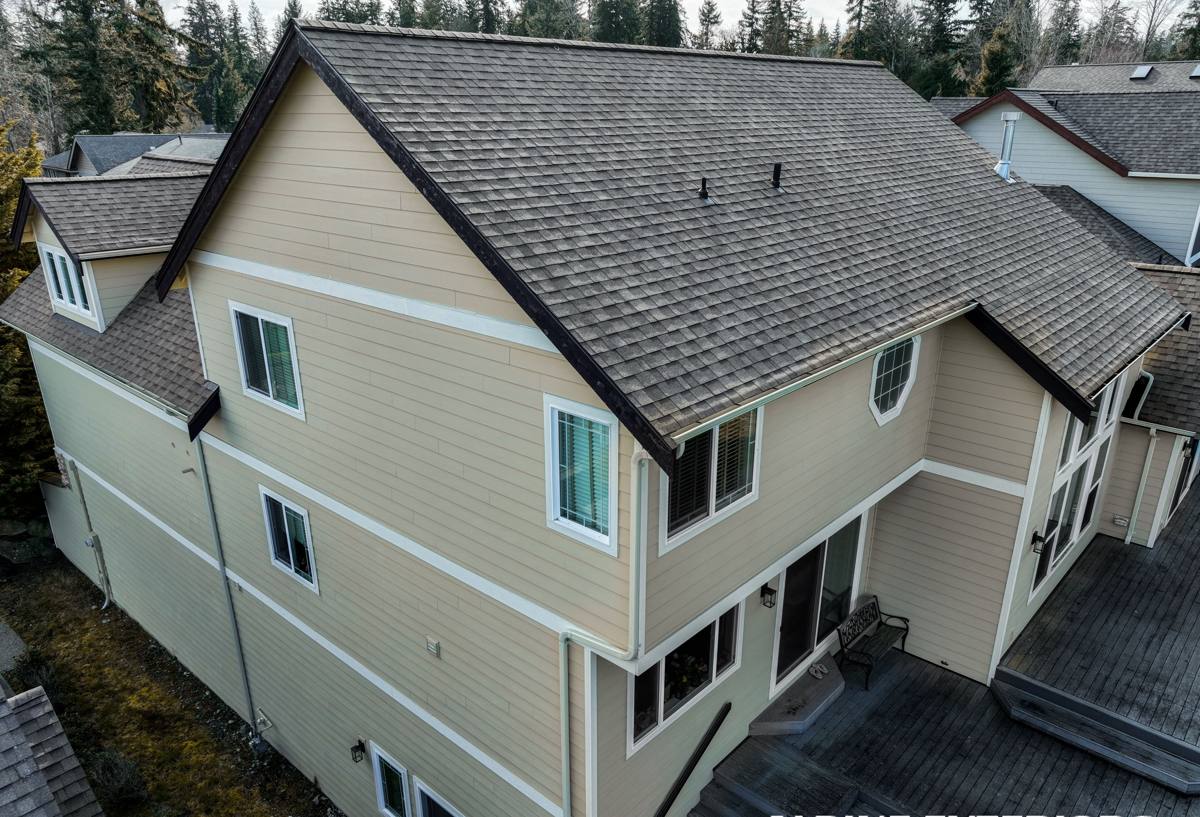
Why Composite Makes Sense Here
Composite decking — a blend of wood fiber and recycled plastic, typically capped with a protective polymer shell — was developed largely to solve the problems that wood decks run into in wet, moderate climates like ours. In Whatcom County, the appeal isn't cosmetic. It's about reducing the maintenance burden that comes with year-round moisture exposure.
What It Solves
- No annual staining or sealing to keep water out of the board
- Capped boards resist the surface moisture that feeds mold and moss growth
- Consistent density means no soft spots forming from repeated wet-dry cycling
- Color and grain hold up under the gray, low-UV light typical of a Bellingham winter
What It Doesn't Solve
Composite is not maintenance-free, and we won't sell it that way. It still needs periodic cleaning to keep organic buildup from taking hold in shaded, damp corners — which describes a lot of yards in this neighborhood. It also depends entirely on what's underneath it. A composite deck installed over undersized framing or poor drainage will fail the same way a wood deck would, just more slowly and less visibly, since the surface hides what's happening below it.
What Salt Air and Moss Actually Do to a Deck
Homeowners often assume the deck surface is the only thing at risk. In practice, the components most likely to fail first are the ones you don't see.
Salt Air and Fasteners
Airborne salt from the bay accelerates corrosion on standard fasteners and connectors faster than it degrades the decking material itself. A screw or joist hanger rated for general exterior use can start corroding years before the board above it shows any wear. Once a fastener weakens, the board can loosen, squeak, or shift — and by the time that's visible, the hardware underneath has usually been compromised for a while.
Moss and Trapped Moisture
Bellingham's moss season isn't just an aesthetic issue. Moss and algae hold moisture against the board surface and in the gaps between boards, which slows drying time after every rain. On composite decking, this mostly affects surface grip and appearance rather than structural integrity, since the capped shell resists absorption — but on the framing underneath, especially at ledger boards and joist tops that don't get airflow, that same trapped moisture is exactly what leads to rot in structural lumber over time.
Driving Rain and Water Direction
Storms in this area rarely fall straight down. Wind-driven rain pushes water sideways under railings, against house walls, and into ledger connections — the single most common failure point on any deck attached to a house. If flashing and drainage at that connection aren't done correctly, water finds its way in regardless of how good the decking surface is.
What a Correct Installation Actually Involves
The decking boards themselves are the easiest part of this job. The framing, drainage, and connection details are where a deck's real lifespan gets decided.
Framing and Structure
Composite boards are heavier than wood and behave differently under load and temperature swings, so joist spacing has to match the manufacturer's engineering specs for that specific product — not generic wood-deck spacing. We check span ratings before we ever set a board.
Ledger Attachment and Flashing
Where the deck meets the house is the highest-risk point for water intrusion in our climate. Correct flashing directs water away from the house framing rather than letting it pool at the connection. This detail matters more in Whatcom County than in drier regions, simply because of how much rain that joint sees over a year.
Fastener and Hardware Selection
Given the salt air exposure in Sehome, we use corrosion-resistant fasteners and structural hardware rated for coastal or wet-climate exposure, not the minimum-grade hardware that passes in a dry inland install. This is one of the cheapest parts of the job to get right and one of the most expensive to fix later.
Drainage and Airflow Underneath
A deck built low to the ground or over poorly graded soil traps moisture underneath with nowhere to go. We look at grading, gaps, and ventilation under the structure so air can actually circulate and moisture doesn't sit against the joists after every rain.
Board Spacing and Expansion
Composite boards expand and contract with temperature more than people expect. Gapping them incorrectly leads to buckling in warm stretches or excessive gapping in cold, damp weather — both of which show up within the first year or two if spacing wasn't calculated for the specific product and the season it was installed in.
Comparing Decking Options for a Sehome Property
| Factor | Composite (capped) | Pressure-Treated Wood | Uncapped Composite |
|---|---|---|---|
| Moisture resistance | High — capped shell resists absorption | Moderate — depends on ongoing sealing | Moderate — more prone to surface wicking |
| Moss/algae resistance | Good, still needs periodic cleaning | Poor without regular treatment | Fair — more porous surface |
| Annual maintenance | Occasional cleaning | Staining/sealing every 1-2 years | Occasional cleaning, more surface care |
| Upfront cost | Higher | Lowest | Mid-range |
| Long-term cost in this climate | Lower over 15-20 years | Higher due to upkeep and earlier replacement | Moderate |
| Fastener/hardware sensitivity | Standard, but salt air still demands corrosion-resistant hardware | Same salt-air hardware concern applies | Same salt-air hardware concern applies |
The honest takeaway: composite costs more upfront, but in a neighborhood dealing with salt air, sustained rain, and heavy moss growth, the reduced maintenance burden and slower degradation usually make it the better long-term value — provided the framing and hardware underneath are done to match.
Our Process on a Sehome Deck Project
- On-site assessment — we look at sun exposure, shade patterns, drainage slope, and proximity to the water, since these vary block to block in this neighborhood
- Structural evaluation — checking existing framing (on replacement projects) or planning new framing to the correct span and load specs for the composite product chosen
- Material selection — matching board profile and color to the home, with an honest conversation about maintenance expectations for that shade and finish in a moss-prone yard
- Ledger and flashing work — the connection to the house is treated as the top-priority detail, not an afterthought
- Framing and fastening — corrosion-resistant hardware throughout, spacing set for the specific product's expansion behavior
- Decking installation — boards set with correct gapping for our seasonal temperature range
- Final walkthrough — reviewing drainage, railing attachment, and stair connections before we call the job done
A Pre-Project Checklist for Sehome Homeowners
- Ask whether fasteners and hardware are rated for coastal/salt-air exposure — not just standard exterior grade
- Confirm joist spacing will be set to the composite manufacturer's span rating, not generic lumber spacing
- Ask how the ledger-to-house connection will be flashed and sealed
- Check how the crew plans to handle drainage and airflow underneath the deck given your yard's grading
- Get board spacing explained in terms of expansion — not just "standard gap"
- Ask what the manufacturer's warranty actually covers versus what's covered by workmanship
Why Hiring a Crew That Already Works in Sehome Matters
A lot of what determines whether a deck lasts in this neighborhood isn't in the product spec sheet — it's local knowledge. Knowing which yards hold moisture longer because of tree cover, which blocks get more direct salt-air exposure, and how Whatcom County's rain patterns hit a ledger connection over a full winter isn't something you get from a manufacturer's install guide. It comes from having done this work, on homes like this one, in this climate, repeatedly. A crew that's unfamiliar with Bellingham's coastal-adjacent conditions may still build a technically code-compliant deck — but "compliant" and "built for this specific climate" aren't always the same thing.
What This Means for Your Deck's Lifespan
None of this is about scaring anyone into overbuilding a simple deck. It's about matching the materials and details to what Sehome's climate actually demands, so the deck you pay for once doesn't need major repair in year six because of a corroded joist hanger or a poorly flashed ledger. Composite decking, installed correctly for this environment, is a straightforward way to get a deck that holds up to salt air, rain, and moss season without turning into a maintenance project every spring.
If you're weighing a new composite deck or replacing an aging one in Sehome, we're happy to take a look and walk through what your specific yard and sun/shade conditions call for. There's no pressure and no cost to get our honest read — just fill out the form below to schedule a free estimate.