 Bellingham Roofing
 Sehome's Siding Has to Fight a Three-Front Battle
Sehome sits close enough to Bellingham Bay to catch salt-laden air off the water, close enough to Sehome Hill's tree canopy to stay shaded and damp for long stretches, and squarely in the path of the driving, wind-blown rain that rolls through Whatcom County most of the year. That combination is rougher on exterior siding than any one of those factors alone. Salt air accelerates corrosion on fasteners and hardware. Shade from mature trees keeps siding wet longer after every storm, which is exactly what moss, algae, and mildew need to take hold. And driving rain doesn't fall straight down — it gets pushed sideways into laps, seams, and trim joints where lesser materials eventually let it in.
None of this means Sehome is a bad place to own a home with wood-look siding. It means the siding has to be the right material, installed the right way, by a crew that understands what this specific neighborhood does to a building envelope over time. That's the whole focus of this page.
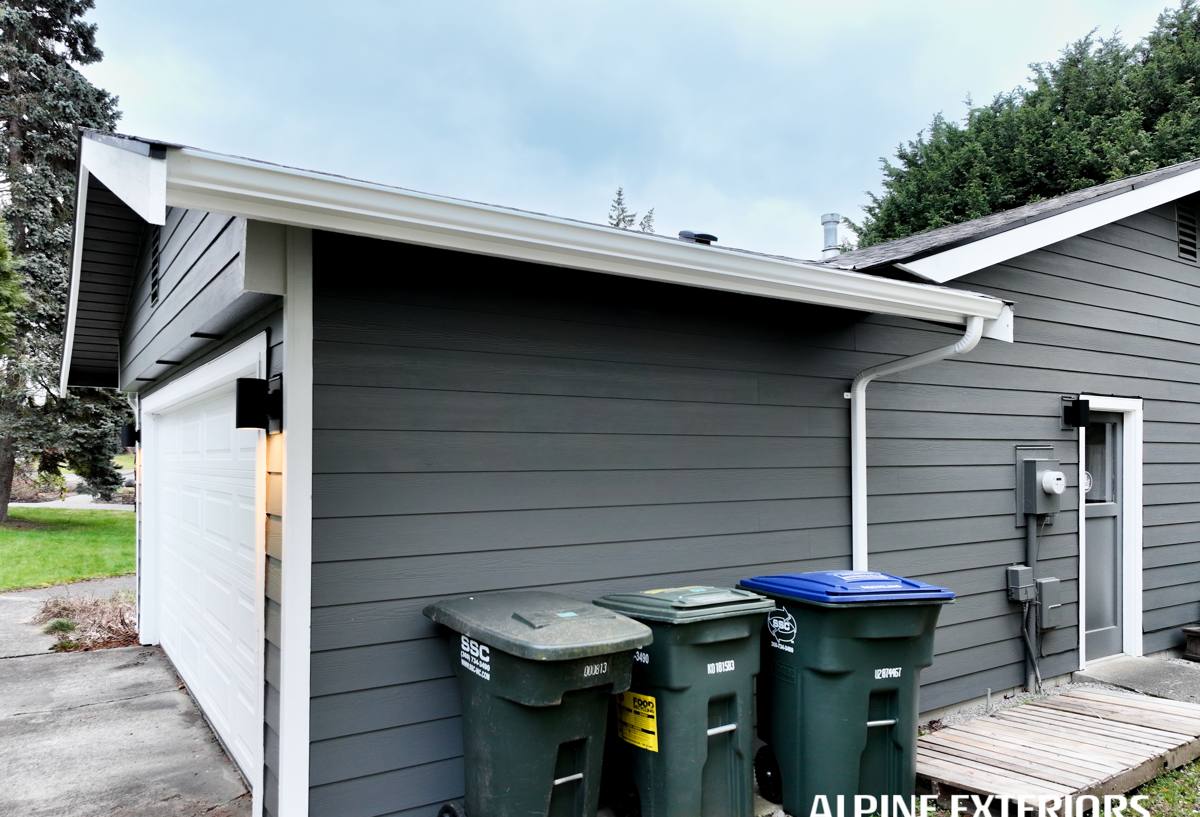
What "Correct" Siding Installation Actually Means Here
A lot of siding problems in this region aren't material failures — they're installation failures. The siding itself might be fine; the water management behind it wasn't. In a climate like Bellingham's, the assembly behind the visible boards matters as much as the boards themselves.
The water-resistive barrier and flashing
Every penetration — windows, doors, hose bibs, light fixtures, vents — needs proper flashing integrated with a continuous weather-resistive barrier underneath the siding. Skip this, or overlap it wrong, and water finds its way behind the cladding regardless of how good the siding itself is. This is where we see the most callbacks from other installers' work: flashing that was taped instead of lapped correctly, or barrier paper that was cut too tight around openings.
A drainage gap, not a tight seal
Siding shouldn't be nailed flush against the sheathing with no room for water to escape if it does get behind the cladding. A rainscreen gap — even a modest one — gives moisture a path out instead of trapping it against the wall assembly, which is exactly what you want in a neighborhood that stays damp under tree cover for days after a storm.
Fastening pattern and joint treatment
Fiber cement siding has a specified nailing pattern, fastener type, and minimum embedment for a reason — get it wrong and boards can crack, cup, or work themselves loose over a few seasons of freeze-thaw and wind-driven rain. Butt joints and seams need to be treated correctly, not just butted together and caulked as an afterthought.
Why We Install Only James Hardie Fiber Cement
We don't install vinyl, LP SmartSide, Cemplank, Allura, primed spruce, or cedar. That's a deliberate standard, not a limitation of what we're capable of installing. Every one of those products has legitimate strengths — vinyl is inexpensive, engineered wood is lightweight, cedar looks great fresh off the truck. But in a climate that combines salt air, sustained shade, and heavy driving rain, we've settled on one material that consistently holds up without turning into an ongoing maintenance project for the homeowner.
James Hardie fiber cement is non-combustible, dimensionally stable in wet-dry cycling, and doesn't feed mold or moss the way organic wood fibers can. It comes factory-finished with ColorPlus technology, which cures the color under controlled conditions rather than relying on field-applied paint that has to hold up against Bellingham's rain and UV exposure on its own. Hardie also engineers specific product lines for different climate zones — the HZ5 line is built for regions with freeze-thaw cycles and sustained moisture, which describes Whatcom County well. The backed warranty on the product is also structured to transfer with the home, which matters if you plan to sell in the years ahead.
We stand behind this standard because we've seen what happens to the alternatives after ten or fifteen years in exactly this kind of environment — not because any of them are poorly made, but because the trade-offs stack up against a homeowner who wants to stop thinking about their siding once it's installed.
How the Common Alternatives Compare in Sehome's Climate
| Material | Moisture & Moss Resistance | Salt Air Durability | Ongoing Maintenance | Fire Resistance |
|---|---|---|---|---|
| Vinyl | Sheds water but traps moisture behind it if installed tight; joints can allow wind-driven rain in | Can become brittle and fade faster near salt air over time | Low, but prone to warping and cracking in impact or heat | Melts/deforms at relatively low heat |
| Engineered Wood (LP SmartSide) | Wood-based core is vulnerable if edges or cuts aren't fully sealed | Moderate; edge-sealing failures are the common weak point | Moderate — requires vigilant caulking and repainting | Combustible |
| Cedar | Absorbs moisture, feeds moss/algae growth in shaded, damp conditions | Moderate; needs consistent refinishing to hold up | High — regular staining/sealing and moss treatment | Combustible |
| James Hardie Fiber Cement | Dimensionally stable, doesn't feed organic growth, sheds and dries well | Strong; non-organic composition resists salt-driven deterioration | Low — factory finish holds color and integrity for years | Non-combustible |
Our Installation Process for Sehome Homes
The steps don't change much from house to house, but the details we pay closest attention to shift based on a home's exposure — a hillside lot under tree cover needs different moss and moisture attention than a home with more open sun and wind exposure closer to the bay.
- Assessment and tear-off. We evaluate the existing siding, sheathing, and any trapped moisture damage before removal, then strip back to sound sheathing.
- Sheathing repair. Any rot, soft spots, or water-damaged sheathing gets replaced before anything new goes up — covering a compromised substrate just hides the problem.
- Weather-resistive barrier and flashing. A continuous barrier goes on with correctly lapped, sealed flashing at every window, door, and penetration.
- Furring or rainscreen strapping. We build in a drainage gap appropriate to the home's exposure so any incidental moisture has somewhere to go besides the wall cavity.
- Hardie board installation. Boards are cut, fastened, and joined to manufacturer specification, with attention to correct nail placement and gapping for expansion.
- Trim, caulking, and touch-up. Factory-finished ColorPlus touch-up paint is used at cut ends and fastener heads so the color match holds up over time.
- Final walkthrough. We inspect every elevation with the homeowner before calling the job finished.
Signs Your Current Siding Is Already Losing the Fight
Because Sehome's shade and dampness accelerate certain kinds of wear, it's worth checking your siding for these signs before small problems become structural ones:
- Green or black streaking, especially on north-facing or heavily shaded walls
- Soft or spongy spots when you press on the siding, particularly near the bottom courses or under windows
- Paint or finish that's peeling, bubbling, or chalking rather than just fading evenly
- Visible gaps opening up at butt joints, corners, or trim boards
- Warping, cupping, or boards that no longer sit flush against the wall
- A musty smell or visible staining on interior walls that back up to exterior siding
Any one of these can be an early warning rather than an emergency — but in this climate, gaps and soft spots tend to get worse quickly once moisture finds a way in.
Why It Matters to Hire a Crew That Already Works in Sehome
Siding installation isn't uniform across Whatcom County. A crew that mostly works drier, more exposed sites can under-build the drainage and flashing detail that a shaded, damp neighborhood like Sehome actually needs. Working this neighborhood regularly means we already know how the tree canopy affects drying time, how the bay's salt air behaves on fasteners and trim hardware over a decade, and which parts of a house tend to take the worst of the driving rain given the local wind patterns. That's the kind of judgment that doesn't show up in a spec sheet — it shows up in fewer callbacks five years down the road.
What Homeowners Can Do Between Now and an Installation
If a full re-side isn't imminent, a few habits slow down the damage this climate causes:
- Keep gutters clear so overflow doesn't run down and pool behind siding at corners
- Trim back vegetation that keeps siding shaded and wet for extended periods
- Rinse visible moss or algae growth before it gets a chance to establish and hold moisture against the surface
- Have caulking and trim joints checked annually, since gaps here tend to open faster under constant wet-dry cycling
Get a Straight Answer About Your Siding
If you're weighing a repair against a full replacement, or just want an honest read on how much life is left in your current siding, we're happy to walk your property and tell you what we actually see — not a sales pitch. Reach out below for a free, no-pressure estimate on James Hardie siding installation for your Sehome home.