 Bellingham Roofing
 South Hill's Exposure: Elevation, Bay Air, and What It Does to Siding
South Hill sits above the rest of Bellingham, which is exactly why homeowners like it and exactly why siding up there works harder than siding in a sheltered valley lot. The elevation catches wind and driving rain off Bellingham Bay before it ever reaches lower parts of the city, and that exposure doesn't let up for most of the year. Add the salt-tinged air that comes with any home within a few miles of Puget Sound, and you have a combination that pushes lesser siding materials toward early failure: swelling seams, peeling paint, soft spots at the bottom courses, and streaks of moss and algae that never fully go away.
None of that is unusual for Whatcom County. It's just more concentrated on South Hill than in a lot of other Bellingham neighborhoods, because the hillside gets the weather straight on rather than filtered through tree cover or lower terrain. Siding here needs to handle wind-driven moisture at the joints, resist the kind of steady damp that keeps organic growth going for months at a time, and hold its finish through freeze-thaw cycles without cracking or delaminating.
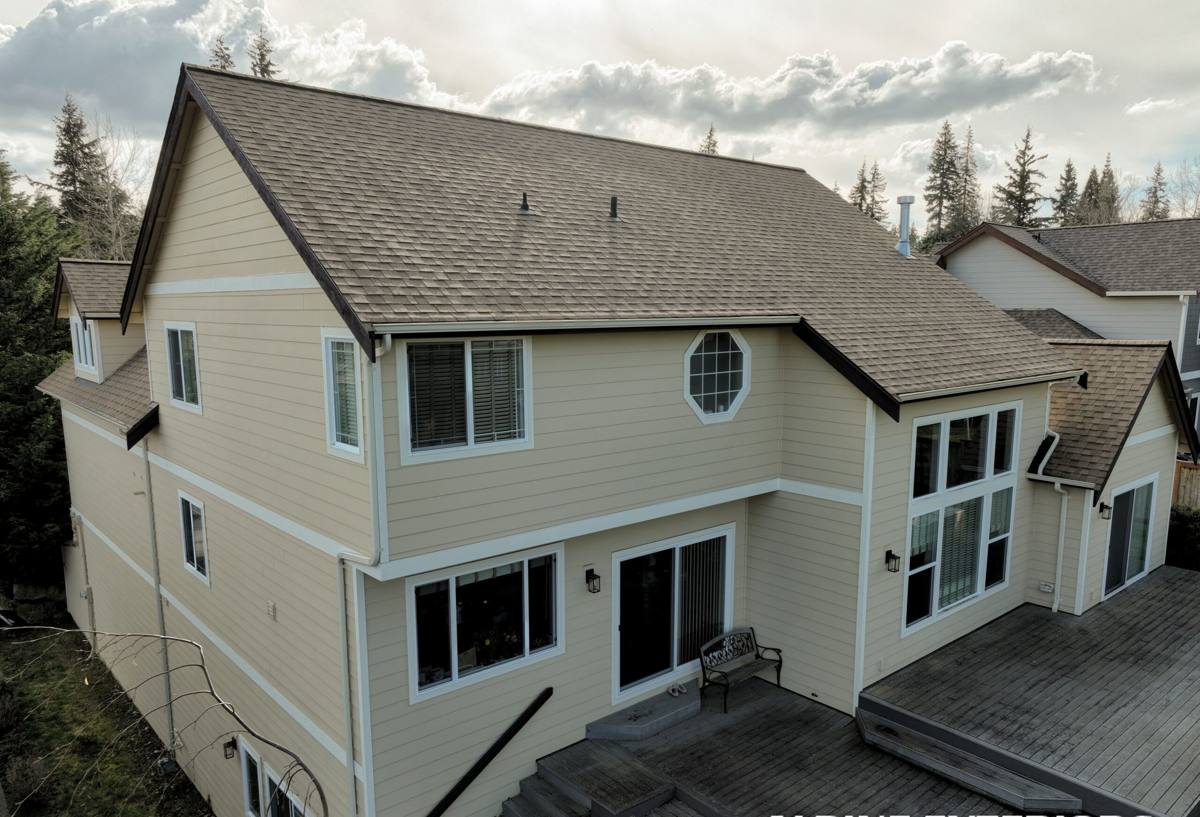
Why Fiber Cement Fits South Hill Homes
Fiber cement is a mix of cement, sand, and cellulose fiber, engineered specifically to resist moisture, fire, and pests in a way that wood-based and vinyl products can't match. For a hillside home taking on rain and salt air, that matters in a few concrete ways:
- It doesn't rot. The cement-based composition doesn't feed fungal growth the way wood or wood-fiber composite siding can when moisture gets behind it.
- It holds paint and factory finish longer. Fiber cement's dimensional stability means less expansion and contraction, so caulked joints and painted surfaces stay intact instead of cracking open and letting water in.
- It's non-combustible. Not a South Hill-specific issue, but a real one across Whatcom County during dry summer stretches, and one more reason it's the material we stand behind.
- It resists moss and mildew staining better than most alternatives when the surface finish is a factory-baked coating rather than field-applied paint, which tends to hold its sheen and shed grime instead of absorbing it.
That's the short version of why fiber cement, generally, is the right category of product for this hillside. The longer version is that not all fiber cement is installed — or manufactured — the same way, and the difference shows up five to ten years down the road, not on day one.
What a Correct Fiber Cement Siding Job Actually Involves
Fiber cement siding is only as good as the water management system behind it. This is the part homeowners rarely see and the part that determines whether a South Hill installation lasts three decades or starts showing problems in five years.
Water Management Behind the Siding
Correct installation starts with a weather-resistive barrier and, in most cases on an exposed hillside lot, a drainage plane that lets any moisture that does get past the siding find its way back out instead of sitting against the sheathing. Every penetration — window and door trim, hose bibs, light fixtures, vents — gets flashed and sealed before a single siding board goes up. Skipping this step is invisible at installation and expensive later.
Fastening, Clearances, and Joint Placement
Fiber cement has manufacturer-specified fastening patterns, minimum clearances from grade, roof lines, and decks, and rules about how far boards can run before a joint is required. On a home exposed to driving rain, those clearances aren't a formality — they're what keeps splash-back and standing moisture away from the bottom edge of the siding, which is where failures start on almost every job we've seen go wrong.
Caulking and Sealant Discipline
Every horizontal and vertical joint either gets caulked with a sealant rated for the application or is detailed to shed water without caulk at all, depending on the manufacturer's system. Inconsistent caulking — too little, the wrong product, or skipped joints — is one of the most common corners cut on rushed siding jobs, and it's one of the hardest problems to spot until water damage shows up behind the wall.
James Hardie: The Only Fiber Cement System We Install
We install James Hardie fiber cement exclusively. We don't install LP SmartSide, vinyl, Cemplank, Allura, or unprimed wood siding, and that's a deliberate standard, not an oversight. Homeowners deserve to know why.
Climate-Engineered Product Lines
James Hardie manufactures regional formulations under its HardieZone system, and the HZ5 line is engineered for the wetter, cooler climate zones that include the Pacific Northwest. That's a meaningful distinction on a hillside lot taking on bay-driven rain — the product formulation itself is built around moisture and freeze-thaw performance rather than being a one-size-fits-all board.
ColorPlus Factory Finish
Rather than relying entirely on field-applied paint, Hardie's ColorPlus finish is baked on at the factory in multiple coats under controlled conditions. It holds color and resists fading, chipping, and the kind of chalky streaking that shows up on field-painted siding after a few damp Whatcom County winters. It also means touch-up, when it's ever needed, is simpler than repainting an entire elevation.
Warranty That Transfers
Hardie backs its products with a long-term, transferable limited warranty — a real asset if a South Hill home changes hands, since it follows the house rather than expiring with the original owner. That warranty is also tied to installation by a contractor following Hardie's specifications, which is part of why correct installation isn't optional if you want the coverage to mean anything.
How Fiber Cement Compares for a South Hill Home
| Factor | James Hardie Fiber Cement | Vinyl Siding | Untreated Wood / Composite |
|---|---|---|---|
| Moisture & rot resistance | High — cement-based, engineered for wet climates | Doesn't rot, but seams and gaps let water track behind it | Vulnerable without diligent maintenance |
| Finish durability in salt air | Factory-baked ColorPlus finish resists fading and chalking | Can fade, warp, or become brittle over time | Field paint needs recoating every few years |
| Fire resistance | Non-combustible | Combustible; can melt or deform | Combustible |
| Typical lifespan when correctly installed | 30+ years | 20-30 years | Highly variable, often 10-20 years |
| Warranty structure | Long-term, transferable | Varies widely by manufacturer | Often limited or none |
This isn't a knock on every other product category — it's the reasoning behind our standard. We'd rather install one system correctly, every time, than offer a menu of materials with different risk profiles.
Our Process for South Hill Siding Projects
Every home on the hill is a little different — orientation to the wind, tree cover, how much bay exposure the elevation and lot layout create — so the process starts with actually looking at the house, not a generic bid.
- On-site inspection. We check the current siding and sheathing condition, look for existing moisture damage around windows and the bottom courses, and note the home's specific wind and rain exposure.
- Scope and product selection. We walk through Hardie's plank, shingle, and panel options, plus ColorPlus color choices, based on the home's style and the owner's preference.
- Tear-off and sheathing check. Old siding comes off and the sheathing underneath gets inspected for rot or damage before anything new goes up — this is the step that catches problems a surface-only estimate would miss.
- Weather-resistive barrier and flashing. Every window, door, and penetration is flashed and sealed to Hardie's specification before siding installation begins.
- Installation to manufacturer spec. Correct fastening patterns, clearances, and joint treatment throughout — not shortcuts to save a day of labor.
- Final walkthrough. We go over the finished job with the homeowner, including what maintenance to expect and when.
Cost Factors for South Hill Fiber Cement Projects
Every project is different, but the same handful of factors drive cost on most South Hill homes:
| Factor | Why It Matters |
|---|---|
| Home size and elevation complexity | Steep lots and multi-story elevations take longer and require more staging |
| Condition of existing sheathing | Hidden rot or moisture damage found during tear-off adds repair scope |
| Siding profile chosen | Lap plank, shingle, and panel systems have different material and labor costs |
| Trim and detail work | Window and door trim, corner boards, and soffit detailing add time |
| Access and site conditions | Tight lots, retaining walls, or limited driveway access affect staging and disposal |
We give a firm, itemized estimate after the on-site inspection — not a phone-quote guess — because on a hillside lot, the difference between a straightforward tear-off and one that uncovers sheathing damage can be significant, and we'd rather tell you that up front.
Moss, Mildew, and Long-Term Maintenance in a Whatcom County Climate
Moss season in this part of Washington runs long, and South Hill's exposure to persistent damp air keeps organic growth active even when other parts of Bellingham dry out. Fiber cement doesn't feed moss and mildew the way wood does, but nothing is maintenance-free in this climate. A little routine attention keeps a correctly installed system looking right for decades:
- Rinse siding annually, especially north-facing and shaded elevations where moss and algae collect fastest
- Keep gutters clear so overflow doesn't run down the siding face and streak it
- Trim back vegetation and tree limbs that hold moisture against the wall
- Inspect caulked joints every couple of years and re-seal any that have cracked or separated
- Address any paint chipping or bare spots promptly, since ColorPlus touch-up is simple when caught early
None of this is heavy maintenance — it's the kind of upkeep any exterior surface needs in a coastal, rainy climate. The point is that fiber cement, installed correctly, makes that upkeep manageable instead of a constant battle.
Why a Crew That Already Works South Hill Matters
A contractor who's worked South Hill before already knows which elevations take the worst of the bay wind, what sheathing condition tends to look like on homes of a certain age up there, and how the hillside's exposure changes the flashing and clearance details compared to a sheltered lot elsewhere in Bellingham. That's not something you can fully substitute with a generic estimate. It shows up in fewer surprises during tear-off, a scope that matches the home's actual exposure, and a finished job that's built for the specific conditions the house sits in — not a average-case installation.
We're a Bellingham-based crew working across Whatcom County, and South Hill is part of our regular territory, not an occasional job. That familiarity is part of what you're paying for when you hire local rather than a traveling crew passing through.
If you're weighing a siding replacement or repair on South Hill, we're glad to come take a look. The estimate is free, there's no pressure, and you'll get a straight answer about what your home actually needs — use the form below to get started.