 Bellingham Roofing
 Composite Decking Built for Sudden Valley's Conditions
Sudden Valley sits in a pocket of Whatcom County that gets more shade, more standing moisture, and more organic debris on outdoor surfaces than most Bellingham neighborhoods. Mature tree cover around Lake Whatcom keeps yards cool in summer, but it also means decks here dry out slower after every rain, collect needles and leaf litter in every gap, and stay damp long enough for moss and algae to take hold. Add in the marine-influenced weather that moves through the county — salt-tinged air off Bellingham Bay, long stretches of driving rain, and a moss season that can run eight months or more — and you have an environment that punishes decking built for drier climates.
Composite decking, installed correctly, holds up to this. Installed poorly, it can trap moisture just as badly as any other material. This page covers what a Sudden Valley composite deck actually needs, what our process looks like on this type of property, and what to ask before you hire anyone to build one.
Why Shaded, Wooded Lots Change the Installation
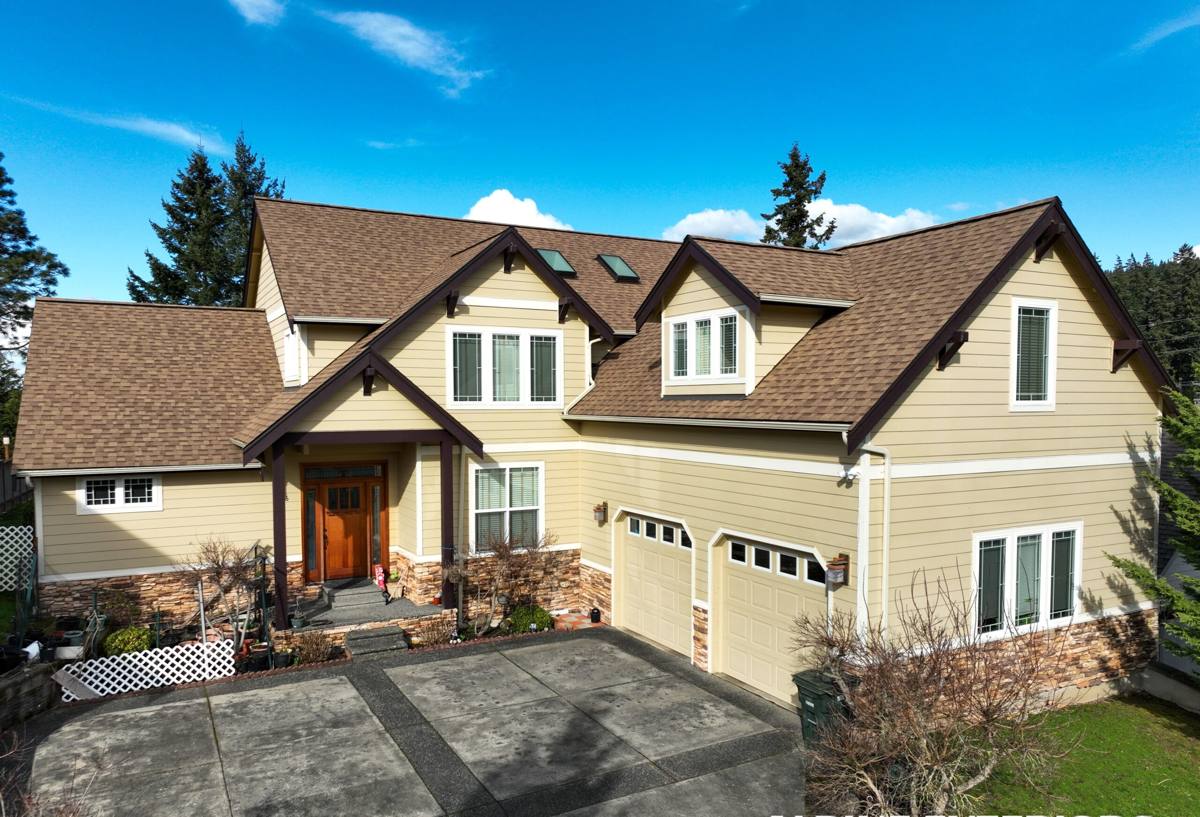
A composite deck on an open, sunny lot and a composite deck under Sudden Valley's tree canopy are not the same project, even if the boards come from the same box. The differences that matter:
Slower drying, more standing moisture
Shade means less sun exposure to evaporate rainwater off the deck surface and out of the gaps between boards. That moisture has to go somewhere, and if the substructure underneath isn't ventilated and sloped to drain, it sits — which is exactly the environment moss, algae, and mildew need to establish themselves on the board surface and in any exposed fastener points.
Organic debris load
Needles, cones, leaves, and pollen collect in board gaps and against the house at a much higher rate under tree cover than on an open lot. Left alone, that debris holds moisture against the boards and the ledger connection at the house, which is one of the more common places we find long-term rot and staining issues on decks in this part of the county.
Reduced airflow under the deck
Dense landscaping and shade also mean less natural airflow underneath the structure. Proper joist spacing, footing height, and skirting design all need to account for that — a substructure that would breathe fine on an exposed lot can stay wet for days on a shaded one.
What a Correctly Installed Composite Deck Involves
Composite boards themselves resist rot and don't need staining or sealing, which is why they're a good fit for this climate. But the board is only part of the system. The parts that actually determine whether the deck performs over 20+ years are the ones underneath and between the boards:
- Joist spacing rated for the specific composite product — many capped composites require tighter joist spacing than standard lumber decking, especially on diagonal or picture-frame patterns
- Hidden fastener systems that don't puncture the board's protective cap, which is where most moisture intrusion into composite boards actually starts
- Consistent gapping between boards for drainage and seasonal expansion — composite moves with temperature more than people expect
- A ledger board connection flashed and sealed properly where the deck meets the house, since this is the single most common failure point on any deck in a wet climate
- Footings set to local frost depth and bearing requirements, not just "deep enough"
- Under-deck ventilation and, where lot grading requires it, drainage systems that route water away from the foundation rather than letting it pool under the structure
Skipping any of these to save a day of labor is how a composite deck that should last decades starts showing problems in five or six years — usually as soft spots at the ledger, staining at fastener points, or moss establishing in low spots where water isn't draining.
Composite vs. Wood vs. PVC: What Fits a Shaded Sudden Valley Lot
| Factor | Pressure-Treated Wood | Capped Composite | PVC/Cellular |
|---|---|---|---|
| Moisture & rot resistance | Lowest — requires yearly sealing to hold up under shade and moss | High — capstock resists moisture, staining, and mold growth | Highest — fully synthetic, no organic material to rot |
| Moss/algae resistance | Poor without regular treatment | Good, though textured surfaces still need periodic cleaning | Good, smoother surfaces shed debris more easily |
| Maintenance | Annual cleaning, sealing, or staining | Occasional washing, no sealing or staining | Occasional washing, no sealing or staining |
| Upfront cost | Lowest | Mid-range | Highest |
| Feel underfoot / appearance | Natural wood grain, fades and grays over time | Wood-look grain, holds color for years | Cleaner, more uniform look, less wood-grain texture |
| Best fit for shaded, wet lots | Only with disciplined annual maintenance | Strong fit — the standard we recommend most often here | Strong fit, at a higher price point |
For most Sudden Valley properties we work on, capped composite is the practical middle ground — it holds up to the shade and moisture without the annual upkeep wood demands, at a lower cost than full PVC systems.
How Our Process Works on Sudden Valley Properties
Site visit and site read
We walk the lot before quoting anything. Tree cover, existing drainage patterns, ledger condition, and how much sun the deck footprint actually gets over a season all change the recommendation — a shaded, downhill lot near the lake gets a different substructure plan than an open one.
Permitting and community coordination
Sudden Valley is unincorporated Whatcom County, and many properties here fall under a community association with its own architectural or design review process in addition to standard county building permits. We handle county permitting on our projects and will tell you upfront if your property is likely to need association approval so there are no surprises mid-project.
Substructure first, boards second
We build and inspect the framing, drainage, and ventilation before a single composite board goes down. This is the part of the job that's invisible once the deck is finished, and it's the part that determines whether you're dealing with problems in year six or not dealing with them at all.
Cleanup and walkthrough
We clear debris, fastener packaging, and offcuts from the site, and walk the finished deck with you — including what routine care it actually needs, which for most composite decks is very little.
Living With a Composite Deck in a Moss-Heavy Environment
Composite decking doesn't need staining or sealing, but "low maintenance" doesn't mean "no maintenance" under Lake Whatcom's tree cover. A realistic routine:
- Sweep or blow off needles, leaves, and pollen regularly — the goal is keeping organic debris from sitting in board gaps
- Rinse the deck a few times a year with a hose and a soft-bristle broom; composite surfaces don't need pressure washing and aggressive pressure can damage the cap
- Address moss or algae spots as soon as they appear with a mild cleaner made for composite surfaces — the longer it sits, the more it can discolor the cap
- Keep gutters and downspouts near the deck clear so roof runoff isn't dumping extra water onto or under the structure
- Trim back overhanging branches where practical to get a little more sun and airflow onto the deck surface
None of this is heavy work, but skipping it entirely in a shaded, wet environment is how even a good composite product ends up looking worse than it should a few years in.
Why Hiring a Crew That Already Works Sudden Valley Matters
Composite decking installation isn't complicated in the abstract, but the details that make it last — joist spacing for shade and moisture, ledger flashing, drainage planning, fastener choice — are exactly the details that get skipped by crews unfamiliar with this kind of lot. A crew that already works properties around Lake Whatcom knows what a wooded, sloped, shade-heavy site needs before they show up, knows the county permitting process, and can tell you honestly whether a given spot on your property is a good fit for composite decking or needs extra drainage work first.
What to Ask Before You Hire
- Are you licensed, bonded, and insured to do decking work in Whatcom County?
- Will you pull the county building permit, and do you know whether my property needs community architectural approval?
- What joist spacing and fastener system are you specifying for the composite product we're discussing?
- How will the substructure be ventilated and drained given the shade and moisture on this lot?
- What does the manufacturer's warranty actually cover, and does your installation meet its requirements?
- Can you walk me through how the ledger connection at the house will be flashed and sealed?
A contractor who can answer these clearly, without hedging, is one who's actually thought through the job — not just quoted a price per square foot.
Get a Straight Answer for Your Property
Every lot in Sudden Valley handles shade, drainage, and moisture a little differently, and the right composite decking plan depends on seeing your specific site rather than guessing from a phone call. We offer free, no-pressure estimates — walk us through what you're picturing, and we'll tell you honestly what your property needs and what it will take to do it right.