 Bellingham Roofing
 Siding Built for the Way Sudden Valley Actually Weathers
Sudden Valley sits in a heavily wooded, lake-adjacent pocket of Whatcom County, and that setting shapes what a home's exterior has to deal with year-round. Tree canopy keeps siding shaded and slow to dry. Proximity to water keeps humidity elevated for most of the year. And like the rest of the Bellingham area, the neighborhood sees long stretches of driving rain carried in on Pacific storm systems, along with the salt-tinged marine air that moves through Whatcom County generally. None of that is dramatic on its own, but stacked together over years, it's exactly the combination that shortens the life of the wrong siding material and, just as often, exposes sloppy installation work that would have gone unnoticed in a drier climate.
This page is specifically about siding installation for Sudden Valley homes — not a general overview of siding everywhere. The goal is to explain what this climate demands, what a correct installation actually involves, and why we install exclusively James Hardie fiber cement siding rather than the alternatives homeowners often ask us about.
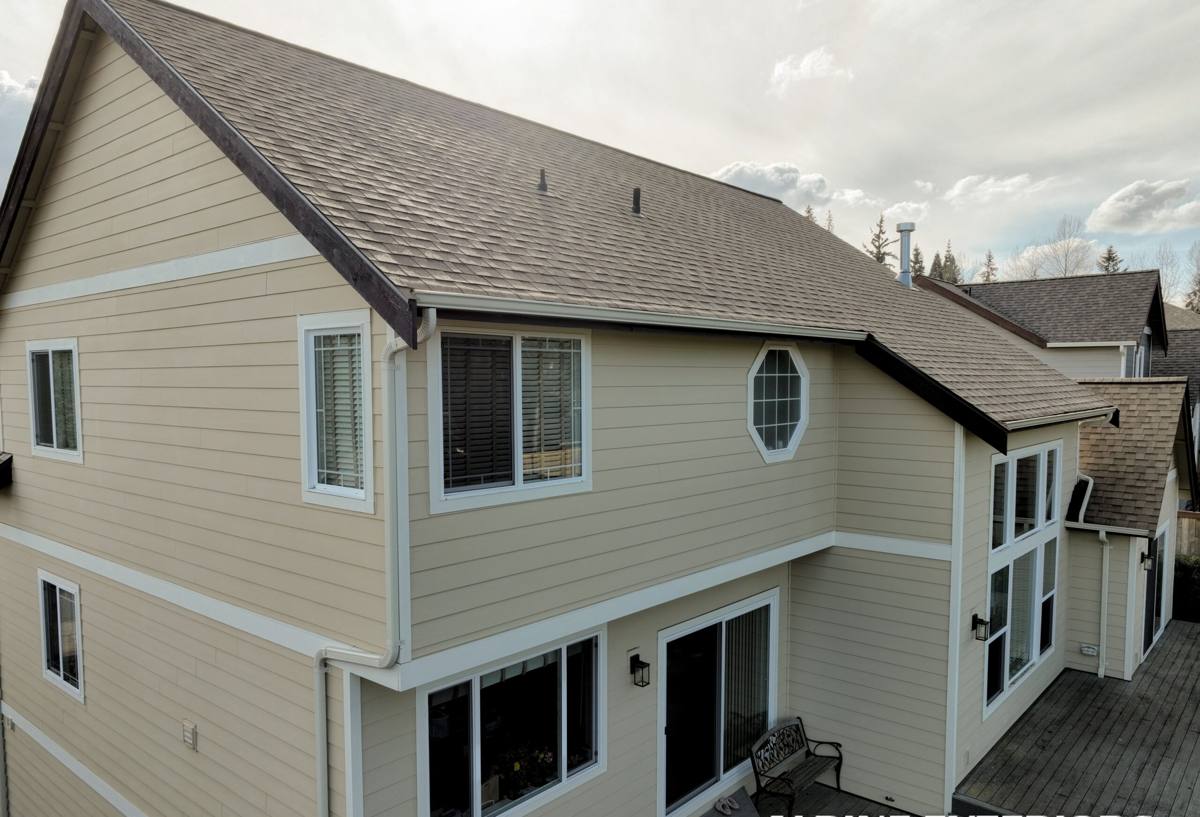
What This Climate Does to Exterior Siding Over Time
Every siding material eventually shows the effects of Pacific Northwest weather. The difference is how much damage shows up, how fast, and how expensive it is to fix. In Sudden Valley specifically, three conditions do most of the work:
Persistent Moisture and Slow Drying
Tree cover is common throughout Sudden Valley, and shaded exterior walls simply don't get the sun exposure needed to dry out quickly after rain. Siding on north-facing walls or walls tucked under mature trees can stay damp for days at a stretch during the wet season. Materials that absorb water or swell when wet are at a real disadvantage here — that moisture has nowhere to go quickly.
Driving, Wind-Blown Rain
Storms moving through Whatcom County frequently bring rain at an angle, not straight down. Wind-driven rain finds every gap in flashing, every under-caulked seam, and every panel that wasn't lapped correctly. This is less about how much rain falls and more about how it's forced sideways into joints and penetrations that a fair-weather installation might get away with.
Moss, Mildew, and Organic Growth
The region's long moss season isn't limited to roofs. Shaded, damp siding — especially anything with a rough or absorbent surface — is a prime target for moss and mildew growth along the lower courses, behind shrubs, and on north walls. Once organic growth takes hold, it holds moisture against the siding surface and accelerates whatever deterioration is already happening underneath.
Why Sudden Valley Homes Are Especially Exposed
Compared to more open, sun-exposed parts of Bellingham, Sudden Valley's tree cover and lakeside humidity mean siding here works harder than it would on an exposed hillside lot. Homes with heavy landscaping close to the walls, limited roof overhangs, or shaded lower stories tend to show moisture-related siding problems years before comparable homes in drier microclimates. That's not a reason to over-engineer a simple project — it's a reason to get the water management details right the first time, because this is not a climate that's forgiving of shortcuts.
What a Correct Siding Installation Actually Involves
Siding is a system, not just a decorative skin. A correct installation manages water at every layer, not just the visible surface. Here's what that means in practice.
The Water-Resistive Barrier
Before any siding goes up, the wall needs a continuous, properly lapped weather-resistive barrier. Every seam, window, and penetration has to be sequenced correctly — flashing tucked under the barrier above it and over the barrier below it — so water is always directed outward and down, never behind the siding.
Rain Screen Gap and Drainage
In a climate this wet, a drainage gap between the siding and the wall assembly matters. It gives any moisture that does get behind the siding a path to drain and dry out instead of sitting against the sheathing. Skipping or shortcutting this detail is one of the most common causes of hidden rot behind siding that looks fine from the street.
Fastening and Clearances
Fiber cement siding has specific fastening requirements — nail placement, spacing, and depth all affect how the panel performs over time. Ground clearance and clearance from roof lines, decks, and patios also matter: siding installed too close to grade or to a horizontal surface stays wet longer and is more prone to moss and rot at the bottom courses.
Trim, Flashing, and Caulk Joints
Corners, window and door trim, and butt joints are where most real-world leaks start. Correct flashing at every horizontal trim piece, and caulking only where the manufacturer specifies it — not as a substitute for proper flashing — is what keeps wind-driven rain out of the wall assembly.
Why We Install Only James Hardie Fiber Cement Siding
We don't install vinyl, LP SmartSide, cedar, primed spruce, or other fiber cement brands. That's a deliberate standard, not a lack of options. James Hardie's fiber cement is engineered specifically to hold up in wet, humid, moss-prone climates like this one:
- Non-combustible core — fiber cement doesn't burn, rot from insect activity, or provide fuel the way wood-based products can.
- Moisture-resistant composition — fiber cement doesn't swell, warp, or delaminate the way engineered wood products can when repeatedly saturated and dried.
- Climate-engineered HZ product lines — Hardie manufactures specific formulations for different climate zones, including versions built for the wetter conditions common throughout Western Washington.
- ColorPlus factory finish — a baked-on finish that resists fading and holds up to repeated wet-dry cycles far better than field-applied paint, reducing how often the exterior needs to be repainted.
- Strong transferable warranty — backed by a manufacturer warranty that can transfer to a future owner, which matters for resale in a market where buyers increasingly ask what the siding is and how old it is.
None of this means other materials are without merit — vinyl is inexpensive and low-maintenance in some climates, wood has real aesthetic appeal, and engineered wood products have improved over the years. But given what this specific climate does to exterior walls over a 20-30 year ownership window, fiber cement is what we're willing to put our name behind and warranty our workmanship on.
Comparing Siding Materials for This Climate
| Factor | James Hardie Fiber Cement | Vinyl | Engineered Wood (LP-type) | Cedar |
|---|---|---|---|---|
| Moisture tolerance | High — engineered for wet climates | High, but can warp in heat/cold cycling | Moderate — vulnerable if seals fail | Requires ongoing sealing/maintenance |
| Moss/mildew resistance | Good with proper clearance | Good, but can trap moisture behind panels | Moderate | Low without regular treatment |
| Fire resistance | Non-combustible | Melts/deforms under heat | Combustible (wood-based) | Combustible |
| Finish longevity | 15+ years (ColorPlus) | Fades over time, no repaint option | Field paint needed periodically | Stain/paint needed every few years |
| Typical lifespan | 30-50+ years installed to spec | 20-40 years | 20-30 years | 20-30 years with upkeep |
Our Sudden Valley Installation Process
Assessment and Removal
We start with an on-site look at the existing siding, wall condition, and any problem areas — shaded walls, low clearance spots, moss buildup, or signs of past moisture intrusion. Old siding and any compromised sheathing are removed and evaluated before anything new goes up; covering up hidden damage is never an option.
Water Management Prep
This is where the project is won or lost. We install the weather-resistive barrier, flashing at every window, door, and penetration, and the drainage gap needed for this climate — all before a single piece of visible siding goes on.
Installation
Hardie panels or lap siding go up to manufacturer fastening specifications, with correct clearances maintained at grade, roofs, decks, and other horizontal surfaces so water has somewhere to go instead of sitting against the material.
Trim, Caulking, and Final Details
Trim and corner details are finished per Hardie's installation guidelines, caulking is applied only where specified, and the site is cleaned up so the finished job looks as good as it performs.
What to Expect From a Correct Installation — Checklist
- Continuous, properly lapped weather-resistive barrier under all siding
- Flashing installed at every window, door, and wall penetration
- Drainage gap maintained behind the siding for this climate
- Manufacturer-specified fastener type, spacing, and depth
- Correct clearance from grade, roofs, decks, and patios
- ColorPlus finish (no field-painting required at install)
- Documented warranty coverage on both material and workmanship
Why Hiring a Crew That Already Works in Sudden Valley Matters
Sudden Valley has its own character as a neighborhood — heavier tree cover, lakeside humidity, and in many cases homeowners association guidelines that affect exterior color and material choices. A crew that already works in this specific area knows to plan around shaded, slow-drying wall sections, understands the access considerations that come with a wooded, hillside community, and isn't guessing at what local moisture patterns will do to a fresh installation. That familiarity shows up in fewer surprises during the project and in siding that's detailed correctly for the conditions it actually has to survive, not generic conditions from a training manual.
A Straightforward, No-Pressure Next Step
If your Sudden Valley home's siding is aging, showing moss, or you're planning ahead for a replacement, we're glad to take a look and give you a straightforward assessment — no pressure, no hard sell. Use the form below to request a free estimate and we'll walk you through what your home specifically needs.