 Bellingham Roofing
 Custom Decks Built for Cordata's Climate, Not Just Its Layout
A deck in Cordata does a different job than a deck in a dry inland climate. It has to shed water fast, resist moss and algae for most of the year, and hold up under salt-tinged air drifting in off Bellingham Bay and the Sound. Homeowners in this neighborhood often come to us after a deck built with a generic, one-size-fits-all approach starts showing problems within a few years — soft spots near the house, black streaks on the boards, rust bleeding from fasteners, or railings that feel less solid than they used to. None of that is normal wear. It's the result of a deck designed for a climate it doesn't actually live in.
This page is about what a custom deck build should look like specifically for a Cordata property in Whatcom County — the material choices, the structural details, and the process that holds up to our wet, moss-prone, coastally-influenced weather year after year.
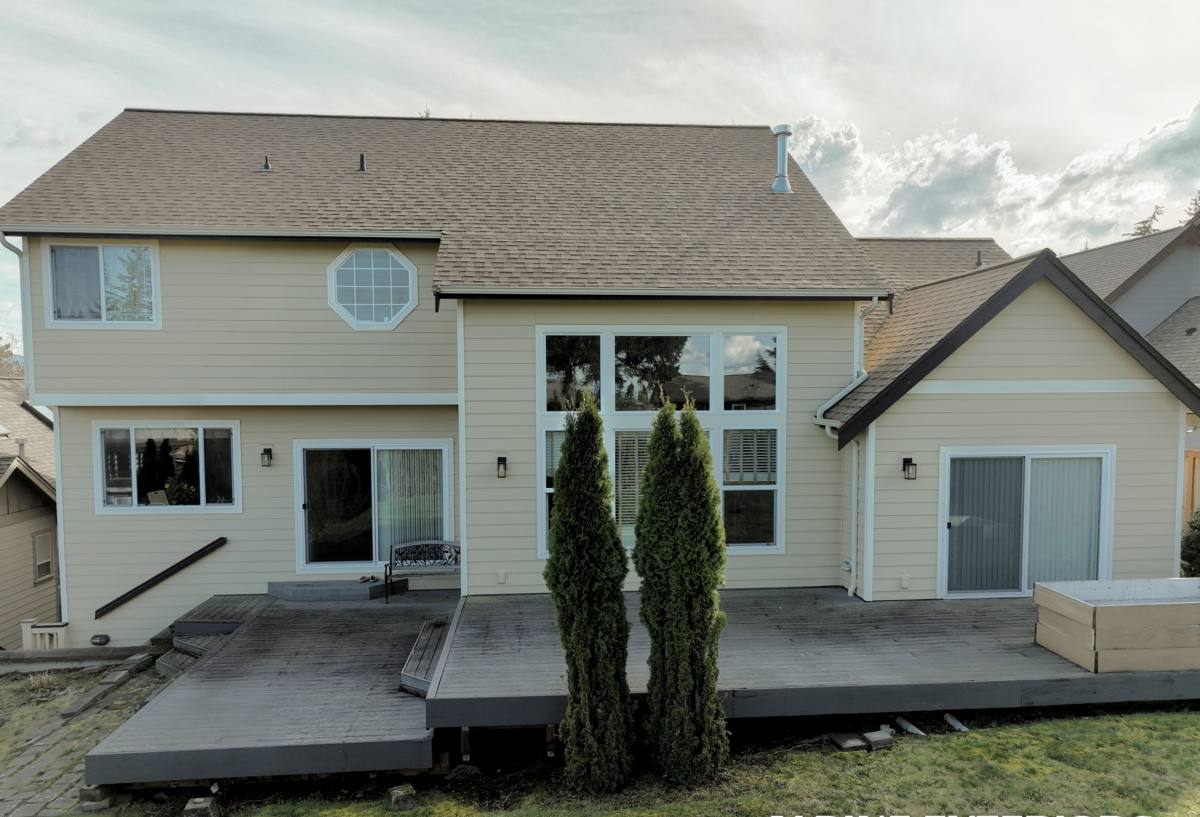
What Bellingham's Climate Actually Does to a Deck
Three things drive almost every deck problem we see in this area, and a correctly built deck is designed around all three from day one:
Driving Rain
Bellingham doesn't just get a lot of rain — a good share of it comes in sideways during fall and winter storms, which means water gets pushed into places a deck in a calmer climate would never have to deal with: ledger connections, stair stringers, under railing posts, and the gaps between boards. If those spots aren't detailed to shed water rather than trap it, rot starts from the inside where you can't see it.
Salt Air
Proximity to Bellingham Bay means the air carries a fine salt content that speeds up corrosion on anything metal — fasteners, joist hangers, railing hardware, structural screws. Standard hardware rated for inland use corrodes noticeably faster here, and once a fastener starts rusting, it weakens exactly where the deck depends on it most.
Long Moss Season
Between the rain and the tree cover common in this part of Whatcom County, moss and algae have a long season to establish themselves — often close to eight or nine months out of the year. Moss holds moisture against the decking surface, stains it, and makes boards dangerously slick. A deck that isn't designed for airflow and drainage will grow moss no matter what surface material you choose.
Choosing a Decking Material That Fits Cordata
There's no single "best" decking material — there's a best material for your budget, your maintenance tolerance, and how much shade and moisture your specific yard sees. We walk every Cordata homeowner through the real trade-offs rather than pushing one product line.
| Material | Moss/Moisture Behavior | Maintenance | Typical Lifespan Here |
|---|---|---|---|
| Pressure-treated wood | Absorbs water; needs sealing to resist staining and moss growth | Annual cleaning, re-sealing every 2-3 years | 15-20 years with upkeep |
| Cedar | Naturally rot-resistant but still needs sealing in this rainfall | Regular cleaning, periodic oil/sealant | 15-20 years with upkeep |
| Composite decking | Doesn't absorb water like wood, but surface moss/algae still needs washing | Occasional wash, no sealing or staining | 25-30+ years |
| PVC/capped polymer | Fully moisture-resistant surface, easiest to keep moss-free | Lowest — soap and water rinse | 25-30+ years |
Composite and PVC decking generally make the most sense for homeowners who want to spend their weekends using the deck instead of maintaining it, especially given how long our moss season runs. Real wood still has a place for homeowners who want a specific look or a lower upfront cost, but we're honest that it demands more attention here than it would in a drier region — that's a maintenance trade-off, not a flaw in the product.
What a Correctly Built Substructure Looks Like
Ledger Attachment and Flashing
The ledger board — where the deck attaches to your house — is the single most common failure point we find on decks in this climate, and it's almost always because flashing was skipped or installed incorrectly. Water that gets behind an unflashed ledger has nowhere to go and rots the house's rim joist from the inside, often long before it shows on the surface. Correct ledger flashing, installed so water is directed out and away from the house rather than trapped against it, isn't optional on any deck we build.
Footings and Frost Depth
Footings need to be sized and set to the frost depth required in this part of Whatcom County, not just poured to whatever looks deep enough. Undersized or shallow footings shift over time, which is what causes a deck to start feeling bouncy or uneven a few years in.
Joist Spacing and Airflow
Tighter joist spacing than the minimum code allows, plus a bit of extra clearance between the deck framing and the ground, does two things: it stiffens the deck underfoot and it lets air move underneath, which helps the structure dry out between rain events instead of staying damp. That airflow matters as much for longevity as the decking material you pick.
Fasteners and Hardware: The Detail Salt Air Punishes First
Given the salt content in the air this close to the water, we treat hardware selection as a structural decision, not an afterthought. Hot-dip galvanized or stainless steel fasteners, joist hangers, and structural screws cost more upfront than standard-grade hardware, but they're the difference between connections that stay tight for decades and ones that start rusting and weakening within a handful of years. This is one of the easiest things for a lower-bid contractor to quietly downgrade, because it's invisible once the decking is installed.
Railings, Stairs, and Code Requirements
Any deck above the height threshold set by Washington building code needs a compliant guardrail system, and Bellingham's permitting process reviews railing height, baluster spacing, and stair details as part of any deck permit. Beyond just passing inspection, railing posts are another spot where water intrusion causes hidden rot if they aren't flashed and fastened correctly — a wobbly railing post is very often a sign of water damage underneath, not just a loose bolt.
- Guardrails required above the code height threshold, with baluster spacing that meets current code
- Stair stringers sized and supported correctly for the run and rise
- Post-to-frame connections engineered to resist lateral load, not just fastened for looks
- All structural hardware rated for exterior, corrosion-prone exposure
Designing Against Moss From the Start
You can't out-clean a poorly designed deck. If a deck traps moisture — through tight board spacing, low ground clearance, or heavy shade with no airflow — moss and algae will come back no matter how often it's washed. We factor moss resistance into the design itself:
- Board spacing that allows water to drain through rather than pool on the surface
- Grooved or textured board profiles chosen with an eye toward slip resistance once moss inevitably forms in shaded corners
- Adequate under-deck clearance and ventilation so the structure dries out between storms
- Layout that accounts for existing tree cover and shade patterns on your specific lot
None of this eliminates the need for occasional cleaning, but it dramatically cuts down how often and how hard you have to work at it.
Our Process for a Cordata Deck Project
Every project starts with a site visit, not a phone quote — we need to see your yard's sun exposure, drainage, existing grade, and how the deck will tie into the house before we can recommend a real design. From there:
- On-site assessment of drainage, shade, house connection points, and existing structure if you're replacing a deck
- Material and layout discussion, with honest trade-offs on cost, maintenance, and lifespan for your specific situation
- Design and a written scope covering footings, framing, decking, railings, and hardware specifications
- Permit submission through the City of Bellingham where required, before any construction begins
- Construction, with ledger flashing, footing depth, and fastener grade handled to the standards above at every stage
- Final walkthrough covering how to care for your specific decking material through our wet season
Why a Crew That Already Works in Cordata Matters
A contractor who works this neighborhood regularly already knows the drainage patterns, the shade conditions from mature tree cover, and how Bellingham's permitting process handles deck projects — none of that has to be figured out from scratch on your project. That familiarity shows up in fewer surprises: footing depths that are right the first time, a permit application that doesn't get bounced back for missing details, and a design that accounts for how much moss pressure your specific lot actually gets rather than a generic assumption.
It also means accountability. A crew with an ongoing presence in Cordata has a reason to build something that still looks and performs well five or ten years from now, not just something that passes final inspection.
Get a Straight Answer on Your Deck Project
If you're planning a new deck or replacing one that's showing signs of rot, rust, or moss trouble, we're glad to take a look and give you a straightforward assessment — no pressure, no upsell. Use the form below to request a free estimate, and we'll walk your property in person before recommending anything.