 Bellingham Roofing
 Fairhaven's Climate Puts Real Stress on Siding
Fairhaven sits close to Bellingham Bay, on hillsides and wooded lots that catch a steady mix of salt-laden air, wind-driven rain off the water, and the deep shade that comes with mature Pacific Northwest tree cover. That combination is harder on exterior siding than most homeowners realize. Salt air accelerates corrosion on fasteners and metal trim. Driving rain finds its way into any gap in a wall assembly, not just straight down but sideways, under eaves and around window trim. And the long, wet, low-light stretch of fall through spring — what most Whatcom County homeowners just call "moss season" — keeps north- and shade-facing walls damp for weeks at a time.
Siding that isn't built or installed for that kind of exposure shows it early: peeling paint, swelling at butt joints, streaking, soft spots at the bottom courses, and moss or algae creeping up from the ground line. None of that is inevitable. It's a product and installation problem, and it's fixable with the right material installed the right way.
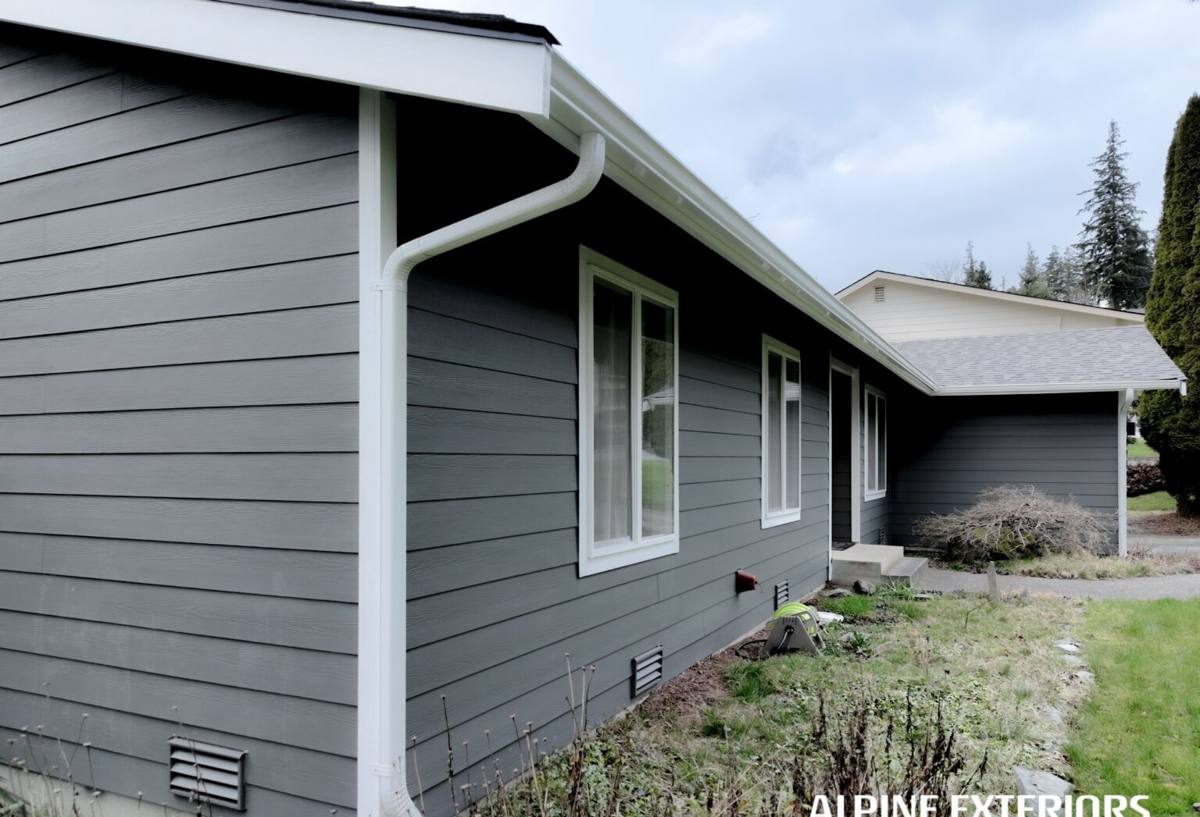
Why We Only Install James Hardie Fiber Cement Here
Bellingham Roofing Company installs one siding system: James Hardie fiber cement. We don't install vinyl, LP SmartSide, Cemplank, Allura, or bare cedar and primed spruce. That's not a marketing position — it's a standard we hold because of what we see on homes in this exact climate, Fairhaven included. Vinyl expands and contracts with temperature swings and can warp or crack in cold snaps; its seams and butt joints give wind-driven rain an easy path in. Wood siding needs a paint and caulk maintenance schedule that most homeowners fall behind on, and once bare wood starts absorbing moisture in a shaded, damp yard, rot follows. Engineered wood products carry their own moisture-sensitivity concerns at cut edges and fastener penetrations, which matters a lot in a climate that rarely lets a wall assembly fully dry out between rain events.
Fiber cement doesn't rot, doesn't feed insects, and holds paint or its factory finish far longer than wood-based alternatives because it doesn't move with moisture the way wood does. That's the whole reason it's what we put on homes in Fairhaven instead.
| Material | Salt air / moisture behavior | Maintenance burden |
|---|---|---|
| Vinyl siding | Seams and panels can warp or crack with temperature swings; doesn't stop wind-driven rain at joints | Low, but limited lifespan and hard to repair invisibly |
| Cedar / primed spruce | Absorbs moisture at end grain and fastener holes; shaded, damp walls are prone to rot | High — regular repainting and caulk upkeep required |
| LP SmartSide (engineered wood) | Wood-strand core sensitive to sustained moisture at cut edges and joints | Moderate — finish and caulk maintenance needed |
| James Hardie fiber cement | Cement-based composition resists moisture absorption and doesn't rot | Low — occasional wash and caulk check |
What Correct Installation Requires in a Marine Climate
Fiber cement is only as good as the wall assembly behind it. In a climate like Fairhaven's, the installation details matter more than the brand name on the box. A crew that rushes the water management layer will end up with a home that looks fine for a year or two and then starts showing problems at the seams — problems that are expensive to trace once siding is buttoned up over them.
Drainage Plane and Rain Screen
Every wall needs a continuous weather-resistant barrier behind the siding, properly lapped so water sheds outward and down, not into the sheathing. On exposures that take direct rain off the bay, we pay close attention to a drainage gap between the siding and the wall so any moisture that does get past the cladding can drain and dry instead of sitting against wet sheathing. This is one of the most commonly skipped steps in a fast siding job, and it's one of the most consequential over a ten-year span.
Fasteners, Flashing, and Clearances
Salt air is hard on unprotected metal, so flashing, fasteners, and trim need to be corrosion-resistant and installed to keep water moving away from seams, not pooling at them. Siding also needs proper clearance from grade, decks, and roof lines — tight clearances trap moisture against the bottom courses, which is exactly where we see the earliest damage on homes with shaded, damp yards. Butt joints, window and door trim, and penetrations all get caulked and flashed as part of the install, not left for the homeowner to maintain later.
The Hardie Products We Use for This Exposure
James Hardie engineers its siding by climate zone, and homes near Bellingham Bay fall into the HZ5 or HZ10 category depending on the specific product line, built to handle wetter, more variable weather than the drier HZ zones used elsewhere in the country. We typically spec HardiePlank lap siding for the field of the wall, with HardieTrim for corners and window and door surrounds, and HardiePanel where a vertical or board-and-batten look fits the home's style — common in Fairhaven's mix of historic and updated homes.
Most of what we install carries Hardie's factory-applied ColorPlus finish. That finish is baked on under controlled conditions rather than field-painted, which means better adhesion and a longer color life than a job-site paint job — a meaningful difference on a home that's going to face several months of damp, low-light weather every year. It also comes with its own finish warranty separate from the substrate warranty, and both are transferable to a future buyer if the home sells, which matters to anyone thinking about resale in a neighborhood like Fairhaven.
Our Process, Start to Finish
We keep the process straightforward and don't skip the steps that protect the wall behind the siding:
- On-site assessment of the existing siding, sheathing, and any moisture or rot found during tear-off
- Removal of old siding and repair of any damaged sheathing or framing before new material goes up
- Installation of the weather-resistant barrier and drainage gap
- Installation of James Hardie trim, then lap or panel siding, with corrosion-resistant fasteners
- Caulking and sealing at joints, penetrations, and trim per manufacturer specification
- Final walkthrough and cleanup, with warranty registration handled on our end
Every job includes registering the manufacturer warranty in the homeowner's name — an easy step to overlook, and one that matters if a claim ever needs to be made years down the road.
What Affects the Cost of a Fairhaven Siding Job
Every home is different, but the same handful of factors drive most of the cost variation we see on siding jobs in this area:
| Factor | Why it matters |
|---|---|
| Condition of existing sheathing | Rot or moisture damage found during tear-off needs repair before new siding goes on |
| Home height and access | Multi-story walls, steep lots, and limited access add labor and equipment time |
| Siding profile and trim detail | Board-and-batten, extensive trim, and custom corners take more labor than plain lap siding |
| Tear-off vs. new construction | Removing and disposing of old siding adds cost compared to siding a new wall |
| ColorPlus vs. field-painted finish | Factory finish costs more up front but lasts longer and carries its own warranty |
We don't quote a job without seeing the home. A firm number depends on what's actually behind the existing siding, which is why the on-site assessment comes first.
Living With Fiber Cement Siding in Fairhaven's Climate
Correctly installed fiber cement is low-maintenance, not zero-maintenance. A few habits keep it performing the way it should through Whatcom County's wet seasons:
- Rinse the siding once or twice a year, especially on shaded, moss-prone walls, with a garden hose and soft brush — skip the pressure washer, which can force water behind panels and damage caulking
- Keep gutters clear so overflow doesn't run down the wall face repeatedly in heavy rain
- Trim back vegetation and tree cover that keeps a wall shaded and damp longer than it needs to be
- Check caulking at trim and joints every couple of years and have gaps resealed before water gets behind them
- Watch the bottom courses near grade and decks, where moisture and moss tend to show up first
Why It Matters to Hire a Crew That Already Works This Neighborhood
Siding installation isn't a one-size-fits-all trade. A crew that mostly works drier inland areas may not think twice about drainage gaps or fastener corrosion resistance, because those details don't punish a shortcut the way they do on a home exposed to Bellingham Bay's salt air and driving rain. A crew that regularly works Fairhaven and the surrounding Bellingham waterfront knows which walls take the worst weather, where moss shows up first, and which installation details actually matter here versus which ones are optional elsewhere. That local pattern recognition is part of what you're paying for when you hire a contractor — not just the material, but the judgment behind how it goes on.
If you're considering new siding, a repair, or just want a straight answer on whether your current siding is holding up the way it should, we're happy to take a look. Reach out for a free, no-pressure estimate using the form below.