 Bellingham Roofing
 Why Sunnyland Roofs Wear Out the Way They Do
Sunnyland sits close enough to the water and to Bellingham's tree canopy that its roofs face a specific combination of stresses most inland neighborhoods don't deal with. Salt-laden air off the bay slowly corrodes exposed metal — fasteners, flashing, vent caps — long before the shingles themselves give out. Add in the driving, wind-blown rain that comes through this part of Whatcom County during fall and winter storms, and you get water finding its way sideways under laps and around penetrations that would stay dry in a calmer climate. Then there's moss. Between the shade from mature trees on many Sunnyland lots and the long stretch of damp, mild weather Bellingham gets roughly nine months a year, moss and moisture-loving algae get a head start on any roof that isn't actively shedding water and drying out between rains.
None of this means Sunnyland homes need exotic solutions. It means the ordinary parts of a roof replacement — underlayment choice, flashing detail, fastener material, ventilation — have to be done correctly, not just adequately, because the climate here doesn't forgive shortcuts the way a drier region might.
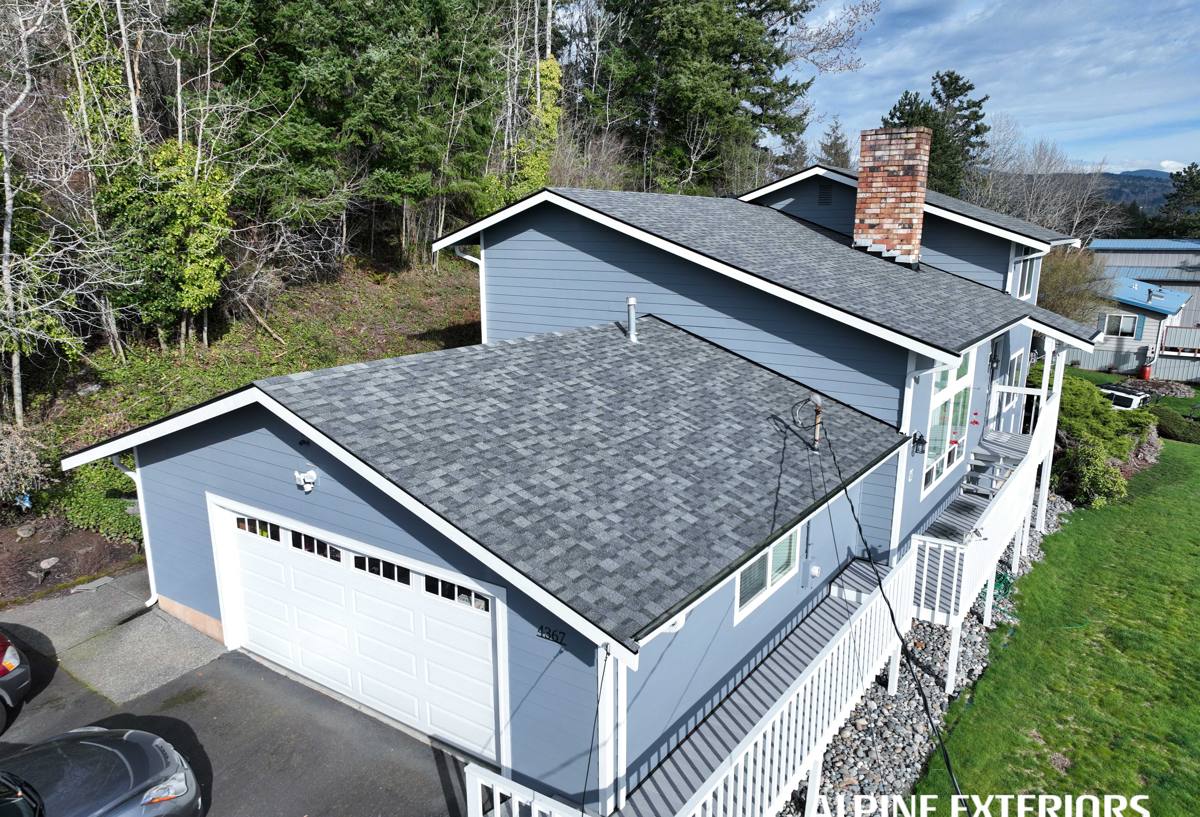
Signs You're Looking at Replacement, Not Another Repair
A lot of roofs get patched two or three times before anyone steps back and asks whether patching still makes sense. Here's what tends to tip a Sunnyland roof from "repair" into "replace":
- Shingles that are cupping, curling, or losing granules in patches rather than just at one flashing point
- Moss that keeps returning within a season or two of cleaning, especially on north-facing slopes
- Soft or spongy decking felt underfoot near valleys, chimneys, or skylights when walked during an inspection
- Daylight visible through the roof deck from inside the attic, or water staining that shows up in more than one spot
- A roof that's already 20+ years old and has had multiple flashing or valley repairs
- Granule buildup in gutters that's increasing year over year rather than tapering off
One or two of these on their own might still be repairable. Several together, especially on an older roof, usually mean the underlying materials have reached the end of their useful life and further patching is just delaying the inevitable while water finds new ways in.
What a Correct Replacement Actually Involves
Tear-Off and Deck Inspection
We don't install new roofing over old. A full tear-off lets us see the actual condition of the sheathing underneath — something you can't judge from the ground or even from inside the attic. Any soft, delaminated, or water-damaged decking gets replaced before anything new goes down. Skipping this step is one of the most common ways a roof replacement fails early, and it's not something you can verify after the fact once shingles are covering it.
Underlayment and Ice-and-Water Protection
Given how much driving rain this area sees, we pay particular attention to underlayment coverage — not just a single layer stapled down, but proper laps and self-adhered ice-and-water shield in the vulnerable spots: valleys, eaves, around chimneys and skylights, and anywhere wind-driven rain is most likely to work its way backward under a shingle course.
Flashing and Fasteners
This is where salt air matters most. Standard galvanized fasteners and flashing can corrode faster this close to the water than they would twenty or thirty miles inland. We use corrosion-resistant flashing and fastener materials suited to a coastal-influenced climate, particularly at chimneys, sidewalls, and any metal-to-metal joints.
Ventilation
A roof that can't breathe traps moisture in the attic, which shortens the life of the decking and the shingles from underneath — invisible until it isn't. Balanced intake and exhaust ventilation is part of a correct replacement, not an upsell.
Material Choices for This Climate
There's no single "best" roofing material for every Sunnyland home — it depends on your roof's pitch, how much shade and moss pressure the lot has, and your budget. Here's how the common options actually compare for a home in this climate:
| Material | Moss/Moisture Resistance | Typical Lifespan Here | Notes |
|---|---|---|---|
| Architectural asphalt shingle | Good, especially with algae-resistant granules | 25-30 years | Most common choice; wide range of price points; needs periodic moss maintenance |
| Standing seam metal | Excellent — sheds moss and moisture fastest | 40-50+ years | Higher upfront cost; corrosion-resistant coatings matter this close to salt air |
| Synthetic shake/slate | Very good | 30-50 years | Mimics cedar or slate look without the moisture-absorption downsides of natural wood shakes |
| Cedar shake (natural) | Fair — needs consistent maintenance | 20-25 years realistically in this climate | We're upfront that natural cedar's moisture absorption and maintenance burden make it a harder sell in a wet, moss-prone area like this |
For most Sunnyland homes, a quality architectural shingle with algae-resistant granules hits the right balance of cost and performance. Metal earns its higher price tag on homes with heavy shade, steep pitches, or owners who want to minimize moss maintenance long-term.
Ventilation and Moisture Control
Western Washington's climate makes attic ventilation less optional than it might be elsewhere. Warm, moist air that can't escape through proper exhaust venting condenses against the underside of a cold roof deck in winter, which over years contributes to rot, mold, and premature shingle failure from below — the kind of damage that isn't obvious until a leak already exists. Intake vents at the eaves paired with exhaust at or near the ridge keep air moving continuously, which also helps the roof surface dry faster after our frequent rain and reduces the damp, shaded conditions moss thrives in.
Our Process
- On-site inspection — we walk the roof (weather permitting) and check the attic, looking at deck condition, ventilation, flashing points, and moss/moisture patterns specific to your lot
- Written estimate — a clear scope and price, no vague allowances, with material options explained honestly rather than upsold
- Scheduling around weather — we plan tear-off days around Bellingham's forecast rather than pushing through a downpour with an open roof
- Tear-off and deck repair — full removal, deck inspected and repaired before anything new is installed
- Underlayment, flashing, and roofing installation — done to manufacturer spec and adapted for local conditions, particularly at valleys and penetrations
- Ventilation check — intake and exhaust balanced for the home's attic volume
- Cleanup and magnetic sweep — job site and yard cleared of debris and stray fasteners
- Final walkthrough — we go over the finished roof with you before calling the job done
Why a Crew That Already Works Sunnyland Matters
Roofing in Bellingham isn't identical to roofing in a drier or more sheltered part of the state, and a crew that regularly works this neighborhood already knows what to expect: how tree cover on a given block affects moss buildup, how tight some lots are for staging material and equipment, and what Whatcom County and City of Bellingham permitting and inspection requirements apply to a residential re-roof. That familiarity shows up in fewer surprises mid-project — knowing which flashing details tend to fail first on homes of a certain age in this area, or how to sequence work around the wetter stretches of the year so the deck isn't left exposed longer than it needs to be.
It also means we're a known, local business if a warranty question comes up five or ten years down the line — not a crew that worked one job in the area and moved on.
Keeping a New Roof Performing After Installation
A correctly installed roof still benefits from basic upkeep in this climate. A short annual routine goes a long way:
- Keep gutters clear so water isn't backing up under the eaves during heavy rain
- Trim back overhanging branches where practical to reduce shade and debris buildup that feeds moss
- Have moss treated or gently removed at the first sign of regrowth rather than letting it establish
- Check attic ventilation isn't blocked by insulation or storage that's crept over intake vents
- Have flashing points glanced at after any major windstorm, since that's when displaced flashing or lifted shingles are most likely
None of this requires a professional visit every time — most of it is a homeowner with a pair of binoculars and a ladder-free look from the ground, plus an occasional professional check-in.
Getting Started
If your Sunnyland roof is showing its age, or you just want an honest read on how much life it has left, we're happy to take a look and put together a written estimate. There's no pressure and no obligation — just a straightforward assessment from a crew that knows this neighborhood's climate and what it takes to build a roof that holds up against it. The form below will get you started.