 Bellingham Roofing
 Siding Replacement in Sehome: What This Neighborhood's Homes Are Up Against
Sehome sits in central Bellingham, rising up toward Sehome Hill with a mix of older housing stock and newer infill packed close together under a heavy tree canopy. That combination, older walls, mature trees, and a climate that stays wet and mild for most of the year, means siding in this neighborhood works harder than siding in a drier part of Washington. Salt air moving in off the Salish Sea, driving rain that comes in sideways more often than straight down, and a moss season that can run nine months out of twelve all chip away at exterior materials in ways that are easy to underestimate until you're standing in front of soft, delaminating panels.
Siding replacement isn't a cosmetic project here. It's the layer that decides whether wind-driven moisture stays outside the wall assembly or works its way into sheathing, framing, and insulation where it can sit unnoticed for years. This page is about what a full siding replacement actually involves for a Sehome home, what correct work looks like, and why we install James Hardie fiber cement exclusively rather than offering a menu of cheaper options.
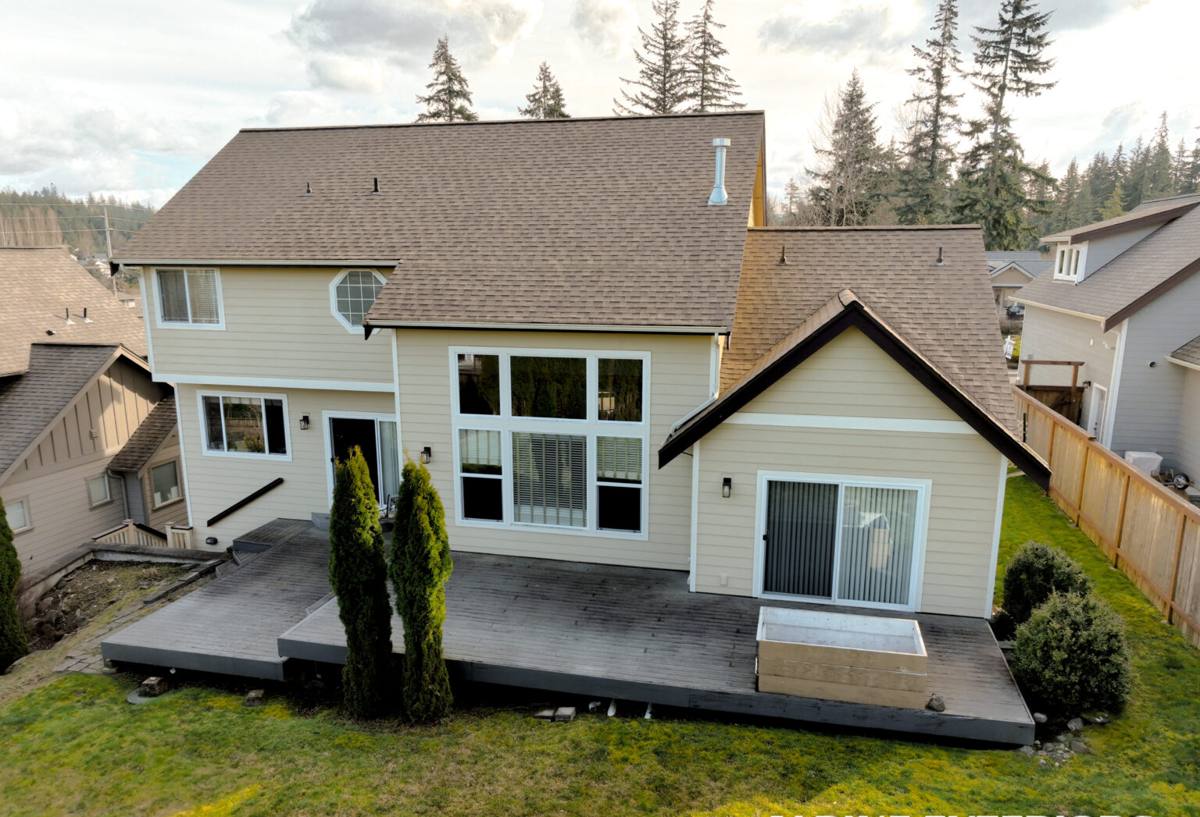
How Bellingham's Climate Wears Down Siding in This Neighborhood
Salt Air and Fastener Corrosion
Sehome is inland of the immediate waterfront, but Whatcom County's marine air still reaches homes here, and salt exposure accelerates corrosion on fasteners, trim flashing, and any exposed metal hardware. Siding that looks fine from the curb can be failing at the fastener level first, since corroding nails and screws lose their grip long before the visible face of a panel shows real damage. Material and hardware choices on a Sehome replacement should account for this from day one, not get treated as an afterthought once the estimate is written.
Wind-Driven Rain Against Older Wall Assemblies
Rain in this part of Washington rarely falls straight down. It gets pushed sideways by wind off the Sound, which drives moisture into seams, laps, and trim joints that a purely vertical rain event would never reach. Older Sehome homes were often sided decades ago under standards that didn't anticipate today's understanding of drainage planes and weather-resistive barriers, so a replacement here is as much about correcting how water is managed behind the siding as it is about what material goes on the outside.
A Long Moss and Mildew Season
Sehome's tree cover keeps a lot of exterior walls shaded for large parts of the day, and shade plus consistent moisture is exactly what moss and mildew need to establish themselves. North-facing walls and anywhere airflow is restricted tend to show growth first, and once moss or algae takes hold on a porous or aging surface, it holds even more moisture against the wall than before, speeding up whatever damage is already underway underneath.
Signs a Sehome Home Needs Full Replacement, Not Just a Repair
Not every siding problem calls for a full tear-off. But there's a point where patch repairs stop making sense, either because the damage is too widespread or because the underlying material has reached the end of what it can reasonably protect. Watch for:
- Soft, spongy, or delaminating panels, especially near the ground, under windows, or at corner trim
- Moss or dark staining that returns within weeks of cleaning, on multiple wall sections rather than one isolated spot
- Visible warping, buckling, or gaps between courses that weren't there a year or two ago
- Paint that won't hold, peeling or bubbling repeatedly even after a fresh coat
- Repair costs on an older wall that are starting to approach what a full replacement would run
- Any sign of moisture inside the home, staining, musty smell, or soft drywall, near an exterior wall
What a Correct Siding Replacement Job Actually Involves
A siding replacement that's done right is mostly about what happens before the new siding ever goes up. The visible finish is the easy part; the wall assembly underneath it is where jobs succeed or fail over the following ten or twenty years.
Tear-Off and Substrate Inspection
Full removal of the old siding lets us actually see the sheathing, framing, and any prior water damage instead of guessing at what's behind it. In a climate like this one, it's common to find at least some soft sheathing or evidence of past moisture intrusion once the old material comes off, particularly around windows, doors, and lower wall sections. That substrate has to be repaired or replaced before anything new goes on; installing over compromised sheathing just locks the problem inside the wall.
Weather-Resistive Barrier and Flashing
A correctly lapped weather-resistive barrier, integrated with window and door flashing so water sheds outward at every transition, is what actually keeps wind-driven rain out of the wall. This is the detail that separates a siding job built for this climate from one that just looks finished. Flashing at penetrations, kick-out flashing where roof lines meet walls, and proper laps at every seam matter more here than in a drier region, because this climate will find any gap eventually.
Installing James Hardie to Manufacturer Spec
Fiber cement performs the way it's rated to perform only when it's installed to the manufacturer's actual specification: correct fastener type and pattern, proper clearance from grade, decks, and roof lines, gapped and caulked joints where the spec calls for it, and factory-cut or properly sealed field cuts so raw edges aren't left exposed to weather. Skipping these details voids the product warranty and undercuts the exact moisture resistance that makes fiber cement worth installing in the first place.
Why We Install Only James Hardie Fiber Cement
We don't install LP SmartSide, vinyl siding, Cemplank, Allura, primed spruce, or cedar. That's not a sourcing decision, it's a professional standard we settled on after years of seeing how different products actually hold up in Whatcom County's specific mix of salt air, sustained moisture, and shade. Each of those alternatives works fine in some climates, or for some homeowners' budgets, but we'd rather stand fully behind one system than offer a cheaper option and let the maintenance burden land on the homeowner five or ten years down the road.
- Non-combustible core: Fiber cement doesn't feed a fire the way wood-based siding can.
- Factory-applied ColorPlus finish: Baked on in a controlled process rather than field-applied, so it resists fading and moisture better over time than site-painted alternatives.
- HZ5 formulation: Engineered for regions with heavy moisture and freeze-thaw cycling, which matches Whatcom County's climate more closely than product lines built for drier regions.
- Dimensional stability: Fiber cement doesn't swell, cup, or warp the way engineered wood can after repeated wet-season exposure.
- Transferable warranty: A meaningful warranty structure, provided installation follows Hardie's published spec, which is exactly why correct installation matters as much as the material itself.
Our Siding Replacement Process
- Walkthrough and estimate: We inspect the home in person, look at wall condition, trim, window and door flashing, and any signs of existing moisture damage before quoting anything.
- Tear-off: Old siding comes off in sections so the wall isn't left exposed to weather any longer than necessary, especially important during Bellingham's wetter months.
- Substrate repair: Any soft or damaged sheathing gets replaced, not patched over, before the weather barrier goes on.
- Weather barrier and flashing: Properly lapped house wrap and integrated flashing at every window, door, and penetration.
- Hardie installation: Panels or lap siding installed to manufacturer spec, correct fastener pattern, clearances, and joint treatment.
- Trim, caulking, and touch-up: Final detailing at corners, trim boards, and any field cuts, using Hardie-approved sealants and touch-up product.
- Final walkthrough: We go over the finished job with the homeowner and register the manufacturer warranty.
Cost Factors for a Sehome Siding Replacement
| Factor | Why It Matters |
|---|---|
| Home size and wall area | More square footage means more material and labor hours |
| Substrate condition | Sheathing repair adds cost but is not optional if moisture damage is found |
| Trim and window complexity | More corners, trim boards, and window openings mean more detail work |
| Siding profile chosen | Lap siding, panel siding, and shingle-style Hardie products carry different material and labor costs |
| Access and lot layout | Sloped or tightly landscaped Sehome lots can slow staging and material handling |
Exact numbers depend on the specific home and what we find once the old siding comes off, which is why we walk each property before quoting rather than pricing off a generic per-square-foot number.
Why Hiring a Crew That Already Works in Sehome Matters
A contractor who works across Bellingham regularly sees how this neighborhood's older housing stock, tree cover, and terrain actually behave through a full wet season, not just how a product performs on a spec sheet. That shows up in practical decisions on a Sehome job: knowing to expect some substrate repair on homes of a certain age before the tear-off even starts, planning around shaded, slower-drying wall sections, and treating flashing and drainage detail as the priority rather than rushing to get panels up. A crew that only occasionally works this specific climate is more likely to apply generic details that don't quite hold up against what Bellingham actually throws at a wall.
If your Sehome home's siding is showing its age, or you're planning ahead rather than waiting for a problem, we're glad to walk the property and give you a straightforward, no-pressure estimate. Use the form below to get started.