 Bellingham Roofing
 Decks in Birch Bay work harder than decks almost anywhere else in Whatcom County. Sitting close to the water means near-constant exposure to salt-laden air, and the same Pacific storm systems that soak Bellingham arrive here with more wind-driven force off the open water. Add in a shoulder season that stays damp and shaded for months at a time, and you've got a structure that's fighting corrosion, rot, and moss all year long. Bellingham Roofing Company repairs decks throughout Birch Bay, and this page covers what actually goes wrong out here, what a correct repair looks like, and how we approach the job.
Why Birch Bay's Climate Is Hard on Decks
Three things combine to shorten deck lifespans near the water: salt air, driving rain, and a long moss season. Salt spray carries onto exposed wood and metal even on properties set back from the shoreline, accelerating corrosion in fasteners, brackets, and any hardware that isn't rated for coastal exposure. Wind-driven rain doesn't just fall straight down here — it pushes sideways into ledger connections, under flashing, and into end grain that would otherwise stay dry. And Whatcom County's mild, wet winters give algae and moss months of uninterrupted growing conditions on any deck surface that doesn't get regular sun and airflow.
None of these factors act alone. Salt accelerates the corrosion that rain already promotes. Moss holds moisture against wood long after a storm has passed, which is exactly the condition that leads to soft, spongy boards and hidden rot in framing underneath. A deck built or repaired without this combination in mind tends to show damage years before a comparable deck further inland.
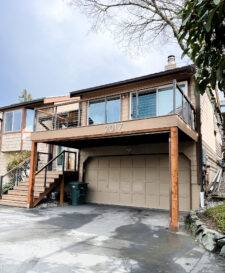
Where We Typically Find Damage
Ledger Board and Ledger Flashing
The ledger board — where the deck attaches to the house — is the single most important structural connection on most decks, and it's also the most common failure point we find. If the flashing behind it was installed poorly, or has simply worn out, water tracks behind the siding and sits against the ledger and the rim joist. This kind of rot is often invisible from the deck surface until the wood is already compromised.
Fasteners and Metal Hardware
Standard coated deck screws and joist hangers are not built for salt air. Over time we see rust streaks bleeding out of screw heads, hanger nails backing out as the metal swells with corrosion, and structural brackets that have thinned enough to lose real holding strength. This is one of the clearest differences between a deck repair done for a Birch Bay property versus one done a few miles inland — the hardware specification matters more here.
Decking Boards and Moss Growth
Wood decking that stays shaded, or that sits under overhanging trees or in the lee of the house, grows moss and algae for much of the year. Beyond the slip hazard, moss holds moisture against the board surface, which speeds up cupping, splitting, and soft spots — especially on boards that see full sun in summer and near-constant dampness the rest of the year.
Framing and Support Posts
Joists, beams, and posts that were undersized, improperly flashed, or built with lower-grade lumber show their weaknesses fastest in this climate. Post bases sitting in standing water or buried in soil or mulch are a common source of rot we find during structural inspections.
Signs Your Deck Needs Repair
Most deck problems give warning signs well before they become a safety issue. Worth checking for:
- Boards that feel soft, spongy, or spring back slowly underfoot
- Rust streaks running down from screw heads or metal connectors
- A railing that wobbles or flexes when you lean on it
- Visible gaps, cracking, or separation where the deck meets the house
- Persistent moss or dark algae staining that returns soon after cleaning
- Nails or screw heads that have backed out or lifted above the board surface
- Cupped, splitting, or checking boards, especially on sun-exposed sections
- Visible daylight or gaps around support posts where they meet the ground or footings
Any one of these on its own might just need a targeted fix. Several at once, especially near the ledger or support posts, usually means it's time for a proper structural inspection rather than a surface patch.
Repair or Replace? How We Make the Call
Homeowners understandably want to know whether a deck can be repaired or whether they're better off replacing it. The honest answer depends on where the damage is and how far it's spread. A few of the factors we weigh:
| Factor | Leans Toward Repair | Leans Toward Replacement |
|---|---|---|
| Ledger board condition | Solid, dry wood behind flashing | Soft or rotted ledger/rim joist |
| Framing (joists, beams, posts) | Isolated rot in one or two members | Widespread rot or undersized framing throughout |
| Decking surface | Scattered damaged boards | Most boards cupped, split, or soft |
| Hardware | Localized corrosion | Rust throughout connectors and fasteners |
| Deck age and original build quality | Sound original construction | Older deck with known code or design shortcuts |
In practice, a lot of Birch Bay decks fall somewhere in the middle — sound framing but corroded hardware and a handful of bad boards, for example. In that case, a targeted repair that also upgrades the hardware to coastal-rated fasteners is usually the right call, and it's a fraction of the cost of full replacement.
What a Correct Deck Repair Actually Involves
A repair that's done right addresses the cause of the damage, not just the visible symptom. That means:
- Checking the structure first. Before we touch surface boards, we confirm the ledger, joists, beams, and posts are sound. Replacing decking over a compromised frame just hides the real problem.
- Correcting flashing, not just resealing it. If water has been getting behind the ledger, the flashing detail gets fixed properly — not caulked over.
- Matching or upgrading fasteners appropriately. Hardware exposed to salt air should be rated for that exposure, not standard-grade coated screws that will corrode again in a few seasons.
- Maintaining proper drainage and board spacing. Gaps between boards need to stay clear enough for water to drain and air to circulate underneath — tight, swollen boards trap moisture and speed up rot.
- Addressing the moss, not just cleaning it. Where recurring moss growth points to a shade or drainage issue, we talk through options rather than just power-washing and moving on.
Our Deck Repair Process
- Inspection. We check the ledger connection, framing, posts, decking, and hardware, and identify what's failing structurally versus cosmetically.
- Straightforward assessment. We walk you through what we found, what needs to be fixed now, what can wait, and give you an honest repair-vs-replace recommendation.
- Structural repairs first. Any rot in the ledger, joists, beams, or posts gets addressed before anything else — this is the part that affects safety.
- Hardware and fastener upgrades. Where corrosion is a factor, we replace fasteners and connectors with hardware suited to salt-air exposure.
- Decking repair or replacement. Damaged boards are replaced with proper spacing and fastening to support drainage and airflow.
- Finish and walk-through. Where sealing or finishing is part of the scope, it's applied correctly, and we walk the deck with you before calling the job done.
Choosing Materials for a Coastal Deck
Both wood and composite decking can work well in Birch Bay, and the right choice depends on your priorities more than one being universally "better." Pressure-treated or cedar decking is more affordable up front and can be repaired board-by-board fairly easily, but it needs regular cleaning and periodic sealing to hold up against the moss and moisture cycle out here — skip that maintenance for a few years and it shows. Composite decking largely avoids the rot and moss-staining issues of wood, but it costs more initially, and if it's ever damaged, matching an older composite board's color exactly can be difficult since manufacturers change product lines over time. Neither option removes the need for sound framing and corrosion-resistant hardware underneath — the decking material is the surface, but the structure underneath it is what actually keeps a deck safe.
Why It Matters to Hire a Crew That Already Works Birch Bay
Deck repair looks straightforward on paper, but a crew that hasn't worked much on the water tends to underestimate how fast salt air and moisture cycle through hardware and framing here. We've seen the pattern enough times to know where to look first — the ledger flashing, the fastener condition, the shaded corners where moss takes hold — instead of treating every deck the same regardless of where it sits. That local pattern recognition is the difference between a repair that lasts and one that needs redoing in a couple of years. It also means we're familiar with Whatcom County permitting requirements for structural deck work, so nothing holds up your project unnecessarily.
Keeping Your Repaired Deck in Good Shape
A good repair buys you years, but a little upkeep protects that investment. A yearly rinse and gentle scrub in shaded, moss-prone areas keeps growth from establishing before it takes hold. Trimming back overhanging branches or vegetation improves airflow and sun exposure, which does more to prevent moss than any cleaner applied after the fact. Checking fastener heads and railing connections once a year for early rust or looseness catches small problems while they're still cheap and easy to fix. And if you notice soft spots, new gaps, or returning moss in the same spot repeatedly, it's worth a quick look before the next wet season rather than waiting until spring.
If your deck is showing any of these signs, or you just want an honest opinion on its condition, we're happy to take a look. Fill out the form below for a free, no-pressure estimate on deck repair for your Birch Bay property.