 Bellingham Roofing
 Why Silver Beach Homes Are Hard on Windows
Homes in the Silver Beach neighborhood deal with a version of Bellingham's climate that doesn't forgive weak spots. Moisture-heavy marine air moves through Whatcom County most of the year, driving rain comes in sideways during fall and winter storms, and the tree cover that gives this neighborhood its character also means shade, damp air, and a moss season that can run eight months or longer. None of that is unusual for the Pacific Northwest, but it adds up differently for windows than it does for, say, a roof or a deck. A window is a hole in your wall with moving parts, seals, and glass — and every one of those elements reacts to constant moisture exposure in its own way.
Older windows in this area often weren't built or installed with that reality fully accounted for. Aluminum frames from decades past conduct cold straight through and sweat on the inside. Wood sashes that aren't maintained absorb water at the joints and swell, stick, or rot. Even newer vinyl windows fail early if the flashing and sealant work behind the trim wasn't done right, because water doesn't need much of a gap to find its way into wall framing. Custom windows done correctly solve for the climate, not just for looks.
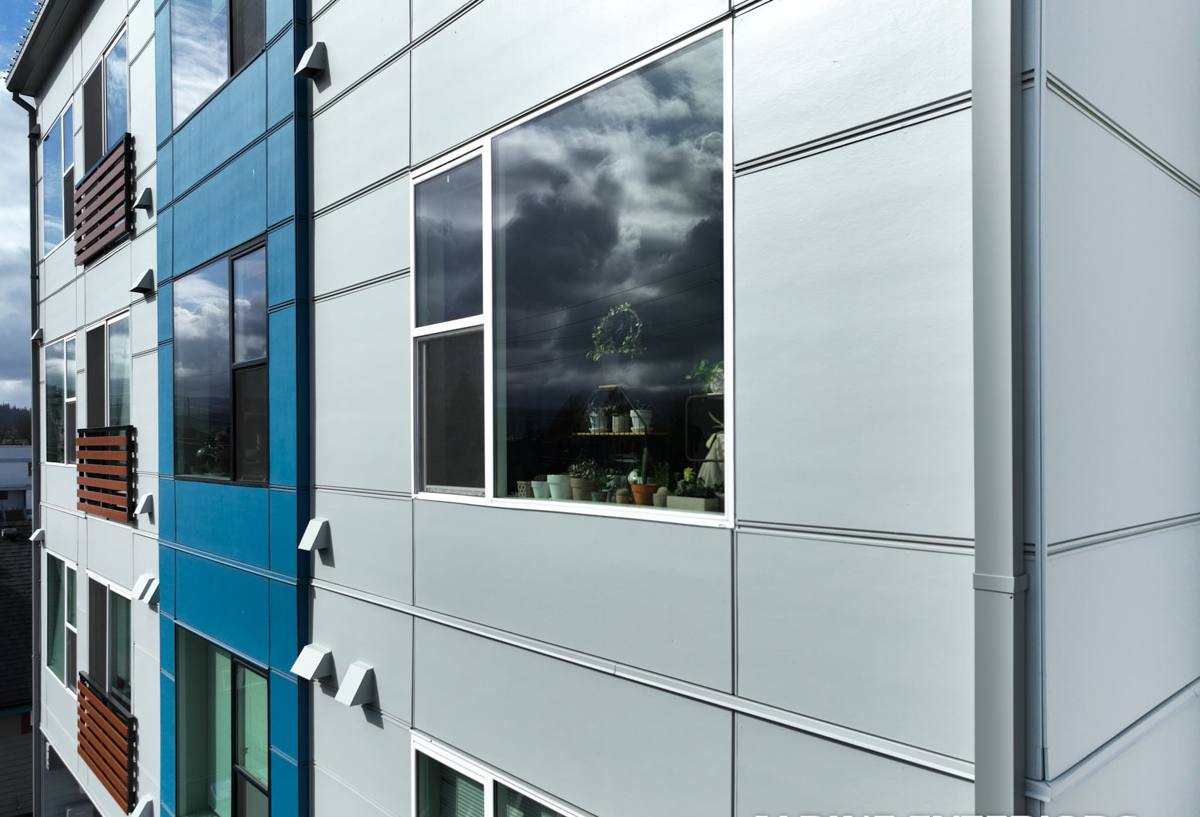
Signs Your Current Windows Are Losing the Fight
Most window failure in this climate is slow and easy to miss until it isn't. Before you decide whether you need a repair, a partial replacement, or a full custom job, it helps to know what you're actually looking at.
- Fogging or a permanent haze between panes — the seal has failed and the insulating gas is gone
- Black or green growth on the frame, sill, or trim, especially on shaded or north-facing walls
- Sashes that stick, drag, or won't stay up without a prop
- Soft or discolored wood at the sill or lower corners of the frame
- Cold drafts you can feel with a hand held near the frame on a windy day
- Condensation on the inside of the glass that shows up every cold morning
One or two of these on a single window is often a localized problem. If you're seeing them across several windows on the same side of the house, that usually points to how the whole group was installed or flashed, and it's worth having someone look at the pattern rather than patching one window at a time.
What "Custom" Actually Means Here
Fitting the Opening, Not the Other Way Around
A lot of Silver Beach homes were built across different decades, with additions, remodels, and repairs layered on over time. Rough openings are frequently a little out of square, a little off from standard sizing, or built to dimensions that predate modern window lines. Custom windows are measured and built to fit the actual opening in your wall, rather than forcing your house to accept a stock size. That matters more than it sounds like — a window that's shimmed and packed to fit an opening it wasn't built for is a window with hidden gaps, and hidden gaps are exactly where this climate gets in.
Matching the House
Custom also means matching grid patterns, trim profiles, and sightlines so new windows don't look like a patch job next to the ones you're keeping, or next to your neighbors' homes if you're doing the project in phases. For homes with any age or character to them, getting the proportions and sash style right is as much a part of the job as the performance specs.
Choosing Materials for a Marine Climate
There's no single "best" window material — there's a best fit for your home's exposure, your budget, and how much upkeep you want to take on. Here's how the common options actually perform under the wet, moss-prone conditions typical of this area.
| Material | How It Handles Moisture | Upkeep | Typical Lifespan |
|---|---|---|---|
| Vinyl | Won't rot or corrode; seams are the main watch point | Low — occasional cleaning | 20–30+ years |
| Fiberglass | Excellent — dimensionally stable, resists warping in wet-dry cycles | Low | 30+ years |
| Wood-clad | Good if the cladding stays intact; interior wood still needs protection | Moderate to high | 20–30 years with upkeep |
| Aluminum | Prone to condensation and cold transfer unless thermally broken | Moderate | Varies widely by build quality |
We don't push one material as the answer for every house. A shaded, moss-prone wall facing prevailing weather calls for a different conversation than a covered porch window that barely sees rain. Part of a proper estimate is walking the exterior and talking through which openings need the most moisture resistance and which have more flexibility.
On glass, the bigger factor for this region isn't sun control — it's condensation and heat loss. A quality double- or triple-pane unit with a Low-E coating and an insulated spacer will run warmer on the inside face of the glass, which is what keeps you from waking up to fogged-over windows on a cold, still morning. We'll walk you through glass packages that make sense for your budget rather than upselling the most expensive option on every unit.
What a Correct Installation Actually Involves
The window unit itself is maybe half the job. The other half — flashing, sealing, and how the window ties into the wall assembly — is what determines whether it holds up through fifteen wet seasons or starts failing in three. This is also the part that's invisible once trim goes back on, which is exactly why it's worth knowing what should happen.
- Old caulk, rotted framing, and failed flashing removed and inspected, not sealed over
- Proper flashing sequence at the sill and sides so any water that gets behind the trim drains back out, not into the wall
- A sill pan or equivalent water-diversion detail at the base of the opening
- Correct, even shimming so the window operates smoothly and doesn't rack over time
- Weather-appropriate sealant applied at the right points — not just a bead around the outside trim
- Interior air-sealing so conditioned air isn't leaking into the wall cavity and causing condensation from the inside out
- Final operation check on every unit before we consider the job done
Skip any one of these steps and the window can look fine for a year or two before a problem shows up as a soft spot in the siding or a stain on an interior wall. This is the step where corners get cut on rushed jobs, and it's the step that matters most in a climate like ours.
Our Process, Start to Finish
We keep the process straightforward because window replacement shouldn't feel like a mystery.
- Walkthrough and estimate. We look at each opening, note the condition of the framing and any moisture damage, and talk through material and glass options that fit your home and budget.
- Measurement and ordering. Once you approve a plan, we take precise measurements for custom-built units so the fit is right the first time.
- Removal and inspection. Old windows come out and we check the framing underneath. If there's rot or damage from a prior failed install, we address it before anything new goes in.
- Installation. New windows are set, shimmed, flashed, and sealed following the sequence above.
- Trim and finish. Interior and exterior trim work is completed to match your home.
- Walkthrough and cleanup. We check operation on every window with you and clean up the job site before we leave.
Why Working With a Crew That Knows Silver Beach Matters
Window problems in this neighborhood tend to follow patterns — which walls take the worst weather, which older homes commonly have flashing issues from a prior remodel, how much shade and moss buildup a given lot typically deals with. A crew that's worked houses in this area brings that context to your estimate instead of treating every job as a blank slate. It also means we're familiar with what Bellingham and Whatcom County require for permitting on window work, so that part of the project doesn't become a surprise partway through.
Just as important is accountability. We're not driving in from out of the area for one job and gone the next week. If a question comes up after the install — how a window is operating, how the trim is holding up through its first wet winter — we're a call away and familiar with the property.
Protecting Your Investment After Installation
New windows still need a little seasonal attention in this climate, especially anywhere moss and shade are part of the picture.
Rinse frames and sills a couple of times a year to clear pollen, moss spores, and grime before they take hold, especially on shaded or north-facing windows. Check that weep holes on vinyl and fiberglass frames stay clear so water can drain instead of pooling. Keep an eye on exterior caulking where trim meets siding, since that's the first line of defense and the cheapest thing to touch up before it becomes a bigger repair. None of this is heavy maintenance — it's the kind of upkeep that protects a correctly installed window for its full lifespan instead of letting preventable moisture problems shorten it.
If your windows are fogging, sticking, drafting, or just showing their age, we're happy to take a look and give you a straight, no-pressure assessment of what's actually going on and what it would take to fix it right. Use the form below to request a free estimate for your Silver Beach home.