 Bellingham Roofing
 Why Lynden's Weather Is Harder on Siding Than It Looks
Lynden sits inland along the Nooksack River in northern Whatcom County, and it's easy to assume that distance from the water means dry, gentle weather. It doesn't. Moisture-laden air off the Salish Sea moves through the Nooksack Valley and collides with Pacific storm fronts most of the year, producing long stretches of driving, wind-pushed rain rather than short showers. That same marine air carries a faint salt content that settles on exterior surfaces even this far from the coast, contributing to the same slow finish breakdown and corrosion that coastal Whatcom County homes deal with, just at a lower intensity.
What that means for siding is simple: it rarely gets a full day to dry out before the next system rolls through. Add in the open farmland and tree-lined rural lots common around Lynden, where morning fog and shade linger longer than in town, and you get conditions that stay damp for days at a time through fall, winter, and early spring.
Moss Season Is Real, and It's Long
North-facing walls, areas under eaves with reduced sun exposure, and siding near mature trees or hedgerows deal with a genuine moss and algae season that can run from October through April. On a wood-based or fiberboard product, trapped moisture behind moss growth is what starts rot at seams and fastener points. On a properly installed fiber cement system, moss and algae are a cosmetic issue you rinse off, not a structural one.
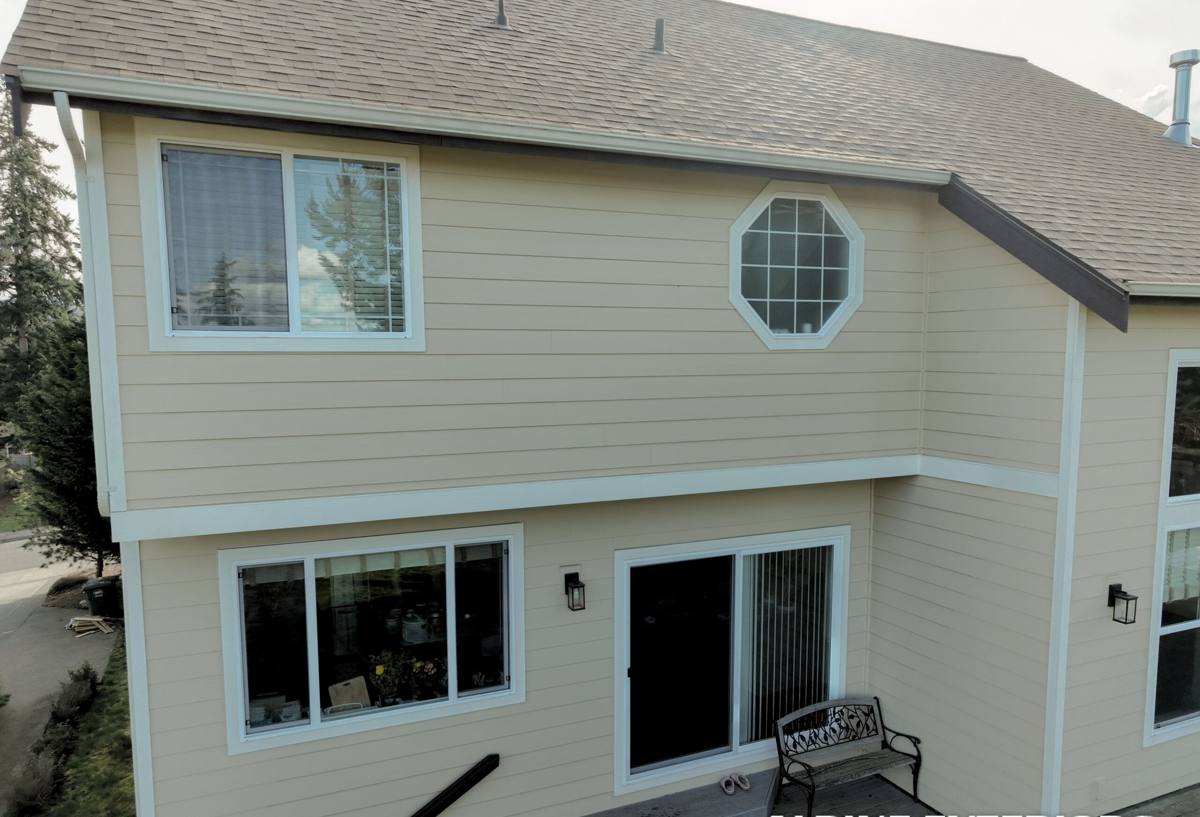
What Lynden Homes Actually Need From Their Siding
Given that climate, the priority list for siding in this part of Whatcom County is short and specific:
- Genuine moisture resistance during long wet cycles, not just water shedding on a dry day
- Dimensional stability so joints and caulk lines don't open up as the material swells and shrinks with humidity
- Resistance to insect and rot damage, which matters more on rural and semi-rural lots near open farmland
- A factory finish that holds its color through UV exposure and repeated wet-dry cycling, so a two-story farmhouse or larger rural home isn't facing a full repaint every several years
- Low ongoing maintenance for households that don't have time to babysit their exterior every season
These aren't abstract wish-list items. They're the exact failure points we see most often on older siding jobs around Lynden: caulk that's failed at trim joints, paint that's chalking and peeling on the weather-facing side of the house, and soft spots at the bottom courses where splash-back moisture never fully dries.
Why We Install Only James Hardie Fiber Cement
We made a decision as a company to install one siding system: James Hardie fiber cement. Not because it's the cheapest option on the market, but because it's engineered specifically for climates like this one. Hardie's HZ5 product line is formulated for the wetter, more temperate regions of the Pacific Northwest, which is a meaningful distinction from products built to a national average climate spec.
Fiber cement itself is non-combustible, which matters for insurance and peace of mind, and it doesn't provide the food source that wood-based siding does for moisture and insects. The ColorPlus factory finish is baked on in a controlled environment rather than field-applied, which gives it better adhesion and UV resistance than a job-site paint job, and it's backed by a transferable warranty that covers both the substrate and the finish when the product is installed to Hardie's written specifications.
We won't install vinyl, LP SmartSide, cedar, or other engineered wood products, and we're upfront about why: in a climate that stays wet as long as this one does, we've found the long-term maintenance burden and moisture sensitivity of those products isn't worth the up-front savings. That's our standard, and it's the reason we can stand behind the work we do.
What a Correct Fiber Cement Installation Actually Involves
Fiber cement siding is only as good as the installation behind it. Most of the problems we get called out to fix on other companies' work trace back to shortcuts in details that aren't visible once the siding is up.
Water Management Behind the Cladding
Siding is the second line of defense, not the first. A correctly built wall has a water-resistive barrier installed and lapped properly, flashing integrated at every window, door, and penetration, and a drainage plane that lets any moisture that gets behind the siding find its way back out instead of sitting against the sheathing.
Proper Clearances and Fastening
Hardie's spec calls for minimum clearances from grade, roof lines, and decks, along with specific fastener patterns and gapping at butt joints to accommodate slight material movement. Skipping these clearances is one of the most common causes of moisture damage we find on inspections, especially at deck ledger boards and grade-level transitions.
Field Cutting and Sealing
Every field cut needs to be made with the right blade and sealed properly, and cut edges that will be exposed to weather need to be primed and caulked, not left raw. This is a step that's easy to rush and impossible to catch after the fact without pulling boards.
Finish Details
Joint caulking, trim integration, and touch-up paint all need to match Hardie's approved products and methods to keep the warranty intact. Off-spec caulk or the wrong touch-up paint can void coverage even if the siding itself is installed correctly.
Comparing Your Options for a Lynden Home
| Material | Performance in Long Wet Seasons | Ongoing Maintenance | Typical Lifespan |
|---|---|---|---|
| Vinyl | Sheds water but can warp, gap, or crack in temperature swings; seams are a moisture entry point | Low, but limited repair options when damaged | 20-30 years |
| LP SmartSide (engineered wood) | Treated to resist moisture, but any breach in the finish exposes wood substrate to rot | Moderate; finish and caulk need regular monitoring | 20-30 years with consistent upkeep |
| Cedar | Natural material, sensitive to sustained moisture and prone to cupping, splitting, and rot without diligent upkeep | High; refinishing on a regular cycle | Varies widely with maintenance level |
| James Hardie Fiber Cement | Engineered for wet, humid climates; dimensionally stable through wet-dry cycling | Low; occasional rinse, no refinishing under normal conditions | Multi-decade with a transferable warranty |
This is a general comparison, not a claim that other materials fail outright. Each product can perform reasonably well when installed correctly and maintained on schedule. Our position is simply that, for this climate, fiber cement gives homeowners the best balance of durability and low maintenance over the long run, which is why it's the only system we put on a house.
Our Process for a Lynden Siding Project
- On-site inspection of existing siding, trim, and sheathing to check for hidden moisture damage before any work is quoted
- Assessment of the water-resistive barrier and flashing details, replacing or upgrading anything that doesn't meet current standards
- Product and ColorPlus color selection suited to the home's exposure and your preferences
- Removal of old siding and prep of the wall assembly, including repair of any rot or damage found underneath
- Installation to James Hardie's written specifications, including clearances, fastening, and sealed field cuts
- Final walkthrough and cleanup so you know exactly what was done and what to expect going forward
Why It Matters to Hire a Crew That Already Works in Lynden
Siding detailing isn't one-size-fits-all across a region. A crew that regularly works in and around Lynden knows which elevations of a home take the brunt of wind-driven rain, understands the drainage challenges common on rural and ag-adjacent lots, and is familiar with permitting through Whatcom County and the City of Lynden. That local pattern recognition shows up in small decisions, like where to add extra flashing attention or how to detail a wall that sits close to open farmland with more exposure to blowing moisture and debris. A crew unfamiliar with this specific climate is more likely to build to a generic spec rather than to what this valley actually throws at a house.
What to Ask Before You Hire a Siding Contractor
- Are you a certified installer for the specific product you're proposing, and can you show documentation?
- Will the water-resistive barrier and flashing be inspected and upgraded if needed, or just covered over?
- What clearances and fastening spec will you follow, and is that written down in the contract?
- Does your installation keep the manufacturer's transferable warranty intact, and what would void it?
- Can you explain how you'll detail the sides of the house most exposed to wind-driven rain?
Caring for Fiber Cement Siding After Installation
One of the practical advantages of fiber cement in this climate is how little it asks of you afterward. An annual rinse with a garden hose (not a pressure washer held too close) knocks down moss and algae before it builds up. Keep gutters clean so water isn't sheeting down the wall face, and check caulk lines at trim and penetrations every year or two, since caulk is the one component that ages faster than the siding itself. Beyond that, there's no refinishing cycle to plan for the way there is with wood.
If you're weighing a siding project on a home in Lynden, we're happy to take a look, walk the exterior with you, and give you a straightforward, no-pressure estimate. There's no cost to have us come out and tell you what we actually see.