 Bellingham Roofing
 Why Roofs in Puget Take a Different Kind of Beating
If you own a home in the Puget area, you already know your roof works harder than roofs inland. You're close enough to the water that salt-laden air reaches your shingles and metal fasteners year-round, exposed enough to driving rain that blows in sideways off the Sound during winter storms, and shaded enough by conifers and marine cloud cover that moss gets a long, uninterrupted growing season most of the year. None of that is unique to any one property in Puget — it's just what this stretch of Whatcom County does to a roof over time. A new roof installation here has to be built with that reality in mind from the first course of shingles to the last ridge cap, not treated like a generic re-roof.
Salt air and marine humidity
Salt air accelerates corrosion on exposed metal — nails, flashing, valley metal, vent boots — faster than it does even a few miles inland. It also keeps roofing materials damp longer after a storm passes, since the humidity doesn't burn off as quickly near the water. Materials and fasteners that aren't rated for this kind of exposure tend to show rust streaks and premature wear years before they should.
Driving rain off the Sound
Bellingham's winter weather doesn't just rain straight down — wind-driven rain gets pushed sideways and upward under shingle tabs, around chimneys, and into any flashing detail that's slightly undersized. A roof that would perform fine in a drier, calmer climate can leak within a few seasons here if the underlayment and flashing weren't installed with that wind-driven moisture in mind.
A moss season that never really ends
Cool temperatures, filtered shade, and near-constant moisture give moss almost year-round conditions to establish itself in Puget. Once moss gets a foothold under shingle tabs, it holds water against the roof surface, lifts shingles as it grows, and shortens the life of the roof underneath it. A new roof installed without moss-resistant details is starting that fight from day one.
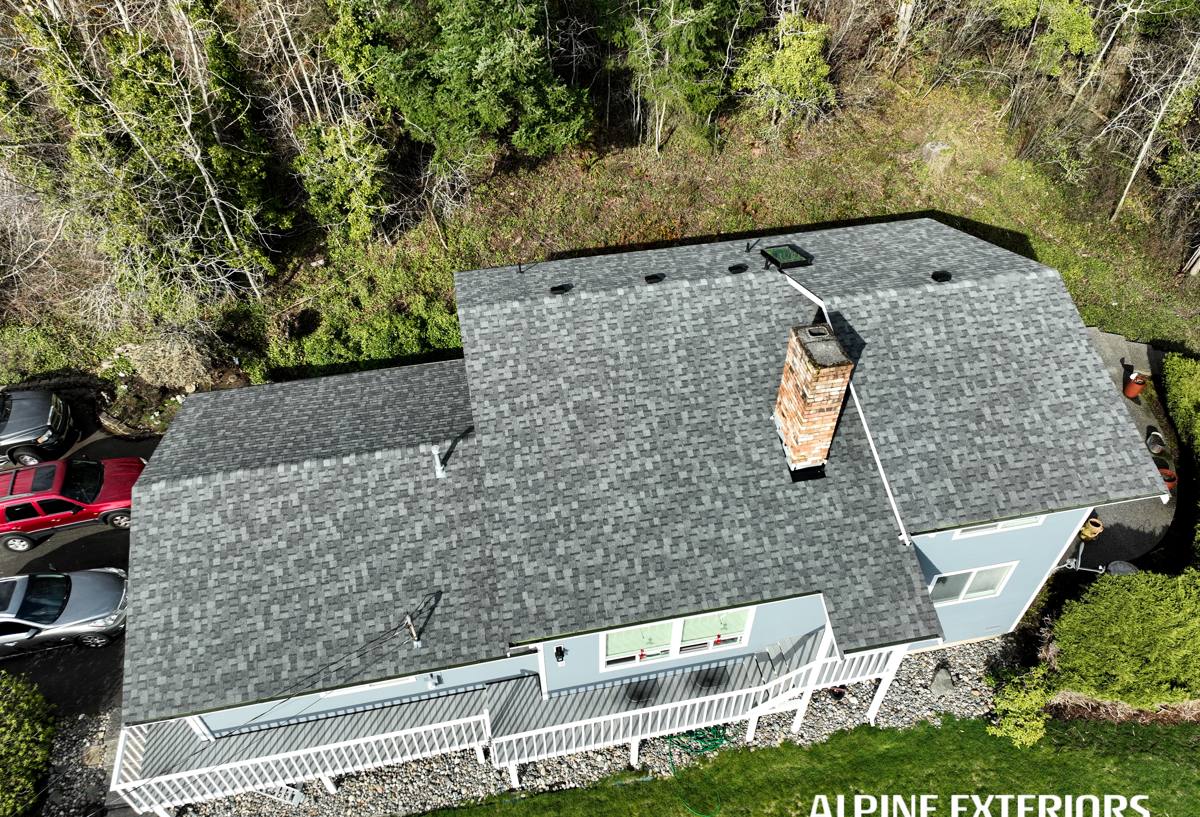
What a Correct New Roof Installation Actually Involves
A new roof is more than shingles nailed to a deck. Done right, it's a layered system where every component is chosen and installed to handle the specific conditions of your site.
Tear-off and deck inspection
We remove the old roofing down to the deck rather than layering over it. That's the only way to find soft spots, delaminated plywood, or water-damaged sheathing before they're sealed under a new roof for another 20-30 years. Any damaged decking gets replaced before anything else goes down.
Underlayment built for wet climates
In a region with as much sustained rainfall as Whatcom County sees, we don't treat underlayment as an afterthought. Synthetic underlayment across the full deck, with self-adhered ice-and-water membrane at eaves, valleys, and roof penetrations, gives the roof a second line of defense if wind-driven rain ever gets past the shingles themselves.
Flashing that actually sheds water
Chimneys, skylights, sidewalls, and valleys are where most roof leaks start — not in the open field of shingles. We install new flashing at every one of these transitions rather than reusing old pieces, with step flashing and counter-flashing sized to handle rain that's being pushed sideways by wind, not just falling straight down.
Ventilation that matches the climate
A roof deck that can't breathe traps moisture from both directions — humid air rising from the house and damp air sitting on the roof surface outside. Balanced intake and exhaust ventilation keeps the deck drier, which matters more here than in drier climates because there's less opportunity for the wood to dry out between rain events.
Choosing a Roofing Material for Puget's Marine Climate
There's no single "best" roofing material for every home, but some perform noticeably better than others under salt air, sustained moisture, and heavy moss pressure. We'll walk through the honest trade-offs of each option rather than push whatever's easiest to install.
| Material | Moss & moisture resistance | Maintenance | Typical lifespan here |
|---|---|---|---|
| Architectural asphalt shingle (algae-resistant) | Good, with copper or zinc granules that inhibit moss and algae growth | Periodic soft-wash cleaning recommended | 25-30 years |
| Standing seam metal | Very good — smooth surface sheds moss and debris, minimal organic growth | Low; occasional fastener and sealant checks | 40-50+ years |
| Cedar shake | Requires diligent upkeep — natural wood holds moisture and is a preferred surface for moss | High; regular treatment and moss removal | 20-25 years with upkeep |
| Synthetic composite shake/slate | Good — engineered surface resists moisture absorption better than natural wood | Low to moderate | 30-50 years depending on product |
We're upfront that cedar shake, while a classic look in the Pacific Northwest, asks the most of a homeowner in a climate like this — its appeal is real, but so is the maintenance commitment needed to keep it performing well near the water. Metal and algae-resistant architectural shingles tend to give Puget homeowners the best balance of upfront cost, appearance, and long-term performance without constant upkeep.
Ventilation and Moisture Control: The Part Homeowners Don't See
Most of what determines whether a roof lasts 15 years or 35 in this climate happens where you can't see it — inside the attic or roof deck. Trapped moisture from poor ventilation leads to sheathing rot, mold on the underside of the deck, and premature failure of the underlayment from the inside out, regardless of how good the shingles on top are.
On every new roof installation, we assess existing intake (soffit vents) and exhaust (ridge vents, roof vents) and correct any imbalance. A lot of older Puget-area homes were built with intake that's been painted over or blocked by insulation, which quietly undermines an otherwise good roof. Fixing that during the re-roof costs far less than dealing with rot damage later.
Signs Your Puget Home Needs a New Roof, Not Another Repair
Homeowners often ask us to look at a leak and end up learning the roof itself is past the point where another patch makes sense. These are the signs worth taking seriously:
- Shingles that are cupping, curling, or losing significant granules, especially on south- and west-facing slopes
- Thick moss growth that keeps returning within months of cleaning
- Soft or spongy spots when walking the roof, or sagging visible from the ground
- Daylight visible through the roof deck from inside the attic
- Rust streaking or corrosion around flashing, vents, or fasteners
- Repeated leaks in different spots after multiple repairs
- A roof approaching or past 20-25 years old with no major upgrades since installation
If you're only seeing one or two of these, a repair may still make sense. If several apply at once, a repair is usually just delaying a bigger job while the deck underneath keeps absorbing damage.
Our Installation Process, Start to Finish
- On-site inspection and estimate — we look at your current roof, attic ventilation, and any problem areas, and walk you through honest options and costs.
- Material selection — we help you weigh the trade-offs in the table above against your budget and how the home will be used.
- Scheduling around Whatcom County weather — we plan installation for dry weather windows whenever possible and take precautions to keep the deck protected if conditions turn.
- Tear-off and deck repair — full removal of old roofing, with any damaged sheathing replaced before new materials go down.
- Underlayment, flashing, and ventilation installation — the layered system described above, installed to the manufacturer's specifications for full warranty coverage.
- Final walkthrough — we review the completed roof with you, clean up the site thoroughly, and go over care and maintenance specific to your new materials.
Permits, Timeline, and What to Expect During the Job
Most residential re-roofs in and around Bellingham require a building permit, which we handle as part of the job so you don't have to navigate that process yourself. A typical single-family home re-roof takes between two and four days depending on size, roof complexity, and weather — and in this climate, weather is the biggest variable. We'd rather push a start date a day or two for a dry window than rush a job in the rain and compromise the underlayment or deck.
Expect some noise and a job site that needs vehicle and pet clearance during work hours, along with a magnetic sweep of the yard afterward for stray nails. We keep you informed of the schedule and any changes rather than leaving you to guess.
Why Hiring a Crew That Already Works in Puget Matters
A new roof installation is a long-term bet on how well it was installed, not just what materials went on it. A crew that already works regularly in Puget and the surrounding Bellingham area knows which details actually matter here — how much ice-and-water membrane a valley needs when winter storms come off the Sound, how aggressively to detail ventilation given the moss season, and which fastener and flashing materials hold up best against the salt air near the water. That local pattern recognition is the difference between a roof that's technically up to code and one that's actually built for what Whatcom County weather will do to it over the next few decades.
It also means straightforward, local communication throughout the job — someone who can walk your roof, explain what they're seeing in plain terms, and stand behind the work afterward because they're not going anywhere.
If your roof in Puget is showing its age or you're just trying to plan ahead, we're happy to take a look and give you a straightforward, no-pressure estimate — no hard sell, just an honest read on where your roof stands and what your options are. The form below is the easiest way to get started.