 Bellingham Roofing
 Why Birch Bay Homes Take a Different Kind of Beating
Birch Bay sits right on the water, and that changes what a home's exterior has to survive. Homes a few miles inland in Bellingham deal with plenty of rain, but they aren't sitting in a steady drift of salt-laden air coming off the bay. That salt film settles on siding, trim, and fasteners day after day, and it's a slow, quiet kind of damage — you don't see it happening, you just eventually notice chalky residue, corroded hardware, and finishes that dull faster than they should.
Add to that the wind. Open water means fewer windbreaks, so storms push rain sideways into walls instead of letting it run straight down. That's called wind-driven rain, and it finds every gap a standard installation leaves behind — a poorly lapped seam, a light bead of caulk, a fastener that missed the framing. On a sheltered inland lot those small mistakes might go unnoticed for years. On a waterfront-adjacent Birch Bay wall, they show up fast.
Then there's moss. Whatcom County's wet season runs long, and shaded, north-facing walls near mature trees or close to the water stay damp for months at a stretch. That's exactly the environment moss and mildew need to take hold. On wood or wood-composite siding, moss isn't just cosmetic — it holds moisture against the surface and accelerates rot underneath. None of this means Birch Bay is a bad place to build. It means the siding and the installation need to be matched to the actual conditions on that lot, not to a generic spec sheet.
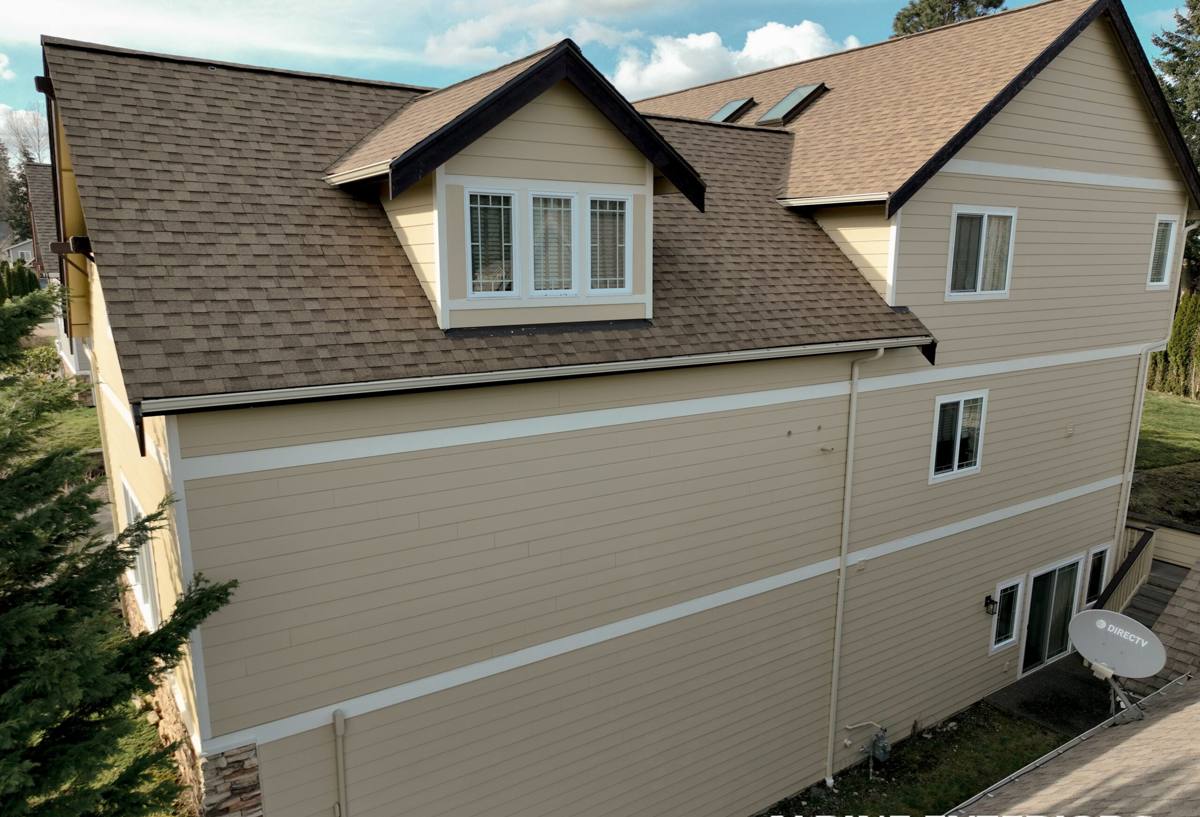
What a Correct Installation Actually Involves
Siding failures in coastal Whatcom County are rarely about the product alone — they're almost always about installation details that got rushed or skipped. A few of these matter more in a Birch Bay setting than almost anywhere else in the area:
Drainage and the rainscreen gap
A small air gap between the weather-resistant barrier and the back of the siding lets any moisture that does get past the surface drain and dry out instead of sitting against the wall sheathing. In a high-exposure spot like Birch Bay, skipping this gap is one of the fastest ways to trap moisture where you can't see it.
Flashing at every penetration
Windows, doors, hose bibs, light fixtures, vents — every place something punches through the siding is a place water wants to get in, especially when it's arriving sideways. Correct flashing, lapped the right direction and sealed with the right materials, is what keeps wind-driven rain out at those points.
Fastener choice and placement
Salt air is hard on hardware. Fasteners need to be corrosion-resistant and driven at the manufacturer's specified depth and spacing — not just close enough. Overdriven or underdriven fasteners are a common, avoidable cause of early siding problems.
Sealed cut edges
Every time a board is cut on site, that raw edge needs to be primed or sealed before it goes up. An unsealed cut edge is a direct path for moisture into the material, and in a salt-air environment that exposure gets worse faster.
Why We Install Only James Hardie Fiber Cement Here
We don't offer vinyl, LP SmartSide, Cemplank, Allura, or bare wood siding — not because those products can't be installed correctly somewhere, but because we've made a professional call that James Hardie fiber cement is the right standard for the homes we work on, and that call matters even more in a place like Birch Bay.
Fiber cement is dimensionally stable — it doesn't swell, cup, or warp with moisture cycling the way wood and wood-composite products can. That matters on a site where the material is wet more often than it's dry for a good chunk of the year. It's also non-combustible, which is a real consideration anywhere in Western Washington's wildfire-adjacent summers, even in a coastal community.
James Hardie's HZ5 product line is engineered specifically for climates like ours — the Pacific Northwest's freeze-thaw cycles, prolonged damp seasons, and marine exposure. The ColorPlus factory finish is baked on in a controlled environment rather than field-applied, which gives it better fade and chip resistance than site-applied paint, and that finish quality holds up better against the low-grade sandblasting effect of salt air over time. Hardie also backs its products with a strong, transferable warranty — useful for homeowners who may sell within the life of the siding, which is common in a desirable waterfront community like Birch Bay.
None of this means other products are junk. It means that once you factor in salt exposure, wind-driven rain, and a long moss season, the trade-offs of cheaper or more moisture-sensitive materials stop making sense to us as installers who have to stand behind the work.
Coastal Exposure Factors and What They Mean for Your Siding
| Exposure Factor | What It Does to Siding | How We Address It |
|---|---|---|
| Salt-laden air | Corrodes fasteners and trim, dulls finishes faster than inland exposure | Corrosion-resistant fasteners, factory-cured ColorPlus finish, sealed cut edges |
| Wind-driven rain | Pushes water sideways into seams, laps, and penetrations | Proper flashing sequence, correct lap and overlap, tested weather barrier |
| Shaded, damp walls | Encourages moss and mildew growth, traps moisture against the surface | Rainscreen drainage gap, material that resists rot rather than feeding it |
| Long wet season | Extends the window materials stay saturated, stressing seams and fasteners | Dimensionally stable fiber cement that doesn't swell or cup with moisture cycling |
Our Installation Process, Step by Step
- On-site assessment: We look at wind exposure, shading, existing moisture damage, and how the current siding has held up before recommending a scope of work.
- Removal and substrate check: Old siding comes off and we inspect the sheathing underneath for rot or soft spots before anything new goes up — covering damaged sheathing just hides a problem.
- Weather barrier and rainscreen: A weather-resistant barrier goes on first, followed by a drainage gap system so any moisture that gets past the siding can escape instead of sitting against the wall.
- Flashing installation: Windows, doors, and every penetration get flashed and lapped correctly before the siding closes in around them.
- Siding installation: James Hardie panels or lap siding go up to manufacturer specification — correct fastener type, spacing, and depth, with cut edges sealed as we go.
- Trim, caulking, and touch-up: Joints and trim are sealed with products rated for exterior, coastal use, and any factory finish touch-ups are done to match.
- Final walk-through: We review the finished job with the homeowner and point out anything worth knowing for long-term upkeep.
Realistic Maintenance for a Salt-Air, Moss-Prone Property
One of the practical advantages of fiber cement in this setting is how little upkeep it needs compared to wood siding — but "little" isn't "none." A few habits go a long way for homeowners in Birch Bay:
- Rinse the exterior once or twice a year to remove accumulated salt film, especially on walls facing the water.
- Walk the perimeter after major windstorms and check for loose or damaged trim, since that's usually the first thing to show wear.
- Watch shaded, north-facing walls for early moss or algae growth and clean it before it spreads.
- Check caulking at windows, doors, and trim joints every year or two — caulk is a maintenance item even on a low-maintenance siding system.
- Keep an eye on gutters and downspouts; overflow running down a wall accelerates staining and moisture exposure right where you don't want it.
Signs Your Current Siding May Already Be Failing
Coastal exposure tends to expose weak installation work years before it would show up inland. Worth a closer look if you notice:
- Soft spots or visible buckling, especially near the bottom of walls or around windows
- Paint or finish that keeps failing in the same spots no matter how often it's touched up
- Moss or algae staining that comes back within a season of cleaning
- Visible gaps at seams, corners, or trim joints
- A musty smell or unexplained moisture inside exterior-facing rooms
Any one of these can point to a moisture path that's been open for a while. Catching it early is a lot cheaper than dealing with sheathing damage later.
What to Ask Before Hiring a Siding Contractor for a Birch Bay Home
| Factor | Why It Matters |
|---|---|
| Local, coastal project experience | Wind-driven rain and salt exposure are specific problems — a crew that's worked them before will plan for them |
| Manufacturer certification | James Hardie's warranty coverage depends on installation meeting their published specifications |
| Rainscreen/drainage detail included | Skipping it is a common corner-cutting shortcut that only shows up years later |
| Written scope covering flashing and fasteners | Vague estimates often mean vague installation standards |
| Tear-off vs. install-over-existing | Installing over damaged or wet substrate hides problems instead of solving them |
Why the Installer Matters as Much as the Product in Birch Bay
James Hardie siding is only as good as the installation behind it, and that's especially true right on the water. The same product, installed correctly with proper flashing, a drainage gap, and the right fasteners, can outperform a rushed job by years — and the difference usually isn't visible until a storm season or two later, when the shortcuts show up as leaks, staining, or trim failure. A crew that already works Birch Bay regularly knows which walls take the worst of the wind, where moss tends to establish first, and how much margin to build in around flashing and sealant so the job holds up under actual coastal conditions, not just fair-weather ones.
If you're weighing a siding replacement or repair on a Birch Bay home, we're glad to take a look and talk through what your specific lot and exposure actually call for. Reach out for a free, no-pressure estimate using the form below.