 Bellingham Roofing
 New-Construction Windows for Silver Beach Homes
Building new in Silver Beach means you get one real chance to put windows in correctly the first time. Unlike a replacement job, where the opening already exists and the old unit tells you what worked and what didn't, new construction is a blank slate. That's an advantage if the framing, flashing, and window selection are handled right from the start — and a long-term liability if they're not. Silver Beach sits close enough to Bellingham Bay and Lake Whatcom that homes here take on a mix of marine air, wind-driven rain, and shaded, moisture-holding tree cover depending on the lot. The window package and the install method both need to answer to that, not to a generic spec sheet.
We install new-construction windows on builds throughout Bellingham and Whatcom County, and Silver Beach jobs come with their own pattern of considerations — lot orientation relative to water and wind, tree canopy that keeps siding and trim damp longer into the day, and the practical realities of coordinating with a general contractor's schedule on a neighborhood where driveways and staging space are often tight.
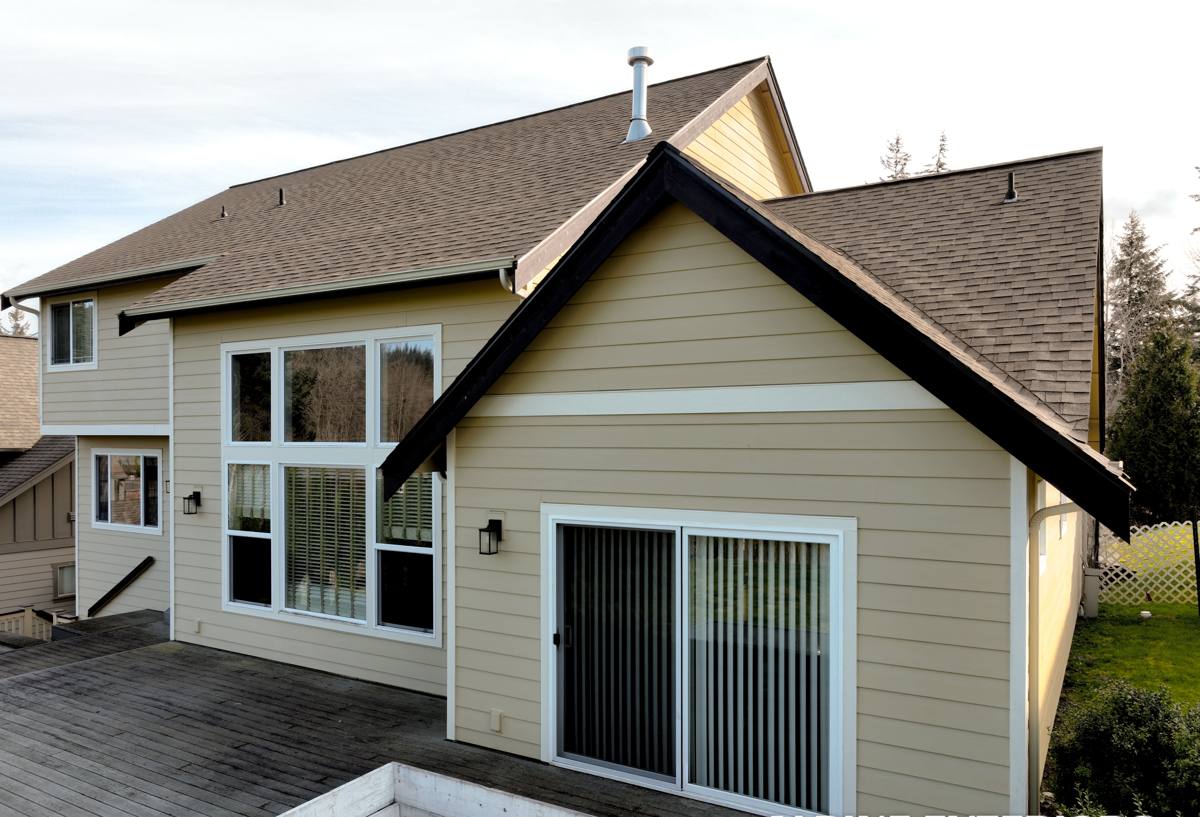
Why the Local Climate Drives the Spec
Whatcom County doesn't get the extreme storms some regions do, but it gets something arguably harder on a building envelope: near-constant low-grade moisture exposure. Salt-tinged marine air accelerates corrosion on fasteners and hardware that aren't rated for it. Driving rain — wind-pushed rather than straight-down — finds gaps that a fair-weather installation would never expose. And the long moss season, which in this climate can run most of the year on north-facing and shaded elevations, keeps organic growth active on sills, trim, and anything with a flat horizontal surface that doesn't shed water fast.
None of that shows up as a problem in year one. It shows up in year five or eight, as soft trim, staining below sill corners, or a window that starts sticking because the frame absorbed moisture it was never sealed against. New construction is where you get ahead of that timeline instead of chasing it later.
What This Means in Practice
- Fasteners and hardware should be corrosion-resistant, not just standard-grade, especially on elevations facing open water or prevailing wind.
- Sill pans and end dams matter more here than in drier climates — a window that only sheds water forward, not sideways, will eventually leak at the corners.
- Flashing tape and sealants need a real cure/bond window, which means install timing has to work with the weather, not against it.
- Overhangs and trim details that shed water away from the wall plane pay for themselves over the life of the house.
What Correct New-Construction Window Installation Involves
New-construction windows are installed into a rough opening before or during the siding phase, using a nailing flange (or, on some products, a block-frame method) that ties into the home's weather-resistive barrier. The sequence matters as much as the window itself:
- Rough opening check. Confirm the opening is square, plumb, and sized correctly before the window ever gets set — fixing framing after the window is in is far more expensive than catching it beforehand.
- Sill pan flashing. A sloped or pre-formed sill pan directs any water that gets past the window back outside the wall assembly, rather than letting it sit against wood framing.
- Weather-resistive barrier integration. The house wrap or building paper has to lap correctly with the window flange — water management only works if every layer sheds down and out, in the right order.
- Flange and corner sealing. Flashing tape at the flange, with special attention to the corners, where most manufacturer flashing systems are weakest if not detailed by hand.
- Shimming and fastening. Proper shim placement keeps the frame from bowing, which affects both operation and long-term seal performance.
- Interior and exterior sealant. Backer rod and sealant where appropriate, sized to the gap rather than just caulked over.
Skip or rush any one of these steps and the window can still look fine — and pass a casual walkthrough — while having a real weak point that only shows up once the marine air and rain season have had a few years to work on it.
Choosing Window Products for a Silver Beach Build
Frame material is a real decision on new construction, not just an aesthetic one. Each option has trade-offs worth weighing honestly against this climate rather than against a marketing sheet.
| Frame Material | How It Handles This Climate | Trade-Offs to Know |
|---|---|---|
| Vinyl | Good moisture resistance, no corrosion risk, budget-friendly | Can expand/contract with temperature swings; quality varies widely by manufacturer |
| Fiberglass | Very stable dimensionally, holds up well to sustained damp exposure | Higher upfront cost than vinyl |
| Wood (clad or unclad) | Classic look, good insulator | Unclad wood needs real maintenance discipline in this climate; cladding shifts that burden to the exterior finish |
| Aluminum | Strong and slim sightlines | Poor insulator unless thermally broken; more prone to condensation without a break |
We don't push one material as universally "best" — we help you match the material to the elevation, the exposure, and the maintenance level you actually want to keep up with. A shaded, moss-prone north wall and a wind-exposed west wall on the same house can reasonably call for different priorities.
How We Work With Your Builder
On new construction, the window install has to fit inside someone else's schedule — usually a general contractor's framing-to-siding sequence. We coordinate directly with the GC or owner-builder so windows arrive and get set at the right point: after the rough opening is framed and inspected, and timed so flashing and sealants aren't being asked to perform in the middle of a downpour.
That coordination includes:
- Confirming rough opening sizes against the window order before anything is on site, so there's no framing rework mid-build.
- Scheduling install around weather windows realistic for Whatcom County, not an idealized calendar.
- Photo-documenting flashing and sill pan details before they're covered by siding — so there's a record of what's behind the wall if it's ever needed later.
- Walking the finished install with the builder or homeowner before final trim goes on, while corrections are still easy.
Energy Code and Permitting Notes
Washington's state energy code sets minimum performance requirements for new-construction windows, including U-factor limits that affect which products qualify for permit sign-off. Bellingham and Whatcom County building departments review these as part of the standard permitting process. We factor code compliance into product selection up front rather than treating it as a paperwork step at the end — the goal is a window package that clears inspection and performs well in this climate, not just one that meets the bare minimum on paper.
Egress requirements for bedrooms and other code-defined spaces also shape sizing and operable-window placement on new builds. These are easy to get wrong on paper and expensive to fix after drywall — another reason the rough opening and window schedule should be confirmed early, together.
Common Mistakes We See on New Builds
Most window problems we get called to fix later trace back to a handful of install shortcuts, not the product itself. On new construction specifically, we watch for:
- Flashing tape applied to a dirty, wet, or dusty surface — it may look sealed but won't actually bond.
- Sill pans skipped or improvised instead of properly sloped and end-dammed.
- House wrap lapped in the wrong order at the flange, so water gets directed behind the barrier instead of over it.
- Fasteners driven too tight or too loose, distorting the frame just enough to affect long-term seal or operation.
- Trim and sealant details that trap moisture instead of shedding it, especially on shaded elevations where moss and algae take hold fastest.
Every one of these is invisible at final walkthrough and obvious five years later. Catching them requires knowing what to look for during the install, not after the siding is closed up.
Why Local Experience on Silver Beach Builds Matters
A crew that's worked new construction elsewhere can still install a window correctly in general terms. What local, Silver Beach-specific experience adds is judgment on the details that don't show up in a manufacturer's install guide: which elevations on a given lot take the worst wind-driven rain, where moss and shade are going to be a long-term maintenance issue, and how a particular builder's framing tolerances tend to run on jobs in this area. That judgment is built from doing the work here repeatedly, not from a single job or a generic checklist.
We're a Bellingham-based crew that works throughout Whatcom County, and new-construction window packages in neighborhoods like Silver Beach are a regular part of that work — not a one-off. That means fewer surprises during install and a product and detailing choice that's already been weighed against exactly the conditions your new home will sit in.
If you're planning a new build in Silver Beach and want the window package handled right from rough opening to final trim, we're happy to walk the plans with you and provide a free, no-pressure estimate — just fill out the form below.