 Bellingham Roofing
 Roof Replacement Built for Sudden Valley Conditions
Sudden Valley sits close to Lake Whatcom, wrapped in mature trees and a canopy that keeps yards shaded and streets quiet. That same setting is hard on a roof. Heavy tree cover means shade that never fully burns off, and shade plus moisture is exactly what moss, algae, and lichen need to take hold. Add in the salt air that drifts up from the Puget Sound and Bellingham Bay, months of driving rain through fall and winter, and the wide temperature swings between a cold Whatcom County morning and an afternoon sun break, and you have a roofing environment that punishes anything installed without the right materials or the right technique.
A roof replacement in this neighborhood isn't just about swapping old shingles for new ones. It's about accounting for the tree debris, the shaded slopes that dry slower than the rest of the roof, and the private, gated layout of the community itself when it comes to scheduling access, staging materials, and coordinating with any association guidelines that apply to exterior work.
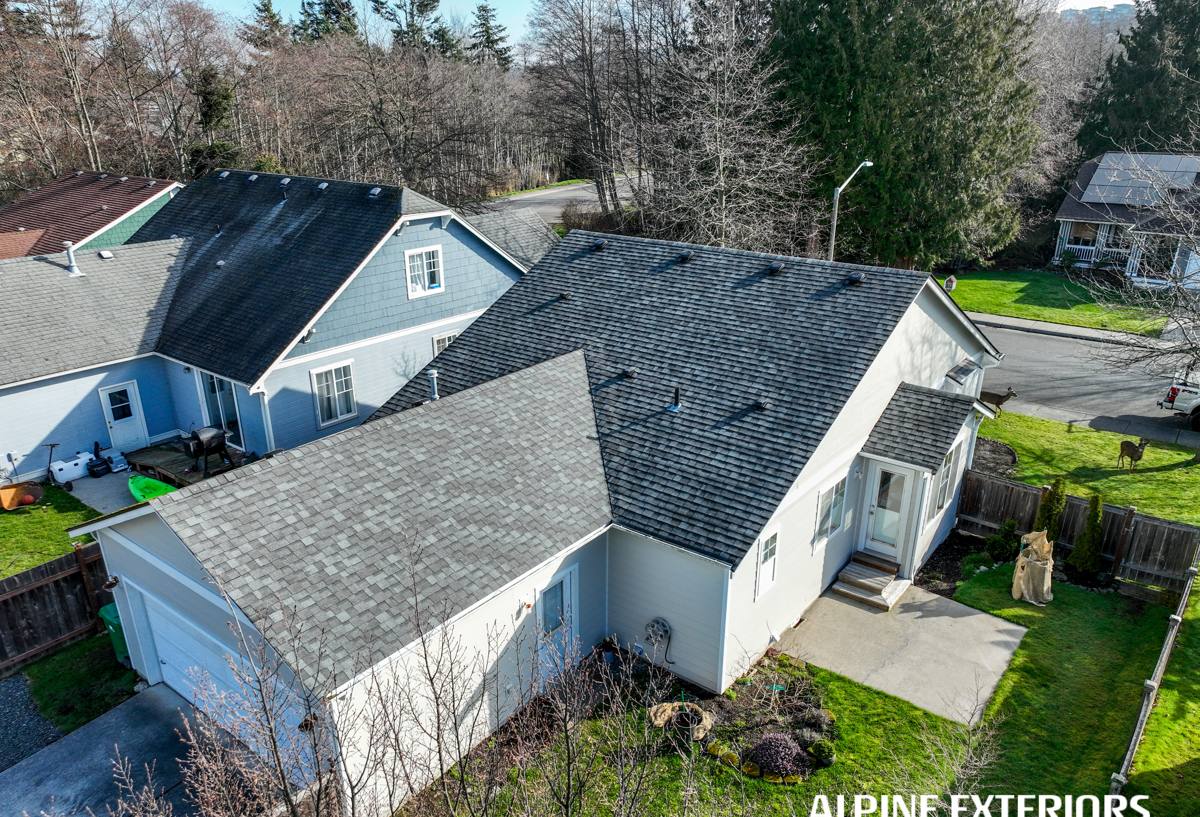
Why Roofs Age Faster in Sudden Valley
Moss and Organic Growth
Shaded, north-facing slopes under tree cover stay damp long after the rest of the roof has dried out. Moss doesn't just sit on top of shingles — its root structure works into the granule surface, lifts shingle edges, and holds water against the roof deck. Left alone through a few wet seasons, that moisture intrusion turns into soft decking, not just a cosmetic problem.
Salt Air and Moisture Cycling
Homes throughout Whatcom County near open water deal with airborne salt that accelerates corrosion on exposed metal — flashing, fasteners, vent stacks, and gutter hardware. Combined with the region's near-constant humidity, metal components corrode faster here than they would in a dry inland climate, which is why fastener and flashing selection matters as much as the shingle itself.
Driving Rain and Wind-Driven Water
Pacific storms don't always fall straight down. Wind-driven rain pushes water sideways and upward under poorly lapped shingles, around undersized flashing, and through nail heads that weren't properly sealed. A roof that looks fine in a light drizzle can still leak in a real Whatcom County storm if the underlayment and flashing details weren't done correctly the first time.
Signs a Sudden Valley Roof Needs Replacing, Not Patching
- Moss or algae streaking that returns within a season or two of cleaning
- Shingles that are cupping, curling, or losing granules in visible patches
- Soft or spongy spots on the deck when walked, especially near valleys or under tree limbs
- Daylight visible through the attic roof boards, or damp insulation after a storm
- Flashing around chimneys, skylights, or vent pipes that's rusted, lifted, or cracked
- A roof approaching or past the manufacturer's expected service life for its material
- Repeated small leaks that keep showing up in different spots each winter
One or two of these on their own might mean a repair is enough. Several at once, especially combined with an aging roof, usually means patching is just delaying a full tear-off — and spending money on repairs to a roof that needs replacing rarely pays off.
What a Correct Roof Replacement Actually Involves
A roof replacement done right is a sequence, and skipping steps is where most premature failures start. Here's what should happen on a Sudden Valley home:
- Full tear-off. Old roofing material is removed down to the deck — not overlaid. Overlaying traps moisture and hides deck damage that needs to be found and fixed.
- Deck inspection and repair. Any soft, delaminated, or water-damaged plywood or OSB gets replaced before anything new goes down. This is also when hidden moss or moisture damage from years of shaded conditions typically shows up.
- Ice and water shield at vulnerable points. Valleys, eaves, and roof-to-wall transitions get a self-adhering waterproof membrane, which matters more here than in drier climates given how often wind-driven rain finds these weak points.
- Synthetic underlayment across the field. A quality synthetic underlayment sheds the incidental moisture that gets past the roof covering during heavy, prolonged rain events — a near-certainty during a typical Whatcom County winter.
- New flashing at every penetration. Chimneys, skylights, vent stacks, and sidewalls all get new metal flashing rather than reusing old pieces, especially given how salt air accelerates corrosion on anything left in place.
- Roof covering installation. Shingles, metal, or another material installed to manufacturer spec — correct nailing pattern, correct exposure, correct starter and ridge details.
- Ventilation check. Balanced intake and exhaust ventilation keeps the attic dry and temperature-regulated, which reduces moisture buildup that feeds moss and mildew from the underside of the deck.
- Cleanup and magnetic sweep. Old material, debris, and stray fasteners cleared from the yard and driveway — important on wooded lots where debris can hide in landscaping.
Choosing the Right Roofing Material for This Neighborhood
There's no single "best" roofing material for every home — it depends on roof pitch, budget, tree cover, and how much long-term maintenance an owner wants to take on. Here's how the common options stack up for a shaded, moisture-heavy property like the ones found throughout Sudden Valley.
| Material | Moss/Moisture Resistance | Typical Lifespan | Maintenance |
|---|---|---|---|
| Architectural Asphalt Shingle | Good with algae-resistant granules; still needs periodic cleaning under shade | 25-30 years | Low to moderate |
| Standing Seam Metal | Excellent — sheds water and moss struggles to anchor on the smooth surface | 40-50+ years | Low |
| Cedar Shake | Poor without diligent upkeep — organic material in a shaded, damp setting invites rot and moss | 20-30 years with upkeep | High |
| Synthetic/Composite Shake or Slate | Good — non-organic material resists moss root penetration | 40-50 years | Low |
On heavily shaded lots we generally steer homeowners away from traditional cedar shake unless they're committed to regular maintenance, simply because untreated wood in a damp, shaded environment holds moisture and feeds the exact organic growth that shortens a roof's life. That's a maintenance and moisture-behavior tradeoff, not a knock on the material itself — it just isn't the right fit for every lot in this kind of tree cover.
How Our Process Works
1. On-Site Inspection
We walk the roof and the attic, not just the ground. Photos document the current condition, deck softness, flashing condition, and any moss or moisture patterns tied to the tree canopy or roof orientation.
2. Honest, Written Estimate
You get a clear scope of work and price — what's being replaced, what materials are specified, and why. No pressure to upsell beyond what the roof actually needs.
3. Material Selection
We walk through the tradeoffs for your specific roof: pitch, shade exposure, budget, and how much upkeep you want going forward.
4. Scheduling and Access
Because Sudden Valley is a private, gated community, we coordinate delivery and dumpster placement in advance so material staging and crew access don't catch anyone off guard on move-in day.
5. Installation
Full tear-off, deck repair, waterproofing, flashing, and roof covering installed to spec, with daily cleanup so the property stays tidy throughout the job.
6. Final Walkthrough
We review the finished roof with you, confirm ventilation and flashing details, and go over care recommendations specific to a shaded, tree-covered lot.
What Drives the Cost of a Roof Replacement Here
Every roof is priced on its own specifics, but a few factors consistently move the number for homes in this area:
| Factor | Why It Matters Locally |
|---|---|
| Roof pitch and access | Steeper roofs and limited driveway access for equipment take more labor and safety setup |
| Deck condition | Moisture damage under moss-prone shaded areas often means more plywood replacement than expected |
| Material choice | Metal and composite materials cost more upfront but need less maintenance in this climate |
| Number of penetrations | Chimneys, skylights, and multiple vent stacks each need new flashing, adding labor |
| Tree cover and debris | Heavier cleanup and protection of landscaping around the home during tear-off |
Maintenance That Actually Extends the Life of a New Roof
A new roof still needs some attention in a climate like this. A few habits go a long way:
- Keep gutters clear of needles and leaves so water isn't backing up under the roof edge
- Trim back overhanging branches to reduce shade and let the roof surface dry between rain events
- Schedule a soft wash or moss treatment before growth gets established, not after
- Have flashing and sealant checked every couple of years, especially around chimneys and skylights
- Address small leaks immediately rather than waiting for the next dry season
Why Local Experience in Sudden Valley Matters
A crew that's worked this specific neighborhood already knows the layout, the gate and access logistics, and how the tree cover on different streets affects moss buildup and drying time. That's not something you get from a contractor who's never worked past the gate. It also means we've seen how roofs in this exact microclimate age over time, which shapes real recommendations instead of generic advice pulled from a national playbook. Being a Bellingham, Whatcom County-based crew also means we're accountable locally — this is our community too, not a one-time job on the way through.
If your roof in Sudden Valley is showing moss, aging shingles, or you're just not sure whether it needs repair or full replacement, we're happy to take a look. Reach out for a free, no-pressure estimate using the form below.